
Every General Counsel can find great insights in the new 2026 Report on the State of the US Legal Market from Thomson Reuters Institute and Georgetown Law. While law firms celebrated record profits and 13% growth in 2025, the data reveals dangerous fault lines beneath their prosperity.
Legal demand surged in 2025—some of the strongest in a decade—driven by regulatory chaos, trade wars, and geopolitical instability. But corporate legal departments, squeezed by stagnant budgets, aggressively moved work from premium-priced Am Law 100 firms to lower-cost alternatives. Meanwhile, firm expenses skyrocketed (tech up 9.7%, talent up 8.2%), and worked rates grew 7.3%—more than double inflation.
But that firm gravy train may be ending. Net Spend Anticipation among GCs has dropped to pandemic-era lows, and forecasts point to demand contraction by mid-2026.
For in-house teams, this isn’t a problem—it’s an opportunity. Here’s what you need to do now.
1. The “mobile demand” strategy is working – accelerate it
What the data shows:
Midsize firms captured nearly 5% demand growth in late 2025 while Am Law 100 firms struggled to reach 2%—the largest gap since the Global Financial Crisis. Other GCs are successfully moving work to firms charging 40% less, often moving from $1,000+/hour AmLaw 100 partners to $600/hour in MidLaw.
LDs spent less per hour in 2025 than 2024, despite average worked rates increasing 7.3%. Strategic firm selection delivers real savings.
What it means:
You have leverage. The price differential between top-tier and mid-tier firms has never been more dramatic, and the quality gap has never been smaller. Midsize and Am Law Second Hundred firms are capturing top talent and handling complex work.
Actions to take:
- Audit current work allocation—Identify matters going to premium firms out of habit.
- Expand your panel—Add Am Law Second Hundred and Midsize firms offering 40% lower rates.
- Create tiered guidelines—Reserve Am Law 100 firms for bet-the-company work.
- Test new providers—Start with low-stakes matters before shifting larger projects.
- Track blended rates—Measure if your strategy is actually reducing spend per hour.
2. Law firms are financially vulnerable – use your leverage now
What the data shows:
Firms are on a spending spree. Technology spending grew 9.7%, knowledge management 10.5%, and talent costs rose 8.2% in 2025. Firms grew headcount by 2.9%, marking three consecutive years of aggressive hiring.
Financial forecasts point to demand contraction by mid-2026, with Net Spend Anticipation approaching pandemic-era lows.
What it means:
Firms are loading up on expenses assuming boom conditions will continue. When demand softens, firms with high fixed costs will be desperate to maintain revenue.
This creates a narrow window. Firms that over-hired will either accept favorable terms or watch work go to competitors.
Actions to take:
- Negotiate multi-year arrangements—Lock in rates before firms recognize their vulnerability.
- Push back on rate increases—7%+ growth is unsustainable with softening demand.
- Demand rate freezes or reductions—If firms want volume, they must compete on price.
- Exercise “most favored nation” clauses—Ensure you get the best rates offered.
- Use competitive bidding—Let firms know you’re comparing alternatives.
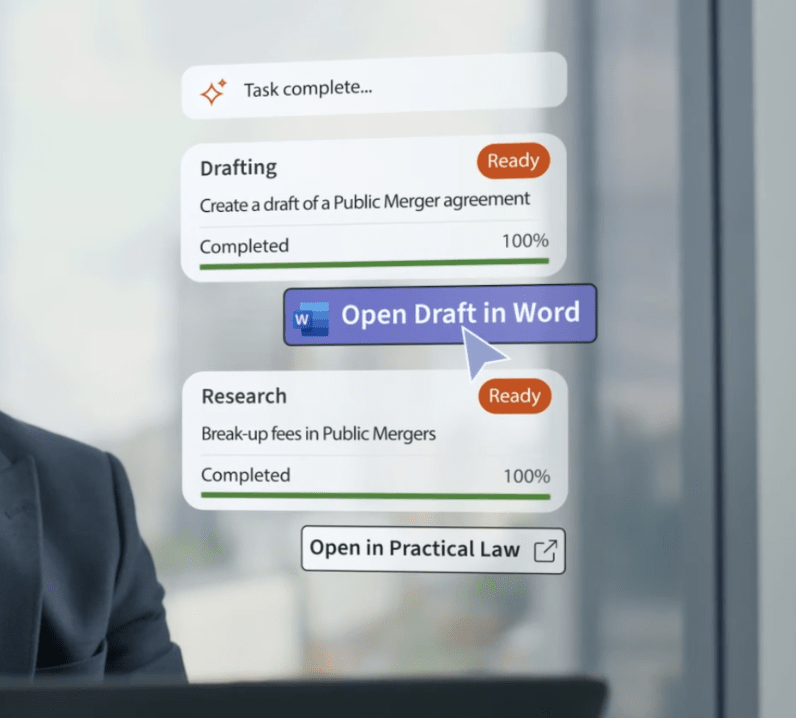
CoCounsel Legal
Bringing together AI, trusted content, and expert insights for evolving legal frameworks
Go professional-grade AI ↗3. The hourly billing model is broken – demand better pricing
What the data shows:
Despite heavy AI investments that fundamentally alter work performance, Thomson Reuters Legal Tracker data shows that 90% of legal dollars still flow through hourly billing arrangements.
This creates tension as firms deploy technology that accomplishes in minutes what took hours, then bill by the hour.
What it means:
Both sides are waiting for the other to blink. GCs want firms to propose innovative billing, while firms complain clients evaluate everything in hourly rates.
You have leverage to break this impasse. Most clients don’t even know if outside firms are using GenAI—a disconnect preventing honest conversations.
Actions to take:
- Require AI usage transparency—Ask: Are you using AI? How?
- Pilot value-based pricing—Tie fees to business outcomes, not hours.
- Benchmark aggressively—Use Legal Tracker data to see what others achieve.
- Reject “AI surcharges”—AI should reduce costs, not increase them.
- Start the conversation—Don’t wait for firms.
4. Build your own AI capabilities to reduce dependency
What the data shows:
86% of GCs believe their teams deliver value, yet nearly 90% report resource limitations prevent strategic impact. This forces tough choices about which firms get your limited dollars.
Corporate legal departments have led outside firms in GenAI use since 2022. You’re already ahead—now accelerate.
What it means:
You’re asked to do more with less while outside counsel costs rise. The only sustainable solution is building AI-enhanced internal capabilities.
Actions to take:
- Increase legal tech budget—You can’t absorb more work without better tools.
- Prioritize GenAI for routine work—Contract review, research, compliance, discovery.
- Bring more work in-house—Nearly two-thirds of GCs are doing this. Use AI to create capacity.
- Partner with ALSPs—Just 27% of North American firms use ALSPs vs. 76% in UK/Europe.
- Measure productivity gains—Track how AI increases capacity to demonstrate ROI.
5. Economic contraction is coming – -prepare your budget defense
What the data shows:
Net Spend Anticipation has slid to pandemic levels. Q3 2025: only 13% of departments anticipated spending increases vs. 22% anticipating decreases.
Financial forecasts point to steep demand contraction by mid-2026—worse if the US economy enters recession.
The legal industry surged like this before the Global Financial Crisis and 2021 inflation crunch. Each time, firms mistook altitude for stability.
What it means:
While 86% of GCs believe they deliver value, C-Suites often rank legal among the least visible contributors. When cuts come, legal will be an early target.
Actions to take:
- Benchmark your spend—Prove you’re already lean.
- Quantify “mobile demand” savings—Show your CFO concrete dollars saved.
- Identify deferrable work—Not all legal work is urgent; create a priority matrix.
- Consolidate your panel—Fewer firms = better volume discounts and relationships.
- Prepare visibility metrics—Track contributions to the company’s top 3-5 strategic goals.
The bottom line: Act now while you have leverage
The 2026 legal market presents a once-in-a-decade opportunity to fundamentally reset outside counsel relationships.
The combination of firms loaded with unsustainable expenses, softening demand, outdated billing models, AI alternatives, and successful mobile demand strategies means GCs who act decisively now can lock in 2-3 years of favorable economics.
Your three-horizon action plan
Immediate (Q1-Q2 2026): optimize current spend
- Renegotiate rates with panel firms
- Move 20-30% of Am Law 100 work to lower-cost alternatives
- Implement matter budgets and fee caps
- Get transparency on AI usage and efficiency gains
Medium-term (Q2-Q3 2026): build internal capabilities
- Deploy GenAI tools for contract review, research, and routine drafting
- Partner with ALSPs for discovery, due diligence, and compliance
- Create internal playbooks for repetitive work
- Benchmark your spend to prove value to the C-suite
Long-term (Q3 2026-2027): transform the model
- Shift 50%+ of relationships to non-hourly arrangements
- Build AI-enhanced in-house team handling 75%+ of volume
- Reserve outside counsel for specialized or high-stakes matters
- Create metrics showing legal as value center, not cost center
The critical warning
When the Global Financial Crisis hit, firms’ realization rates cratered and stayed down for nearly a decade. Collection realization dropped from 95% in 2007 to 88% by 2015.
If conditions deteriorate in 2026, firms will become desperate for revenue. This gives you leverage to challenge dubious line items, demand write-offs, reject rate increases, and negotiate retroactive discounts.
The opportunity is yours to take – right now.
Streamline and save with GenAI-powered spend management software
Legal Tracker AI