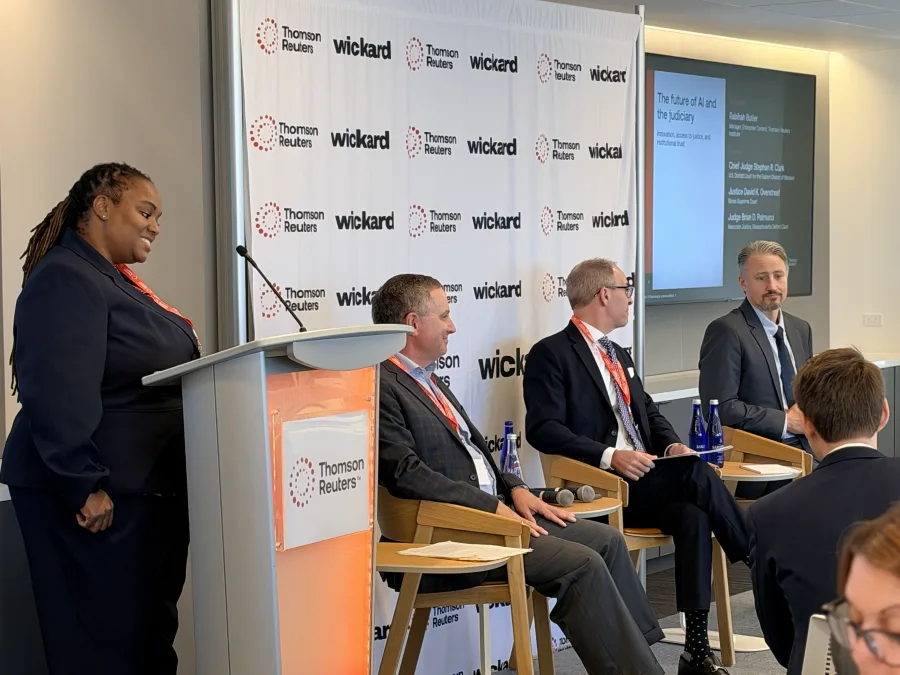
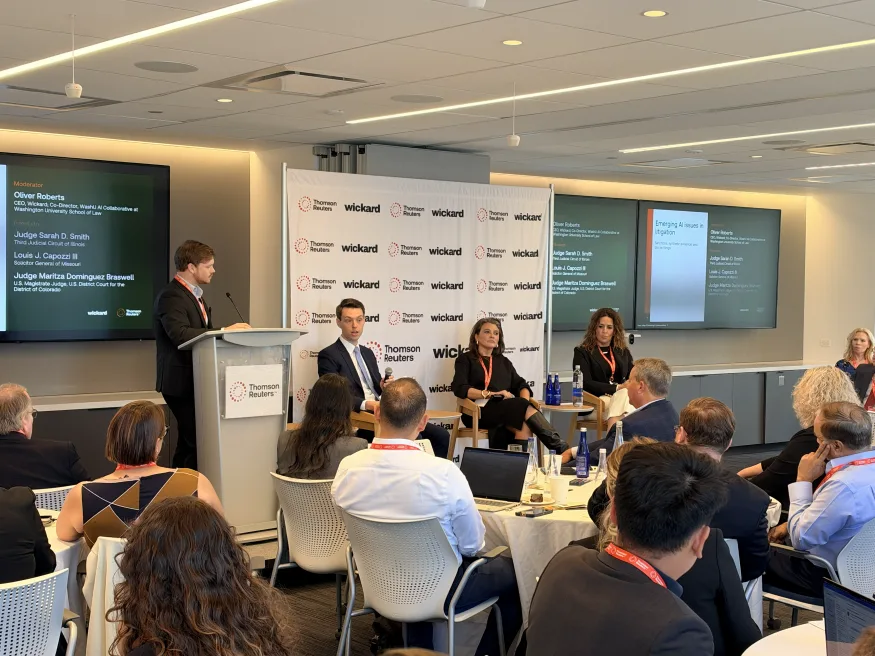
On October 8, judges, academics, government officials, and legal technology leaders gathered at Thomson Reuters headquarters in Times Square for the inaugural Thomson Reuters-Wickard Judicial AI Summit. Co-sponsored by WashU Law and Michigan Law, the invitation-only event had one goal: a practical, candid conversation about how AI is reshaping the courts and how the judiciary can respond responsibly.
Jump to ↓
The conversations that mattered
Continue exploring AI and the future of the legal profession
A room built for judges
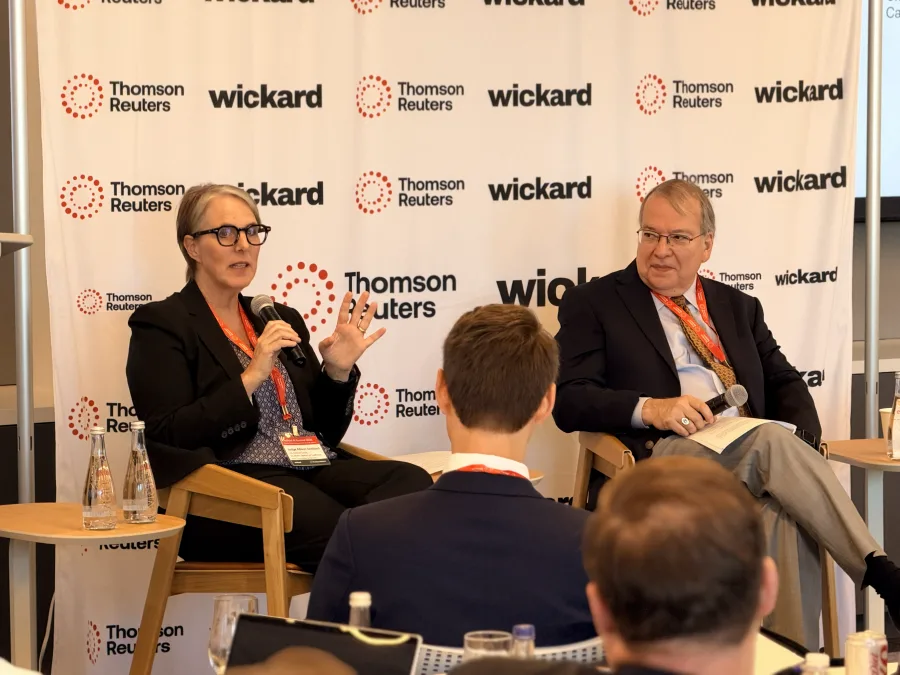
What set this summit apart was who was in the room. The Host Committee included judges from across the country, from federal district and magistrate courts to state trial and appellate benches, among them Judge Xavier Rodriguez (W.D. Tex.), Judge Allison H. Goddard (S.D. Cal.), Judge Maritza Dominguez Braswell (D. Colo.), and Judge Joshua Deahl of the D.C. Court of Appeals. They were joined by distinguished academics from law schools such as WashU, Cardozo, Case Western, Fordham, Villanova, and Brooklyn Law School, plus innovation leaders from firms like Littler, Sullivan & Cromwell, and Morgan Lewis.
As Oliver Roberts, Founder and CEO of Wickard, put it when announcing the summit, the aim was to bring judges together with leading academics and technologists for a practical discussion, not a theoretical one. Sixty-two attendees took part, and the day worked as an ongoing conversation, with panelists and the audience interacting throughout and peers learning from one another as they deliberated the future of the judiciary.
The conversations that mattered
The program tackled the issues courts are facing right now:
- AI in chambers: How judges, clerks, and court staff can responsibly use AI. Panelists pointed to organizing data, such as building case chronologies, as a low-risk, high-gain use because the tool is sorting information rather than making decisions. Judge Goddard described a workflow in which AI reframes an idea and the clerk refines it, warning that simply handing work off can go badly. Judge Deahl suggested it may become judicial malpractice not to use AI for research and verification, given its ability to check for accuracy.
- Fabricated citations and AI-generated pleadings: What sanctions are appropriate when filings contain hallucinated authority? Judges pushed back on the idea that hallucinations are the main story, noting that lawyers were misreading rulings well before AI and that reported hallucination counts lack context. Judge Braswell cautioned against strong sanctions for pro se litigants who misuse AI in good faith, favoring educational materials, and warned that too hard a line could undercut access to justice. Panelists urged courts to differentiate between nefarious use and inadequate use.
- Deepfakes and synthetic evidence: How courts can evaluate evidence when seeing is no longer believing. Deepfakes drew the most concern. For now, AI-generated images are easily detected, but AI audio is nearly impossible to detect. Some judges are issuing standing orders to create rules and transparency around AI use in their courts. Panelists said the fight is over who bears the burden of proving evidence is not fake, noted that a fake can still anchor a jury even after it is exposed, and raised “the liar’s dividend,” where genuine evidence is dismissed as fake. They discussed requiring disclosure of AI use in evidence and noted that judges will need training to understand the source of the data in front of them.
- Access to justice: Where AI could widen access to the courts, and where it could create new barriers. Judge Palmucci called access to justice the best use of AI with the lowest risk, and Judge Smith said she welcomes rising filing volume as a sign of improved access, while asking what the standard of care should be when such technology exists. Panelists favored guidance and education for pro se litigants.
See it in action
Zach Ratzman of Thomson Reuters gave attendees a hands-on demonstration of CoCounsel Legal, the company’s AI tool built for the bench. For trial courts, he showed how it can transcribe handwritten filings, including those from pro se litigants, and build chronologies from a case record, the kind of low-risk, high-gain organizing work panelists had highlighted. For appellate courts, it can prepare bench memos and work through lengthy records ahead of argument. Throughout, the judge stays in control of the work and the decision. Attendee questions focused on practical details, including language translation (CoCounsel Legal supports 40 languages) and assurances that content is not shared.
Many of the risks raised across the summit are ones CoCounsel Legal was built to address. It validates case citations against Westlaw content so judges and clerks can confirm that authority exists and says what it is claimed to say. It also identifies and ignores malicious prompt injections hidden in filings, and customer content is not used to train AI models. Because a human stays in the loop, reviewing and deciding, it helps guard against the “cognitive surrender” panelists warned about, where users delegate more than they realize.
Voices from the summit
Braswell on pro se misuse of AI
“We’re in a construction zone,” said Judge Maritza Dominguez Braswell (D. Colo.), urging courts to “give a little bit of grace” to people who are trying to use AI and get it wrong.
Rodriguez on removing barriers to AI adoption
“‘No’ is not an answer. It just leads to shadow use,” said Judge Xavier Rodriguez (W.D. Tex.), on the need for internal procurement teams to work with courts to enable these tools.
Goddard on clerks
“Law clerks are AI natives,” said Judge Allison H. Goddard (S.D. Cal.), describing a workflow in which AI reframes an idea and the clerk refines it.
Goddard and Palmucci on hallucinations
Judge Goddard cautioned that headline hallucination counts fall prey to the frequency illusion, because “the numbers don’t have a denominator.” Judge Brian Palmucci, Massachusetts District Court, put it more bluntly: “Hallucinations are a distraction.”
Rodriguez on data volume and the standard of care
“How are we supposed to go through all that data without some kind of technology solution?” asked Judge Xavier Rodriguez (W.D. Tex.). As the volume of material in a case grows, so does the question of what care a careful judge is expected to take, and that standard is evolving along with the tools.
Palmucci on the stakes
Judge Palmucci called AI “transformative,” a “game changer for the future of people’s rights.”
Key takeaways
- Panelists called hallucinations a distraction, noting that lawyers misread rulings long before AI and that reported hallucination figures often lack context. The courts have turned their focus towards identification of deepfakes and responsible use.
- Access to justice came up repeatedly as AI’s strongest opportunity, and the standard of care is the open question. Guidance and education for pro se litigants was the favored response.
- AI literacy is fundamental to the judiciary. Courts are struggling to keep pace, which makes law schools important partners in teaching the technology, and judges and clerks need to recognize when they are delegating too much.
Continue exploring AI and the future of the legal profession
For more insights on the topics discussed at the Judicial AI Summit, visit the Thomson Reuters Legal Blog. You can also learn more about how CoCounsel Legal helps legal professionals put AI to work with confidence.