
Borrower tactics for liability management transactions trigger a corresponding lender protection. Here's what two years of deal data show about that arms race.
Highlights
- J.Crew blockers rose from 15% of deals in Q1 2023 to 38% in Q2 2025; anti-Serta protections reached 85% of deals.
- Omniblockers — a 'poison pill' for all liability management transactions — appeared in only 4% of 2025 issuances.
- Warner Bros. introduced the first 'anti-boycott' term via a $17.5 billion JPMorgan bridge loan; PetSmart came full circle by adding comprehensive blockers to its own new debt.
By Dan Wertman, originally published across the Noetica blog from September 2024 to September 2025, now part of Thomson Reuters.
In 2016, J.Crew used unrestricted subsidiary capacity to move material intellectual property out of the credit group, releasing creditors’ security interest in those assets and raising new financing against them. It was one of the earliest and most consequential liability management transactions and it opened a door that borrowers have been walking through ever since.
Serta followed with the uptier. PetSmart followed with the drop-down. And now, lenders are fighting back. Here’s what Noetica’s data shows about the arms race reshaping capital markets deals.
Jump to ↓
Priming debt and sacred rights
New tactics: Warner Bros. and “anti-boycott”

Liability Management Transactions (LMTs) Toolkit
Comprehensive resources for understanding liability management transactions (LMTs)
See where the LM arms race stands now ↗
The J.Crew blocker comeback
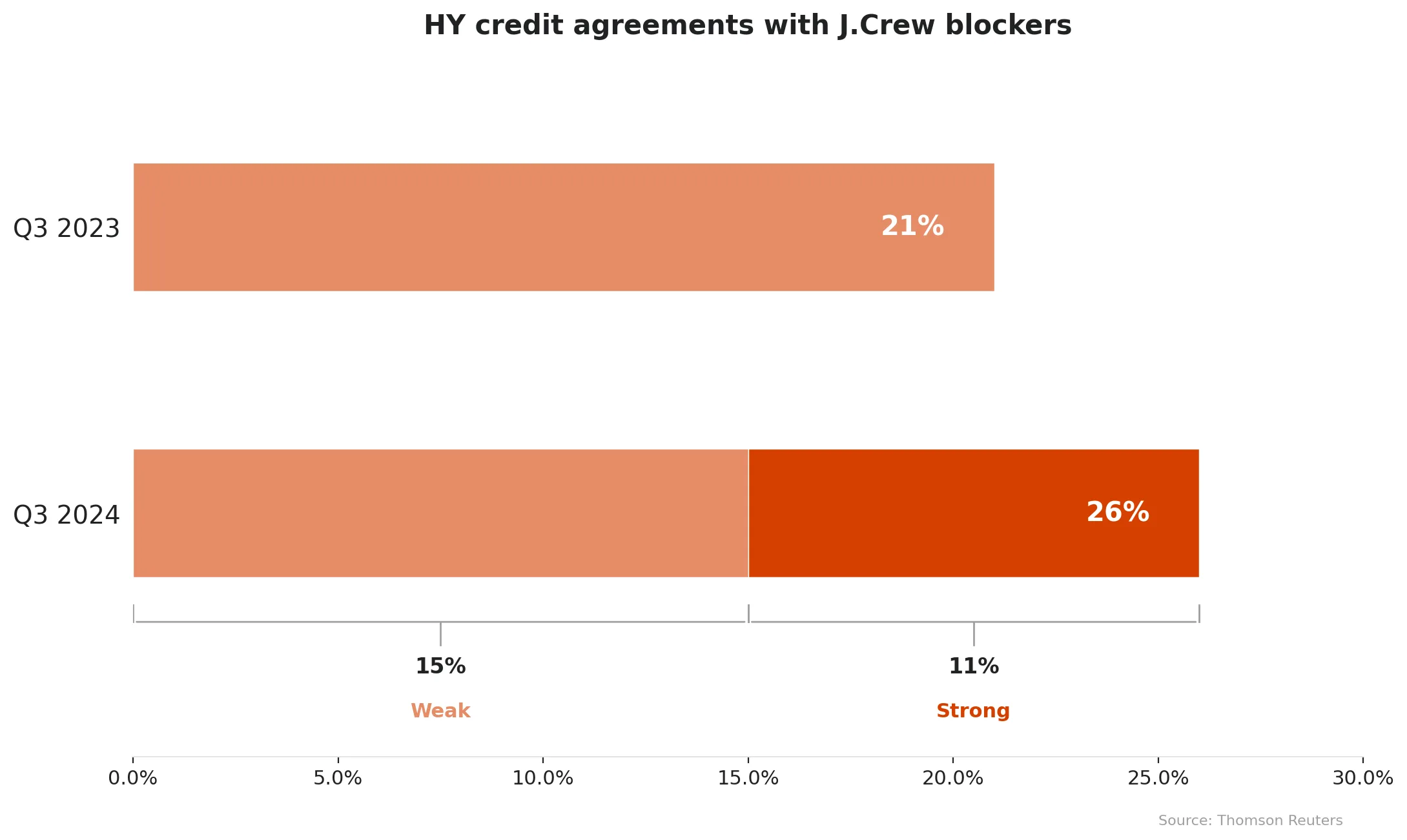
At a basic level, J.Crew blockers aim to protect lenders from value leakage through the transfer of material IP to entities beyond the reach of lenders.
In Q3 2024, 26% of publicly filed high-yield credit agreements included limitations on IP transfers, compared to 21% in Q3 2023. Crucially, 11% of agreements in Q3 2024 provided full protection by prohibiting both the transfer of material IP and the designation of a subsidiary as unrestricted while holding material IP; 15% included weaker protections.
Priming debt and sacred rights
“Priming debt” is like a game of shuffleboard: one player lands on 10, and the next player knocks their disc down to 7 while staying on 10. Priming debt effectively subordinates existing debt to new debt, giving borrowers more time to forestall a restructuring or bankruptcy while utilizing existing collateral.
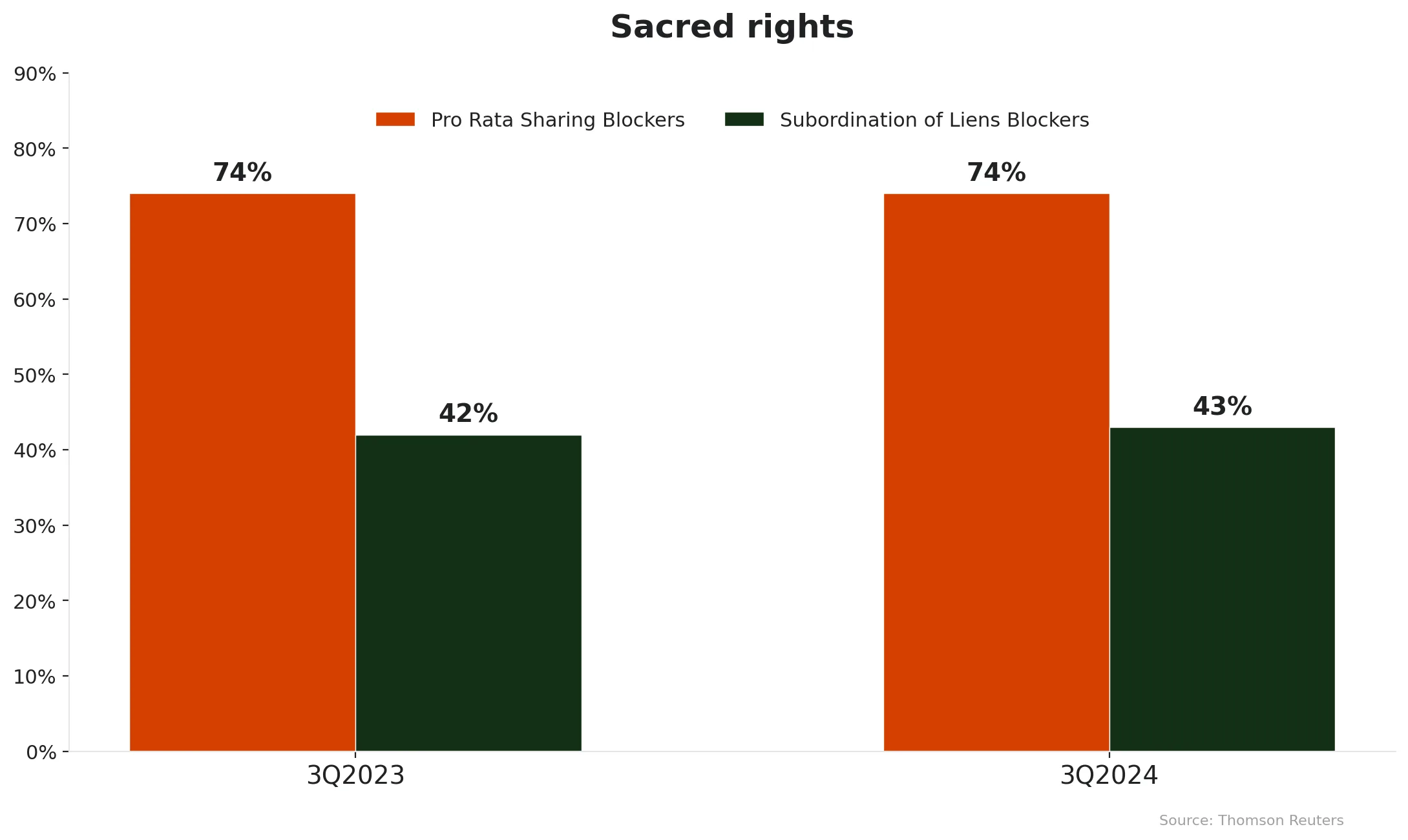
With liability management transactions becoming more prevalent, and borrowers using loopholes to raise priming debt with the approval of a bare majority of lenders, you would expect increasing prevalence of “sacred rights” blockers in new deals as a counterbalance. Interestingly, that hadn’t been the case at the time.
In Q3 2024, 74% of publicly filed credit agreements required all lenders to consent to amendments to pro rata sharing provisions, consistent with the same period in 2023. Similarly, 43% required all lenders to consent to subordination of liens, with 42% requiring the same in Q3 2023.
Named blockers go mainstream
They say you can’t teach an old dog new tricks, but that’s exactly what happened in PetSmart’s $4.7 billion financing. PetSmart is famous for pioneering one of the most replicated liability management tricks in credit history and pulled the ultimate plot twist: it now has “comprehensive” liability management blockers in its new debt, including both J.Crew blockers and anti-Serta protections, as well as a pledge of the very Chewy stock that it moved out of creditors’ reach in 2019.
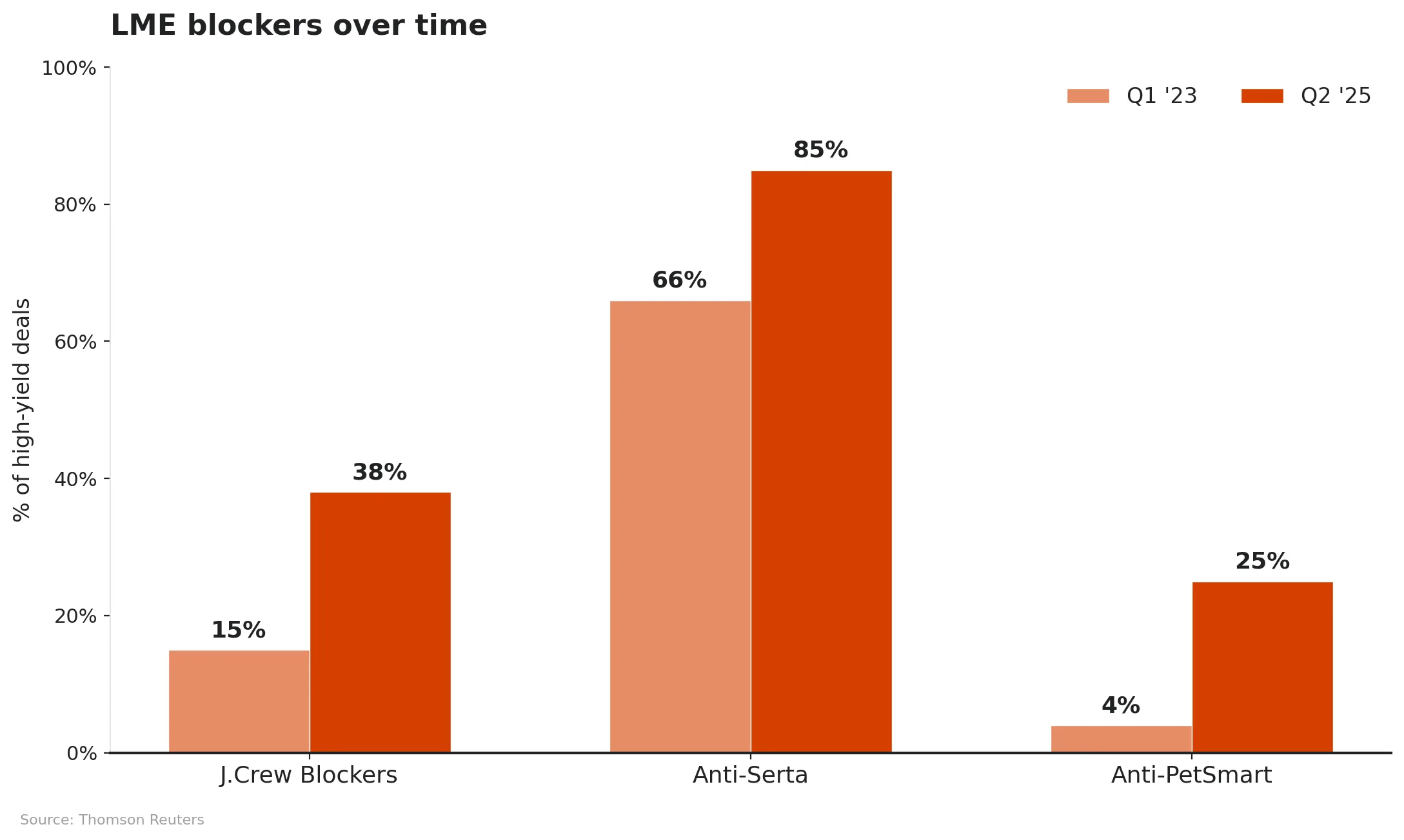
This isn’t just happening at PetSmart. These types of investor protections are becoming table stakes in high-yield lending. Noetica’s data shows this on a macro scale:
- J.Crew blockers were included in 38% of deals in Q2 2025, up from 15% in Q1 2023.
- Anti-Serta protections were included in 85% of deals in Q2 2025 — that’s almost all high-yield deals that closed in Q2.
- Namesake anti-PetSmart protections were included in 25% of deals, up from just 4% in Q1 2023.
Omniblockers: the poison pill
A “poison pill” for liability management transactions? Enter “omniblockers.”
Omniblocker terms effectively aim to prevent all types of liability management exercises. The broad language included in these blockers is designed to avoid liability management transactions across the board, with companies like Spirit Airlines, Trinseo, MultiPlan, Sinclair, and Altisource including blockers in term sheets and debt agreements.
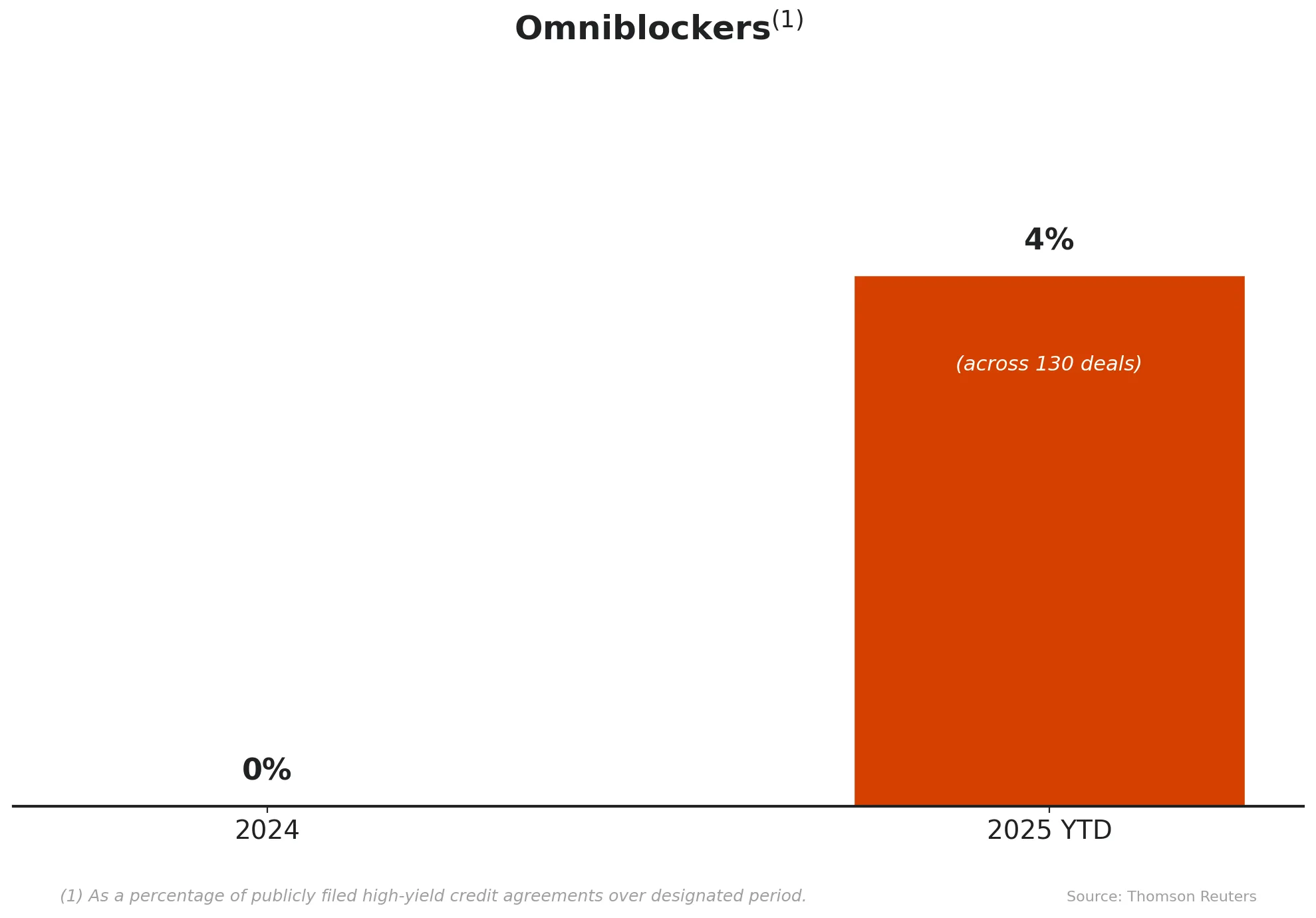
While these omniblockers offer potential for better risk management for lenders and investors, it’s important to note that these terms have yet to be tested in court. And so far, borrowers have successfully prevented the terms from becoming widespread: of publicly filed high-yield credit issuances in 2025, only 4% include omniblocker terms.
Structure for economics
In my first NYC apartment, halfway into my lease, the building shut off the gas to do nine months of required repairs. I seriously thought about moving. Then my landlord called: “What if I knock $200 off rent, get you an electric oven, and send you a hot plate?”
This is a “structure for economics” trade-off: and it’s exactly what’s happening in capital markets deals. Noetica’s data tells a fascinating story:
- EBITDA cost savings add-backs were included in almost 50% of deals in Q2 2025, up from 37% in Q1.
- 30% of deals included unlimited add-backs (versus near-zero in Q3 2024).
- Over 80% of deals with EBITDA add-backs met or exceeded a 20% cap.
Translation: borrowers can now add more “projected savings” to their financial calculations, giving them economic headroom. At the same time, lenders are securing liability management blockers at higher rates than Noetica has ever tracked.
Trading structure for economics works not only for landlord negotiations, but for billion-dollar capital markets deals too.
New tactics: Warner Bros. and “anti-boycott”
The rise of new capital markets terms isn’t new. J.Crew revolutionized the drop-down, Serta the uptier. Now Warner Bros. appears to have created a term of its own: the “anti-boycott” term.
Facing a share decline of 60% since its 2022 merger, Warner Bros. Discovery needed to re-split the company while somehow convincing investment-grade noteholders to accept a “haircut” on their debt — previously unheard of in liability management transactions. And they had to act fast:
- JPMorgan’s landmark $17.5 billion bridge loan — the industry’s largest ever — gave Warner Bros. the capital needed to pay off existing bondholders.
- Employing a “consent solicitation” (instead of the usual debt exchange or tender offer) allowed Warner Bros. to pay creditors to change the terms of their bonds — permitting a mere five-day deadline to accept.
- Inclusion of a new structural element — the “anti-boycott” term — would subsequently make it harder for creditors to organize opposition to future debt incurred by Warner Bros.
It worked. For creditors, this was a fresh reminder of the novel and aggressive tactics becoming far more commonplace in the capital markets. For Warner Bros., while successful in the restructuring, this may be a Pyrrhic victory, since it must now re-tap the bond market not long after leaving current bondholders unhappy (it now carries a junk rating on its debt).
As reported by American Banker, AI is making sneaky liability management harder: the era of borrowers being able to shift assets into subsidiaries outside the reach of creditors is ending, as AI enables lenders to identify and preemptively block such strategies.
What comes next
The pattern is clear: every new borrower tactic produces a corresponding lender protection, and every lender protection produces a new workaround. Tracking this arms race in real time across hundreds of millions of deal terms is exactly what Noetica’s platform is built for.
For more deal-term benchmarking like this, explore the latest Capital Markets Radar Report from Noetica, now part of Thomson Reuters.

Navigate capital market dynamics with confidence
Key trends in term benchmarking from Noetica, a leader in transaction data and now part of Thomson Reuters
Access report ↗