AI legal brief drafting with Westlaw Brief Builder in CoCounsel Legal helps litigators build defensible briefs faster with trusted legal authority and accurate citations.
Highlights
- Westlaw Brief Builder drafts litigation briefs grounded in Westlaw, Keycite, and Practical Law content, not open-web guesswork.
- A guided workflow moves from document intake to argument selection, deeper research, and a formatted, citation-backed draft.
- Built-in citation checking and quote verification catch bad cites before a draft reaches a partner's desk.
A filing deadline that isn’t moving. An argument that has to land. No room for a citation error.
Litigators need more than a fast first draft. They need one grounded in authority they can trust.
Generic AI can produce brief-like language quickly, but it does not begin with the controlling law or distinguish reliable authority from plausible-sounding output. That leaves litigators checking citations line by line and rebuilding arguments before they can stand behind the work.
That difference is the foundation of Westlaw Brief Builder.
Built into CoCounsel Legal, it reasons from trusted Westlaw, Keycite, and Practical Law content rather than the open web, helping litigators move from case documents to a defensible first draft.
You choose which arguments lead and which authority controls. The tool suggests. You decide.
Jump to ↓
Why generic AI creates risk in legal brief drafting
From case documents to a defensible first draft
How built-in verification catches citation problems
Why defensible work requires Fiduciary-Grade AI
How to move faster without compromising defensibility
Why generic AI creates risk in legal brief drafting
Most AI tools were built for general writing, not legal work. They generate fluent prose, but they don’t know the difference between controlling authority and a case that’s been overturned. They produce citations that look correct and aren’t. For a motion that has to land, that gap is the whole ballgame.
The problem isn’t just accuracy. It’s trust.
When you draft a brief, you need to know where every proposition comes from and be able to defend it. A tool that generates text first and checks sources later puts the burden of verification entirely on you.
Source quality determines AI reliability in legal work, and most tools pull from sources no lawyer would cite. The research isn’t coming from a tool that may or may not have seen a case correctly. It’s coming from Westlaw.
Purpose-built AI takes a different approach. No other legal AI drafting tool draws on the authoritative content of Westlaw, Keycite, and Practical Law. Every draft is grounded in trusted and current legal information, not generic AI guesswork. The verification happens as part of the process, not after.
From case documents to a defensible first draft
Westlaw Brief Builder walks you through a guided, multi-step process. It begins with intake and document analysis, then moves through argument identification and authority research via Westlaw Deep Research.
From there, it drafts the brief as a document you can download, review, and edit. It brings Westlaw research, Practical Law templates, and local court rules directly into the drafting workflow.
Here is how the workflow unfolds:
- Intake and document analysis. You upload your documents and answer a few questions about the brief. Westlaw Brief Builder summarizes that information and gives it back to you for review. You confirm what’s correct and flag what’s missing. This step makes sure the tool understands your matter before it does anything with it.
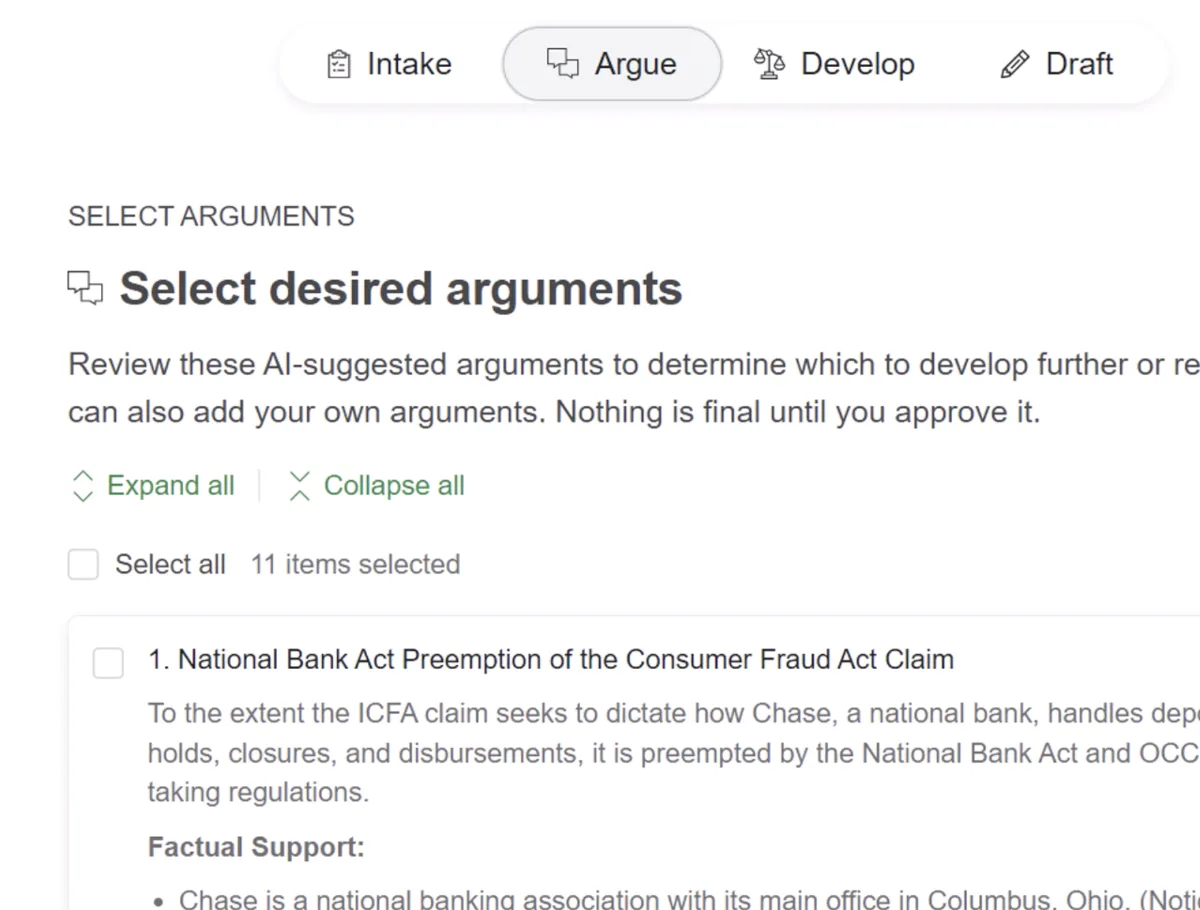
- Argument identification. Westlaw Brief Builder runs deep research agents to find potential arguments. Each proposed argument comes with a summary of the supporting facts and the legal reasoning behind it. CoCounsel Legal presents you with promising arguments, but you decide which ones are most likely to work in your scenario. You see the reasoning. You see which claims each argument targets. You decide what goes in. This is fundamentally different from dropping a complaint into a public LLM and asking it to write a motion.
- Develop step. Westlaw Brief Builder takes the arguments you selected and does deeper research on each one, pulling from Westlaw Advantage and your uploaded documents. It builds out the legal reasoning and turns your selections into fully formed arguments with citations to primary law and pin cites.
- Draft creation. The final step produces a formatted draft. It has a table of contents with correct page numbers, a table of authorities, and citations to record documents. You can draft a legal brief with AI and get back something that looks like a brief, not a rough outline. From there, you refine, adjust, and make the strategic calls only you can make.
Other litigation drafting AI tools use templates that create a mechanical process. Westlaw Brief Builder is different. It adapts to your strategy. It’s not a form-fill tool or a rigid workflow. It guides the drafting process the way litigators actually build arguments: flexibly and iteratively.

How built-in verification catches citation problems
The part that separates purpose-built AI from everything else is what happens before the draft goes out the door. Citation checking, quote validation, and issue spotting aren’t afterthoughts. They’re part of how Westlaw Brief Builder works.
Once you’re comfortable with the draft, CoCounsel helps you verify statements and citations against Westlaw. It checks that:
- The cases exist
- The citations are correctly formatted
- The holdings match how they’re being used
Westlaw Brief Builder runs a verification process that takes you argument by argument through the document. For each proposition, you see what was said in the draft alongside the cited document. You can compare the two and confirm for yourself whether the source is being described correctly.
This is verification built into the workflow, not bolted on. Before anything goes out the door, built-in citation checking and quote verification catch bad cites so they never reach a partner’s desk.
The attorney stays in control at every step. The tool surfaces the authority. You confirm it. You decide what stays and what goes.
That is the difference between a draft you have to defend and a draft you can stand behind. When your associates draft with Westlaw Brief Builder, what lands on your desk is grounded in Westlaw, Keycite, and Practical Law. Your review time goes where it belongs: on strategy, not corrections.
Why defensible work requires Fiduciary-Grade AI™
The reasoning behind Westlaw Brief Builder reflects a broader standard. Thomson Reuters calls it Fiduciary-Grade AI™.
It is AI built for professionals with duties of care and compliance obligations. It is grounded in authoritative, domain-specific content. It is encrypted. It produces outputs that can be traced, verified, and defended by the professional responsible for them.
It’s Fiduciary-Grade AI. It is encrypted… We wanted to make sure we get the facts and the citations we’re giving you, which are very detailed and specific, that we get those right, because if we don’t get those right, it just doesn’t work.
Director, Product Management, Thomson Reuters
This is built on Thomson Reuters infrastructure, with the same enterprise-grade security that protects Westlaw and all Thomson Reuters products. Your documents and data are not used to train any AI models. Your client information stays within your firm’s environment.
This is the standard for work where almost right isn’t good enough. A motion to dismiss. An opposition brief. A reply that has to land. In those moments, you need a tool that works the way you already think. One that starts from the law, not from a blank page.
CoCounsel Drafting for litigators brings this approach across the drafting workflow. Westlaw Brief Builder focuses it on the specific moment that matters most: the brief under deadline.
How to move faster without compromising defensibility
When a filing deadline is approaching, speed only matters if the work can withstand scrutiny.
Westlaw Brief Builder brings trusted research, guided argument development, and built-in verification into one drafting workflow, helping litigators move from case documents to a strong first draft while keeping professional judgment firmly in control.
Ready to spend less time checking AI-generated work and more time sharpening your argument? Learn more ↓
CoCounsel Legal
Draft defensible briefs grounded in Westlaw authority — with built-in citation verification at every step
See how CoCounsel Legal drafts ↗