The People's Lawyer never had a simple job. Today, that job is harder than ever.
State attorneys general sit at the intersection of some of the most consequential legal work in the country. On any given day, an AG office might be pursuing a major consumer fraud case across a dozen states, conducting environmental enforcement against an industrial polluter, or defending a civil rights investigation — often all at the same time, often with the same overworked staff.
The tools powering that work, however, haven’t kept pace. Too many offices are still running on a patchwork of disconnected point solutions: one platform for legal research, another for document review, a third for drafting, and a fourth for multi-state coordination. The result is friction at every seam — and friction, in a resource-constrained public law office, is a tax that attorneys general can no longer afford.
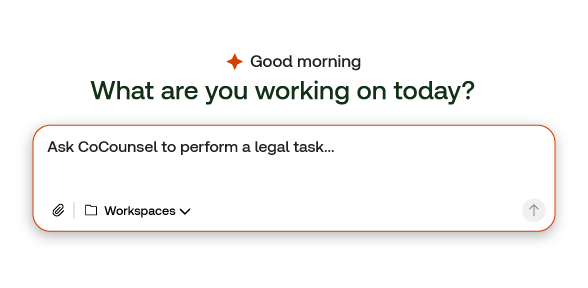
CoCounsel Legal offers a different approach. Engineered to work at the level of a senior associate, CoCounsel Legal reasons from Westlaw, Practical Law, and your office’s own knowledge to help attorneys move from plain-language requests to polished work product with citations. It is Fiduciary-Grade AI™ built to the standard the profession demands.
Highlights
Help attorneys general work more efficiently by preserving matter context across every stage of a case.
Deliver trusted, verifiable legal work grounded in Westlaw, Practical Law, and office knowledge.
Jump to ↓
| The hidden cost of disconnected tools |
| One connected AI experience for government legal work |
| In practice: The consumer fraud investigation workflow |
| The bottom line for AG offices |
The hidden cost of disconnected tools
Ask any Assistant Attorney General what slows them down, and for the most part, it’s the constant context-switching — the exporting, reformatting, and re-entering of work between systems that should, in an ideal world, talk to each other.
Consider what actually happens when research insights get lost between platforms:
- An Assistant Attorney General completes a 50-state research analysis in one system. To use those findings in document review, she manually transfers notes into a second tool — replicating work, introducing error, and wasting time that could be spent on substantive analysis.
- A draft complaint is built in one platform without access to the evidentiary findings from document review in another. Key connections between legal authority and document evidence are left to individual memory rather than system integration.
- New staff must ramp up on multiple vendor tools. Each tool brings its own interface, workflow, training requirements, and support model, delaying productivity and increasing the burden on already-stretched teams. A unified legal AI experience reduces that friction by giving attorneys one place to conduct research, analysis, drafting, and document-related work. Vendor fragmentation compounds every one of these problems. Each additional tool could mean another contract, another security review, another support relationship, and another training program. For offices already stretched thin, that overhead is punishing.
Disconnected tools also fragment the context legal work depends on. Research may live in one system, matter documents in another, templates somewhere else, and prior office positions in yet another place. That makes it harder to maintain consistency, verify reasoning, and produce work product that reflects the office’s standards and institutional knowledge.
One connected AI experience for government legal work
CoCounsel Legal was purpose-built to solve exactly this problem. It is a complete AI-powered solution that combines three foundational capabilities in a single, seamlessly integrated platform. Engineered to work at the level of a senior associate, it reasons from Westlaw, Practical Law, and your office’s own knowledge in one connected AI experience:
- Westlaw‘s authoritative primary law, with KeyCite verification available so attorneys can confirm authority before relying on it.
- CoCounsel Legal‘s AI reasoning experience, helping attorneys develop the legal approach, analyze matter materials, and draft work product with citations.
- Practical Law‘s trusted guidance, toolkits, and templates, which help inform the legal approach and support consistent, high-quality drafting
Your office’s prior work – including prior matters, templates, documents, opinions, regulatory positions, and enforcement stances – shapes the output, so each result reflects both the law and the positions your team has already established.
For AG offices juggling multi-state coordination, Thomson Reuters HighQ — available as an add-on — extends this connected CoCounsel Legal experience into a centralized, secure workspace for all participating states. Offices that have deployed HighQ alongside CoCounsel Legal have seen collaboration efficiency gains of up to 48%.1
1. Source: 2025 Thomson Reuters internal study CoCounsel Legal
In practice: The consumer fraud investigation workflow
Consider a scenario most AG offices know well: a consumer protection team investigating online marketplace fraud that spans multiple states. The assignment requires statutory and case law research across a large number of jurisdictions, review of thousands of pages of business records and consumer complaints, and ultimately a well-grounded, defensible complaint.
With disconnected tools, this workflow unfolds across weeks of platform-switching and manual transfer.
With CoCounsel Legal, it looks like this:
Stage 1: Research
The team can describe the task in plain language and have CoCounsel Legal develop the legal approach from the beginning. It reasons from authoritative Westlaw primary law, trusted Practical Law guidance, and the office’s own matter materials. Practical Law’s consumer protection toolkit can help inform the enforcement strategy, and key-cite verification helps attorneys confirm that authority is current before it becomes part of a public enforcement position. The work is saved within the CoCounsel Legal workspace, where the matter context is ready for the next step with no need to rebuild the foundation.
Result: 15% research efficiency improvement.1
Stage 2: Document Review
When thousands of pages of business records and consumer complaints arrive in response to a civil investigation demand, CoCounsel Legal can analyze the document production in light of the legal approach already developed in the workspace.
No re-entry of search terms. No re-establishing legal framework. A timeline of key dates and events is generated automatically from the documents themselves. The reasoning path is visible as it works, and every source is linked so attorneys can click through and verify the work themselves. — an essential requirement for public accountability.
Result: Document analysis up to 68% more efficient.1
Stage 3: Complaint Drafting
The complaint is drafted in CoCounsel Legal with the legal approach, document insights, and matter already developed in the workspace — no exports, no switching systems. Practical Law consumer protection complaint templates provide structural scaffolding. Every suggested citation is linked so the AAG can verify before relying on it.
Result: Drafting up to 50% faster.1
Stage 4: Multi-State Coordination (with HighQ)
When the investigation expands into a coordinated multi-state matter, HighQ’s centralized workspace gives all participating offices role-based access to shared research, documents, and drafts from Stages 1–3. Participating states build on the originating office’s work rather than duplicating it. Secure communication channels replace fragmented email threads. Version control eliminates the chaos of multiple competing drafts.
HighQ does not replace CoCounsel Legal. Rather, it extends CoCounsel Legal’s capabilities into a multi-state coordination context, helping participating offices share appropriate research, documents, drafts, and work product in a secure, centralized workspace.
Result: Up to 48% collaboration efficiency gain with HighQ add-on.1
1. Source: 2025 Thomson Reuters internal study CoCounsel Legal
The bottom line for AG offices
CoCounsel Legal isn’t a technology upgrade. It’s a structural change to how an attorney general’s office operates — from intake through enforcement. The efficiency gains are documented. The value is not just fewer systems. It is better continuity from one step of the matter to the next: the same trusted sources, the same matter context, and the same attorney oversight carrying through the work.
For offices tired of managing multiple vendor relationships, navigating separate training programs, and losing valuable context between platforms, there is a better way. CoCounsel Legal helps attorneys move from plain-language requests to polished, verifiable work product grounded in Westlaw, Practical Law, and their office’s own knowledge. As Fiduciary-Grade AI™, it delivers the reliability and transparency government legal teams demand.
See how CoCounsel Legal helps legal professionals move seamlessly from research to work product in one connected AI experience.