
Discover why intelligent compliance is essential to fast-growing companies
Highlights
- Fast-growing companies face significant compliance risks as manual processes and spreadsheets become fragmented with scale.
- Disjointed workflows and siloed systems increase errors, audit risks, and operational inefficiencies for lean teams.
- Intelligent compliance networks and workflows deliver measurable ROI and strategic capacity for high-growth organizations.
For fast-growing companies with lean teams, compliance often starts simply. They may have a few spreadsheets for vendor tracking, email threads for policy updates, and shared drives for audit documentation.
This approach works remarkably well until expansion outpaces spreadsheets. What begins as manageable quickly transforms into corporate compliance fragmentation, one of the most significant yet invisible operational risks facing scaling organizations today.
Jump to ↓
The hidden risks of scaling compliance on spreadsheets
The cost of missed intelligence
How point solutions increase fragmentation
The compliance network advantage
ROI that high-growth companies can’t ignore
What’s next for leaders of high-growth organizations
The hidden risks of scaling compliance on spreadsheets
Spreadsheets feel practical because they’re familiar and flexible. But as a company grows, so does the number of versions, lists, and owners. Sales builds one vendor tracker, procurement maintains another, legal keeps its own contract database, and finance manages payment details separately.
None of these segments speak to each other and reconciling their spreadsheets becomes a full-time job. This isn’t rare. In fact, research shows that 48% of surveyed organizations cite legacy technology as their primary operational roadblock¹ while 36% struggle with siloed data and systems¹.
These issues intensify for fast-growing companies that still rely heavily on spreadsheets and manual processes.
When manual work multiplies
Corporate compliance fragmentation doesn’t just create redundancy, it also actively multiplies manual work, which quietly consumes already-limited capacity. Consider mandatory employee training on data privacy. In a fragmented environment, this requires pulling reports from a learning management system, cross-referencing against HR lists, manually checking exceptions, updating multiple spreadsheets, and preparing reports in various formats for different stakeholders.
Each step introduces opportunities for error. An employee who changed departments gets counted twice or not at all. Someone who completed training right before the report is incorrectly flagged as non-compliant. These errors cascade through downstream processes, triggering unnecessary follow-ups and eroding trust in compliance data.
While the survey does not break workflow challenges down by revenue band, the findings highlight risks that are especially acute for fast-growing companies ($100–$300M).
The data on this inefficiency is striking:
- 55% of surveyed organizations report disjointed workflows lead to excessive tracking time for requests from different platforms¹
- 45% face excessive internal follow-ups with other departments¹
- 42% spend excessive time searching for and requesting data needed to complete tasks¹
More critically, 54% of organizations lack the required context to complete cross-functional corporate governance and compliance tasks¹, while 49% lack a continuous, cross-functional view of data and insights¹.
When compliance teams spend most of their time on administrative tasks managing fragmented systems, organizations miss out on strategic insights and proactive risk management that effective compliance functions should provide.
The cost of missed intelligence
Mid-market organizations feel the pain of fragmented intelligence acutely because a single missed update or manual error can have outsized impact on customers, cash flow, or audits. Fragmented compliance makes change harder to track. Responsibilities are scattered, leaving no full picture. Legal may track regulations while operational teams fail to adjust in time. Privacy teams monitor new markets, but sales teams entering them aren’t always aligned.
When changes are identified, communicating them to those who must act is futile. Updates arrive via emails, meetings, and manual follow-ups, which are slow, unreliable processes where changes slip through cracks.
The impact of these gaps is measurable:
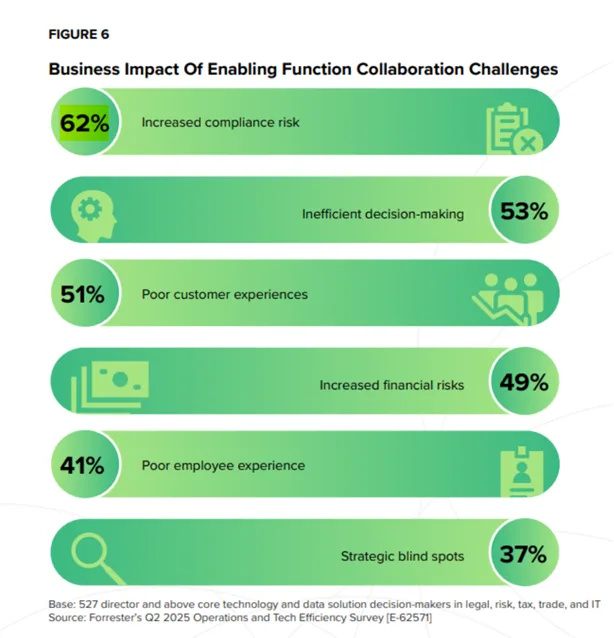
For fast-growing companies, where teams are leaner and spreadsheet-driven processes are more common, these challenges tend to hit harder, making the need for intelligent, scalable compliance technology even more urgent.
The audit wake-up call
Nothing exposes compliance fragmentation faster than an audit. What should be a straightforward request for evidence becomes a scramble across:
- Email threads
- Shared drive folders
- Different versions of spreadsheets
- Individual employee files
For lean teams, even a single audit request pulls people away from revenue-driving work for days or weeks. Evidence often doesn’t exist in usable formats (or at all). Documentation conflicts appear. And suddenly, leadership sees the true risk of running compliance on disconnected tools.
Beyond immediate costs, gaps or inconsistencies in documentation can lead to audit findings, remediation requirements, or penalties.
How point solutions increase fragmentation
Recognizing spreadsheet limitations, many organizations turn to specialized software tools: one for vendor risk management, another for policy administration, a third for training. This appears to be progress, but accumulating point solutions without integration strategy simply replaces spreadsheet fragmentation with system fragmentation.
Each tool brings its own data model, interface, access controls, and integration challenges like increasing cost, complexity, and onboarding burden. Finding vendor information might require checking the risk management system, contract platform, ERP system, and shared drives, making simple tasks frustratingly time-consuming.

Webinar
Achieving Intelligent Compliance: Forrester’s Insights on AI, Integration, and the Measurable Impact on Legal, Tax & Risk Teams
Watch now ↗The compliance network advantage
For fast-growing companies, the risks of relying on disconnected compliance systems become even more pronounced as their operational complexity accelerates. This is where an intelligent compliance network becomes paramount to streamline essential business activity without adding headcount to juggle disconnected vendors.
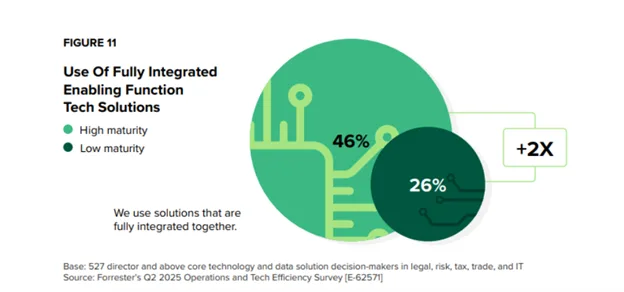
The business case for intelligent compliance workflows is compelling. Research shows that organizations at high maturity levels are two times more likely to use fully integrated tech solutions (46% vs. 26% at low maturity)¹ and three times more likely to use fully integrated solutions from the same vendor (19% vs. 6%)¹. Organizations understand that seamless integration is critical. 52% cite it as the most important capability when selecting technology solutions¹, followed closely by the ability to consolidate data into a single unified ecosystem (46%)¹.
ROI that high-growth companies can’t ignore
A comprehensive Forrester Total Economic Impact study quantifies the benefits of intelligent compliance. Organizations implementing ONESOURCE+ achieved a 199% return on investment with a net present value of $8.8 million over three years². The payback period was less than six months².
That saved time becomes strategic capacity, allowing teams to focus on higher-value work like risk prevention, process improvement, and market expansion.
What’s next for leaders of high-growth organizations
For fast-growing companies, leaders must decide not if but when to address compliance fragmentation. Waiting for an audit or regulatory issue is risky.
To scale safely, companies need infrastructure built for where they’re going. Intelligent compliance focused on manual work instead of strategic growth strengthens audit readiness, and enables faster, more confident decisions. Growth is good. Growing on spreadsheets isn’t.
Special paper
AI Meets Governance And Compliance: Enabling Cross-Functional Intelligence To Accelerate Strategic Execution
Download the full paper ↗
¹ Forrester Consulting, Thought Leadership Paper “AI Meets Governance And Compliance: Enabling Cross-Functional Intelligence To Accelerate Strategic Execution,” commissioned by Thomson Reuters, October 2025.
² Forrester Consulting, “The Total Economic Impact™ of Thomson Reuters ONESOURCE+,” commissioned by Thomson Reuters, October 2025. Results are for a composite organization based on interviewed customers.