Trend alert: new outside date structure in M&A deals has entered the market
Highlights
- A new applicable margin election term lets acquirers extend financing past the deal's outside date.
- Only two publicly filed deals feature the structure so far, less than 1% of market penetration.
- Lenders stay economically whole while acquirers gain flexibility on regulatory-delay timelines.
By the Noetica Research Team, originally published on the Noetica blog, now part of Thomson Reuters. August 2025.
Acquisition financing just got more flexible. A new term — the “applicable margin election” — is allowing acquirers to extend deal timelines beyond original outside dates while maintaining favorable lender economics, solving one of M&A’s most persistent timing problems. With only two deals in the market featuring this structure, we’re witnessing the birth of what could become the next acquisition market standard.
Jump to ↓

Law firm success checklist
How to make transaction management your competitive advantage
See how your deal team manages transactions ↗
What have we seen so far?
Traditionally, acquisition financing operates on rigid timelines. Borrowers secure financing commitments that expire on or around the “outside date” in their acquisition agreements. When buyers and sellers need to extend that outside date for regulatory approvals or other conditions, lenders have historically resisted extending their commitments on the same terms.
The applicable margin election term offers a solution.1
This structure allows acquirers to extend financing commitments beyond the original outside date by electing to begin paying the interest rate spread starting at the original deadline, continuing until the loan is funded or terminated. Here lies the innovation: acquirers now have control over commitment extensions and financing sources are still made whole, allowing acquirers to push financing deadlines past original outside dates and eliminating the need to renegotiate with lenders when deals face regulatory delays.
Utilizing Noetica’s AI-powered platform, which scans hundreds of millions of terms in public and private deals nightly, we’ve identified the only 2 publicly filed deals featuring this term. At less than 1% of public market penetration, these transactions represent true market pioneers.
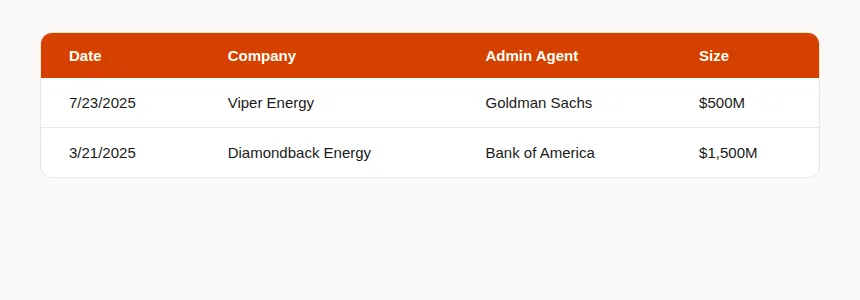
Below is a sample term from the Viper Energy deal, showing how the applicable margin election is structured:
“Applicable Margin Election: If on or prior to the Sitio Initial Outside Date, the Sitio Acquisition Agreement has been amended or otherwise modified to extend the “outside date” or any similar term or concept (in each case including as it may be further extended in accordance with the Sitio Acquisition Agreement or pursuant to successive amendments) (any such amendment or other modification, a “Sitio Outside Date Amendment”) to a date later than the existing “outside date” or any similar term or concept (in each case including as it may be further extended in accordance with the Sitio Acquisition Agreement or pursuant to successive amendments) (the “Sitio Extended Outside Date”), then, upon the execution of such Sitio Outside Date Amendment, the Applicable Margin Election Period shall automatically begin as of the Sitio Initial Outside Date (the “Applicable Margin Election”). The Parent Guarantor shall, no later than one (1) Business Day following the effective date of any Sitio Outside Date Amendment, deliver a copy thereof to the Administrative Agent.”
Pay now, close later
Without this structure, an acquirer facing a delayed outside date has to renegotiate with its financing sources from a position of weakness. The applicable margin election avoids that: by voluntarily accelerating interest payments once the original outside date passes, the acquirer keeps its financing commitment in place without reopening the deal. The trade-off is straightforward — pay now, close later. Lenders are compensated for the extension risk, and acquirers maintain deal certainty.
First mover response
The emergence of applicable margin election terms addresses growing regulatory unpredictability in M&A transactions. This structure provides acquirers with timeline flexibility while maintaining lender economics — creating the conditions for broader market adoption.
The successful execution of both deals through public markets demonstrates institutional confidence in the term and suggests acquirers see clear commercial advantages in managing deal execution risk this way.
Market implications
While only two deals have adopted this structure, these successful precedents could trigger adoption. Applicable margin election terms address genuine market needs around regulatory timing uncertainty, making it likely that we will see these terms increasingly adopted in acquisition financing contexts. Market participants should prepare for requests to incorporate applicable margin election terms as both buyers and sellers observe the benefits of this new approach.
In a market where identifying trends early provides competitive advantage, Noetica’s real-time AI analytics deliver instant visibility into emerging market structures — identifying innovations at their inception, faster than traditional surveys, league tables, or anecdotal intelligence ever could.
1 So far, we’ve only seen these terms in deals where parties are represented by Wachtell, Lipton, Rosen & Katz.
For more deal-term benchmarking like this, explore the latest Capital Markets Radar Report from Noetica.