3-step method and research tools that every attorney should know
Highlights
- Legal research requires defining scope, identifying issues, and verifying jurisdiction before searching sources.
- Secondary sources like treatises and practice guides provide efficient starting points for research.
- Always verify case law validity using citators to ensure you're citing good law.
Knowing where to start a difficult legal research project can be a challenge. But if you can distill your approach down to a few clear and repeatable steps, the process will be significantly easier — not to mention quicker.
Solid research skills are crucial to crafting a winning argument. Whether you’re a seasoned attorney or law school student, knowing how to perform legal research is important — including where to start and what steps to follow.
Jump to ↓
Why is legal research so challenging?
Step 1: Key questions to ask yourself when starting legal research
Step 2: How to research case law and other primary sources of law
Step 3: Make sure you are using ‘good’ law

White paper
AI-powered legal drafting: the definitive guide for legal professionals
Access white paper ↗
Why is legal research so challenging?
When conducting legal research, each step — from defining research questions to synthesizing findings — demands critical thinking and rigorous analysis.
- Identifying the legal issue is not so straightforward. Legal research involves interpreting many legal precedents and theories to justify your questions. Finding the right issue takes time and patience.
- There’s too much to research. Attorneys now face a great deal of case law and statutory material. The sheer volume forces the researcher to be efficient by following a methodology based on a solid foundation of legal knowledge and principles.
- The law is a fluid doctrine. It changes with time, and staying updated with the latest legal codes, precedents, and statutes means the most resourceful lawyer needs to assess the relevance and importance of new decisions.
- The stakes are high. Producing incorrect or incomplete research for your client can be disastrous — not only for your client, but also for your career.
Legal research can pose quite a challenge, but with the right approach, professionals can navigate complex sources efficiently and deliver well-supported findings. Here are the key steps to consider:
Step 1: Key questions to ask yourself
Before you begin looking for laws and court opinions, you first need to define the scope of your legal research project. The following key questions can help you do this.
What are the facts?
Always gather the essential facts so you know the “who, what, why, when, where, and how” of your case. Taking the time to write down everything will help you in the long run, especially since you’ll likely need a statement of facts in an eventual filing or brief anyway.
Even if you don’t think a fact may be relevant now, write it down because it may become relevant later. These facts will also be helpful when identifying your legal issue.
What is the actual legal issue?
You will never know what to research if you don’t know precisely what your legal issue is. Does your client need help collecting money from an insurance company following a car accident involving a negligent driver? How about a criminal case involving excluding evidence found during an alleged illegal stop?
No matter the legal research project, you must identify the relevant legal problem and the outcome or relief sought. This information will guide your research so you can stay focused and on topic.
What is the relevant jurisdiction?
Don’t cast your net too wide — make sure you stay focused on the relevant jurisdiction. To ensure your legal research is comprehensive, you must ensure you’re consulting the correct jurisdiction’s statutes, case law, and administrative regulations.
For example, does your case deal with federal or state law? If it is state law, which state? You may find a case in California state court that is precisely on point, but it won’t be beneficial if your case involves New York law.
Or you may be in a situation where you need to analyze, identify, or compare statutes and regulations on a specific topic across multiple jurisdictions. In this scenario, AI Jurisdictional Surveys on CoCounsel Legal or Westlaw Advantage can create a quick jurisdictional survey to get you started.
For instance, if the case involves researching opt-out laws for a Delaware corporation with branches in all 50 states: Simply provide the details related to your question within the CoCounsel Legal chat, and choose the relevant states from the menu.
A good query might look like this: “Do customers have opt-out rights against having their personal data sold, and what are the penalties for violating those rights?”
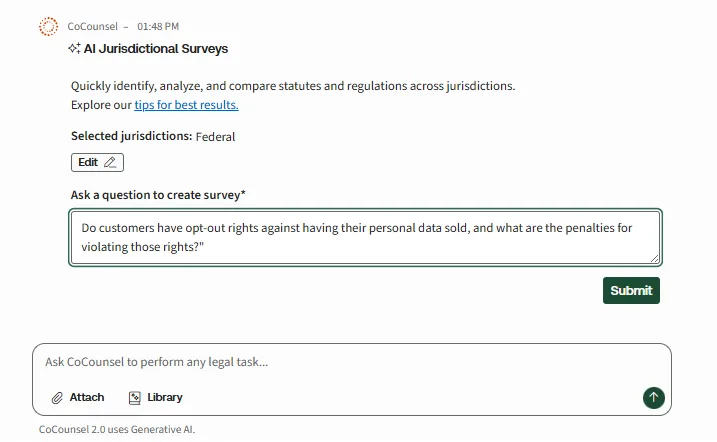
In just a few minutes, the large language model (LLM) will return an in-depth survey with citations to statutes, regulations, and other primary sources of law. This can serve as a solid jumping off point for your research and save you valuable time.
Learn more about creating AI jurisdictional surveys in Westlaw Advantage.
Where to start legal research: The library, online, or even AI?
In years past, future attorneys were trained in law school to perform research in the library. But now, you can find almost everything from the library — and more — online. While you can certainly still use the library, you will probably be costing yourself valuable time.
When it comes to online research, some people start with free legal research options, including search platforms. But an even better option is beginning with a research tool created for attorneys.
Practical Law helps lawyers get up to speed quickly and accelerate their work by providing resources that are written and maintained by over 650 full-time attorney-editors globally.
Today’s attorney should also know how to effectively utilize AI in their legal research. Rather than relying on free AI tools, it’s best to use AI that’s been built specifically for legal research.
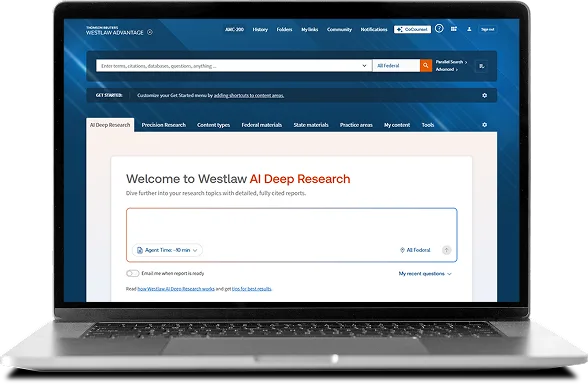
For example, Deep Research on Westlaw Advantage uses LLMs and agentic capabilities to help you conduct and deliver more accurate and comprehensive legal research.
Deep Research will formulate a multi-step plan and then leverage trusted, proprietary Westlaw content and tools to complete the research – refining the process for optimal results. It delivers transparent insights along with fully cited reports so you can be confident in your results.
Simply enter your legal question, select up to three jurisdictions, and choose how in-depth you want your answer to be.
To follow an employment law example that utilizes Deep Research, watch this full training video.
How will you keep track of your research?
Decide from the outset how you will organize your research, so you don’t forget any sources or citations you find. For example, you can maintain a research log on Excel, keep a folder on Westlaw, or use citation management software.
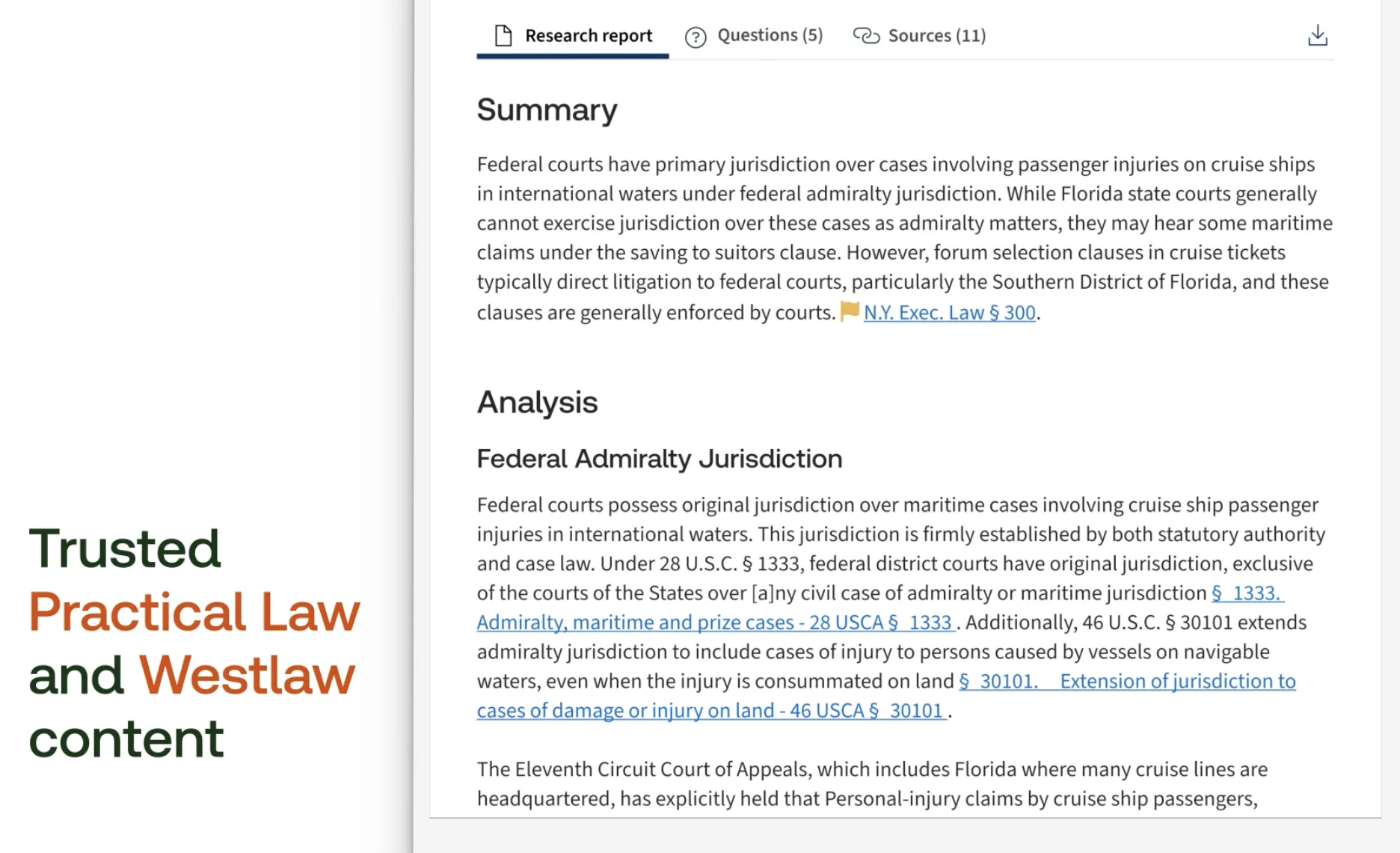
CoCounsel Legal
85% of users find more key information with advanced review and analysis tools, enabling better, faster decisions
See it in action ↗Step 2: How to research case law and other primary sources of law
Now that you have gathered the facts and determined your legal issue, the next step is knowing what to look for. After all, you will need the law to support your legal argument, whether providing guidance to a client or writing an internal memo, brief, or some other legal document.
But what type of law do you need?
The answer: primary sources of law. Some of the more important types of primary law include:
- Case law, which are court opinions or decisions issued by federal or state courts
- Statutes, including legislation passed by federal and state lawmakers
- Regulations, including those issued by either federal or state agencies
- Constitutions, both federal and state
If it’s primary law you want, it makes sense to begin searching there first, right?
Not so fast. While you will need primary sources of law to support your case, in many instances, it is much easier — and a more efficient use of your time — to begin your search with secondary sources such as practice guides, treatises, and legal articles.
Why? Because secondary sources provide a thorough overview of legal topics, meaning you don’t have to start your research from scratch. After secondary sources, you can move on to primary sources of law.
While no two legal research projects are the same, the order in which you will want to search different types of sources may look something like this:
Secondary sources
If you’re researching a new legal principle or an unfamiliar area of the law, the best place to start is secondary sources
Secondary authority refers to any source — such as law journals, practice guides, legal encyclopedias, and treatises — that explains, analyzes, summarizes, or critiques the law. They are a good jumping-off point for legal research since they’ve already done the work for you; it saves you additional time since they often identify and cite key statutes and seminal cases.
Some online secondary sources that might be helpful include:
- Treatises: Expert-written books on specific areas of law, like construction law or contract law, kept in local law libraries. For example, Georgetown Law has an online treatise finder. Northwestern also has a treatises directory that includes links to ones that can be found on Westlaw.
- American Law Reports (ALR): Collections of cases on narrow issues of law. These can be found on research platforms like Westlaw.
- Continuing Legal Education (CLE) courses
- Practical Law: expertly created and maintained how-to guidance, templates, and more combined with powerful AI capabilities
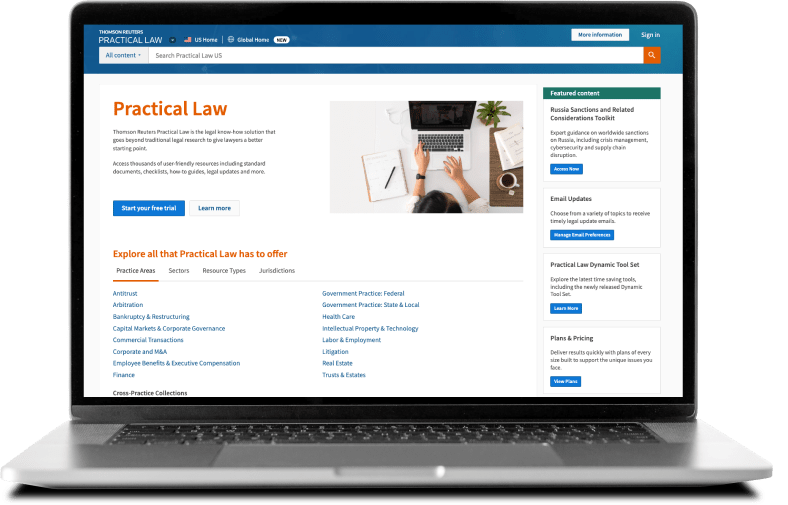
Practical Law
How-to guides, templates, checklists, comparison charts, and more — all written and maintained by over 650 full-time experienced attorney editors
Access Practical Law ↗Case law
If you have already found some case law in secondary sources, great, you have something to work with. But if not, don’t fret. You can still search for relevant case law in a variety of ways, including running a search in a case law research tool.
Examples of sources you might use include:
- PACER (Public Access to Court Electronic Records): For searching federal court records.
- Court Listener: A free legal research website, run by a nonprofit, where you can search court cases and legal opinions.
- Google Scholar: Select the case law option to search opinions via keywords, jurisdiction, and more.
- State courts’ online websites: Such as Texas Courts Online.
Starting with an advanced legal research tool like Westlaw for your case law research will make your search far more efficient. This is because it can help you quickly determine the relevance and timeliness of what you find.
Once you find a helpful case, you can use Westlaw to find other related cases. Most cases contain headnotes that summarize each of the case’s important legal issues. These headnotes are also assigned a Key Number based on the topic associated with that legal issue. So, once you find a good case, you can use the headnotes and Key Numbers within it to quickly find more relevant case law.
Westlaw Advantage
The latest in agentic AI with expert legal content, empowering you to build stronger cases with less manual effort
Access Westlaw Advantage ↗Statutes and regulations
In many instances, secondary sources and case laws list the statutes and regulations relevant to your legal issue. But if you haven’t found anything yet, you can still search for statutes and regulations online like you do with cases.
Some free sources you might utilize include:
- States’ self-hosted law directories: These include the Texas Legislature Online and the Revised Code of Washington.
- American Legal Publishing Code’s library of state codes.
- Municipality codes via General Code’s map or CivicPlus’s map.
- State constitutions hosted online.
Once you know which statute or reg is pertinent to your case, pull up the annotated version on Westlaw. Why the annotated version? Because the annotations will include vital information, such as a list of important cases that cite your statute or regulation.
Sometimes, these cases are even organized by topic — just one more way to find the case law you need to support your legal argument.
To learn how to compare statutes using AI, watch this full training video.
Legal research isn’t linear
Keep in mind that legal research isn’t always a linear process. You may start by going from source to source as outlined above and then find yourself needing to return to secondary sources once you have a better grasp of the legal issue.
In other instances, you may even find the answer you are looking for in a source not listed above, like a sample brief filed with the court by another attorney. Ultimately, you need to go where the information takes you.
Step 3: Make sure you are using ‘good’ law
One of the most important steps with every legal research project is to verify that you are using “good” law — meaning a court hasn’t invalidated it or struck it down in some way.
After all, it probably won’t look good to a judge if you cite a case that has been overruled or use a statute deemed unconstitutional. This doesn’t mean you can never cite these sources — you just need to take a closer look before you do.
The simplest way to find out if something is still good law is to use a legal tool known as a citator. This tool will show you subsequent cases that have cited your source as well as any negative history, including if it has been overruled, reversed, questioned, or merely differentiated.
For instance, if a case, statute, or regulation has any negative history — and therefore may no longer be good law — KeyCite, the citator on Westlaw, will warn you.
Specifically, KeyCite will show a flag or icon at the top of the document, along with a little blurb about the negative history. This alert system allows you to quickly know if there may be anything you need to worry about.
Some examples of flags and icons that you might see on a case include:
- Red flag: The case is no longer good for at least one point of law, meaning it may have been overruled or reversed on appeal.
- Yellow flag: The case has some negative history but is not expressly overruled or reversed. Another court may have criticized it or pointed out the holding was limited to a specific fact pattern.
- Blue-striped flag: The case has been appealed to the U.S. Supreme Court or the U.S. Court of Appeals.
- The KeyCite Overruling Risk icon: The case may be implicitly undermined because it relies on another case that has been overruled.
Another bonus of using a citator like KeyCite is that it also provides a list of other cases that merely cite your source. This can lead you to additional sources you didn’t know about.
Learn more about KeyCite Overruling Risk in this full training video.
Perseverance is key when it comes to legal research
Given that legal research is a complex process, it will likely come as no surprise that this guide isn’t the end of your legal research journey.
Entire law school courses and countless books focus solely on legal research methodology. Many attorneys will spend their entire careers honing their research skills — and even then, they may not have perfected the process.
So, if you’re just beginning, don’t get discouraged if you find this process difficult — almost everyone does at first. With enough time, patience, and dedication, you can become adept at the art of legal research.
Thomson Reuters originally published this article on November 10, 2020.