
Highlights
- Casino industry experiences 46% year-over-year growth with increasing online gaming integration.
- Advanced KYC and AML compliance tools help casinos identify fraud while maintaining customer experience.
- Thomson Reuters CLEAR and Everi collaboration provides comprehensive risk management solutions for gaming venues.
The casino industry is experiencing swift growth, offering substantial opportunities but also heightened risks of fraud and money laundering. With a remarkable 46% year-over-year expansion, the sector is moving towards 24/7 operations and integrating online interactive gaming.
Further, rapidly expanding areas such as online sports betting and online casinos have significantly increased pressure on all gaming organizations to make anti-money laundering (AML) compliance more efficient and protect themselves from newer fraudulent methods. According to subject matter experts, the growth in online platforms, rather than traditional outlets like convenience stores or fraternal halls, is driving the need for more robust compliance measures. These organizations must leverage public records and intelligence to identify and mitigate risks effectively in this evolving digital landscape.
Traditional know your customer (KYC) and customer due diligence (CDD) methods at casinos can slow operations, potentially leaving security gaps that compromise compliance. Casinos market themselves as venues of ease and excitement, and if compliance activities and anti-fraud work becomes too visible or onerous, customers will not be happy, and their overall experience will suffer. An example of this is using membership cards to provide rewards and make ID verification easier.
Jump to ↓
The future of gambling risk and compliance
Casinos customized use of KYC and CDD
Preparing for tomorrow’s gamer
The future of gambling risk and compliance
As cash-based venues, casinos have long had a unique risk exposure to fraud and money laundering risk. Other commercial and financial service outlets, as they move towards swift digital transactions, can leverage the wealth of data they gather and then use machine learning to evaluate risk. Cash transactions offer less transparency, making casinos more vulnerable to illicit activities.
In addition, regulatory requirements have grown higher than ever, and many state and local laws tie licensing and other permissions to a variety of restrictions. Some of these restrictions include exclusion or higher scrutiny of players tied to certain industries — such as the marijuana trade, which is legal only in some states, must operate in cash, and is still prohibited at the Federal level.
Casino vetting managers can identify potentially nefarious players by employing advanced technologies that streamline compliance and intelligence gathering. These tools facilitate swift risk assessments, allowing casinos to obtain necessary insights without disrupting customer playtime. By leveraging cutting-edge solutions, casinos can enhance their vetting processes efficiently and discreetly, maintaining a seamless gaming experience.
For example, Thomson Reuters, a leader in public record intelligence, has collaborated with Everi, an IGT brand and trusted gaming and casino financial technology provider, to offer solutions for casinos. Thomson Reuters CLEAR Person and Business Reports and CLEAR Adverse Media and Sanctions data can integrate with Everi’s AML Compliance platform to give casinos the ability to increase intelligence about their patrons and meet heightened compliance challenges.
Everi already provides many data-driven insights and compliance services to casinos, linking with existing patron management systems and automating the organization of data generated by both players and transactions in an already AML-friendly way. Everi also provides analytic tools and report generation for the back of the house. It can file Suspicious Activity Reports (SARs), currency transaction reports (CTRs), and other required reports electronically. For those participating in the voluntary information-sharing program with other entities under Section 314(b) of the USA PATRIOT Act, standardization of information gathered about patrons and transactions is key to better intelligence sharing.

Casinos customized use of KYC and CDD
Casinos gather a wealth of data from their customers via loyalty programs in order to develop effective marketing and calibrate patron incentives to promote a longer length-of-stay and future visits. The same tools can often be used to flag potential fraud and AML activities. The size of a particular gaming venue does not necessarily dictate its risk exposure to money laundering or fraud — location, amenities, and local and state laws shape these, as well.
As casinos increasingly rely on loyalty programs and online systems, they become more susceptible to synthetic identity fraud. To combat this type of fraud, casinos must verify a variety of sources for each individual to confidently allow them to play. Solutions like CLEAR provide multi-source personal information validation, enabling casinos to confirm details such as name, address, phone number, and Social Security number, as well as screen emails and assess phone risk. This comprehensive approach helps casinos quickly flag synthetic identities and strengthen their anti-fraud measures.
The CLEAR and Everi collaboration brings together CLEAR’s state-of-the-art public records technology with Everi’s gaming-focused report management, risk analysis, and compliance tools. The result is a comprehensive solution that protects casinos.
Preparing for tomorrow’s gamer
In today’s digital era, consumer expectations are increasingly set by the fast-payment models used in other industries. With the average age of casino visitors dropping over the last 10 years, an energetic and expanding casino industry can rely on some of the same advanced info intel innovations as other financial services companies to simultaneously reduce risk, avoid adverse events and disruptions, and discover potential growth opportunities.
Among the innovations now being developed in the gambling industry are secure-yet-faster credit services, access to cryptocurrency, and online and site venue platform integration. To meet these opportunities while keeping up with KYC and AML compliance requirements, casinos need access to comprehensive yet flexible tools for securitization.
With the right partners, casinos can leverage their current advantage of longtime data gathering and analysis about their clientele through their popular loyalty programs and then combine that with next-generation risk management tools that can integrate with them.
KYC and AML compliance rules increasingly hold casinos to the more stringent rules applied to other financial institutions. Although this creates an increased reporting and compliance burden for the gaming industry, it also provides data that can help it evaluate fraud risk, especially when combined with the right tools. Advanced and comprehensive screening and vetting tools with enhanced data accuracy and reports that will help mitigate fraud and keep the casino safe.
Stay informed
New forms of identity fraud, driven by fast transactions and industry expansion, present challenges for casinos as they work to meet regulatory requirements and adapt to evolving threats. However, these developments also offer opportunities to apply intelligence-based solutions that strengthen customer engagement and support revenue growth. By implementing effective strategies for digital transactions, casinos can address risks while enhancing their operations.
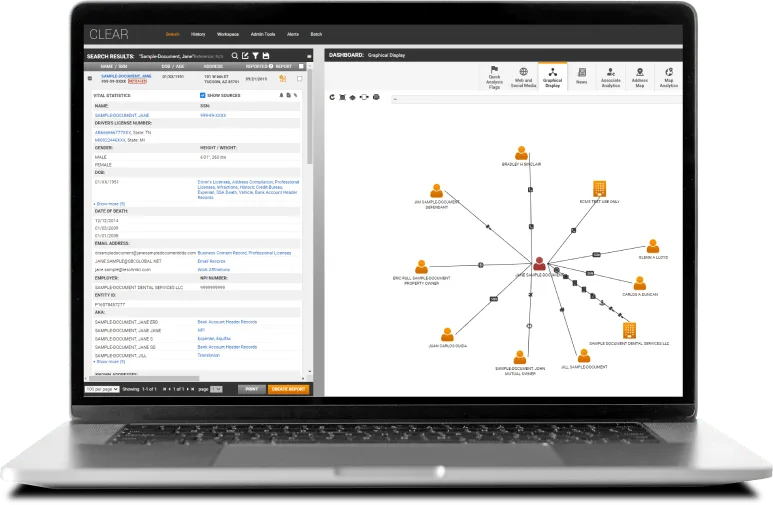
CLEAR
Bring key content together to connect the facts and provide intelligent analytics through one solution with CLEAR, a public records technology tool
Request free demo ↗
Disclaimer
Thomson Reuters is not a consumer reporting agency, and none of its services or the data contained therein constitute a ‘consumer report’ as such term is defined in the Federal Fair Credit Reporting Act (FCRA), 15 U.S.C. sec. 1681 et seq. The data provided to you may not be used as a factor in consumer debt collection decisioning, establishing a consumer’s eligibility for credit, insurance, employment, government benefits, or housing, or for any other purpose authorized under the FCRA. By accessing one of our services, you agree not to use the service or data for any purpose authorized under the FCRA or in relation to taking an adverse action relating to a consumer application.