
Highlights
- Connected compliance replaces fragmented processes with a unified way of working that gives teams a shared, consistent view of every task.
- Intelligent workflows cut down on manual effort by improving how teams access context, share information, and stay aligned.
- Modern compliance ecosystems accelerate progress by creating smoother handoffs and enabling teams to operate in a more coordinated, predictable way.
Compliance work no longer happens within a single function. Legal, risk, tax, and trade teams are increasingly required to operate as one, sharing information, coordinating decisions, and responding quickly to regulatory and business change. Yet in many organizations, that work is still carried out across disconnected systems, manual handoffs, and fragmented processes.
When workflows are split across tools and teams, progress slows. Context gets lost between requests, approvals, and reviews. Teams spend time searching for information, chasing updates, or recreating work that already exists elsewhere. The result isn’t just inefficiency, it’s increased risk, delayed decisions, and limited visibility into what’s happening where.
Intelligent compliance networks offer a different operational model. Instead of work moving through emails, spreadsheets, and isolated platforms, workflows run through a shared environment with consistent data, embedded controls, and clear ownership at every stage. This creates a more reliable way for teams to move work forward — with fewer interruptions, less rework, and greater confidence that decisions are based on complete, current information.
Jump to ↓
Understanding the impact of disconnected work
Why integrated workflows matter
The role of AI in intelligent compliance networks
What organizations gain from connected compliance
Building a foundation for seamless compliance
Compliance as a connected and intelligent function
Understanding the impact of disconnected work
Recent research reveals the true impact of siloed compliance functions. According to a comprehensive Forrester Consulting study of 527 director-level decision-makers across corporate governance and compliance roles, it highlights common challenges:
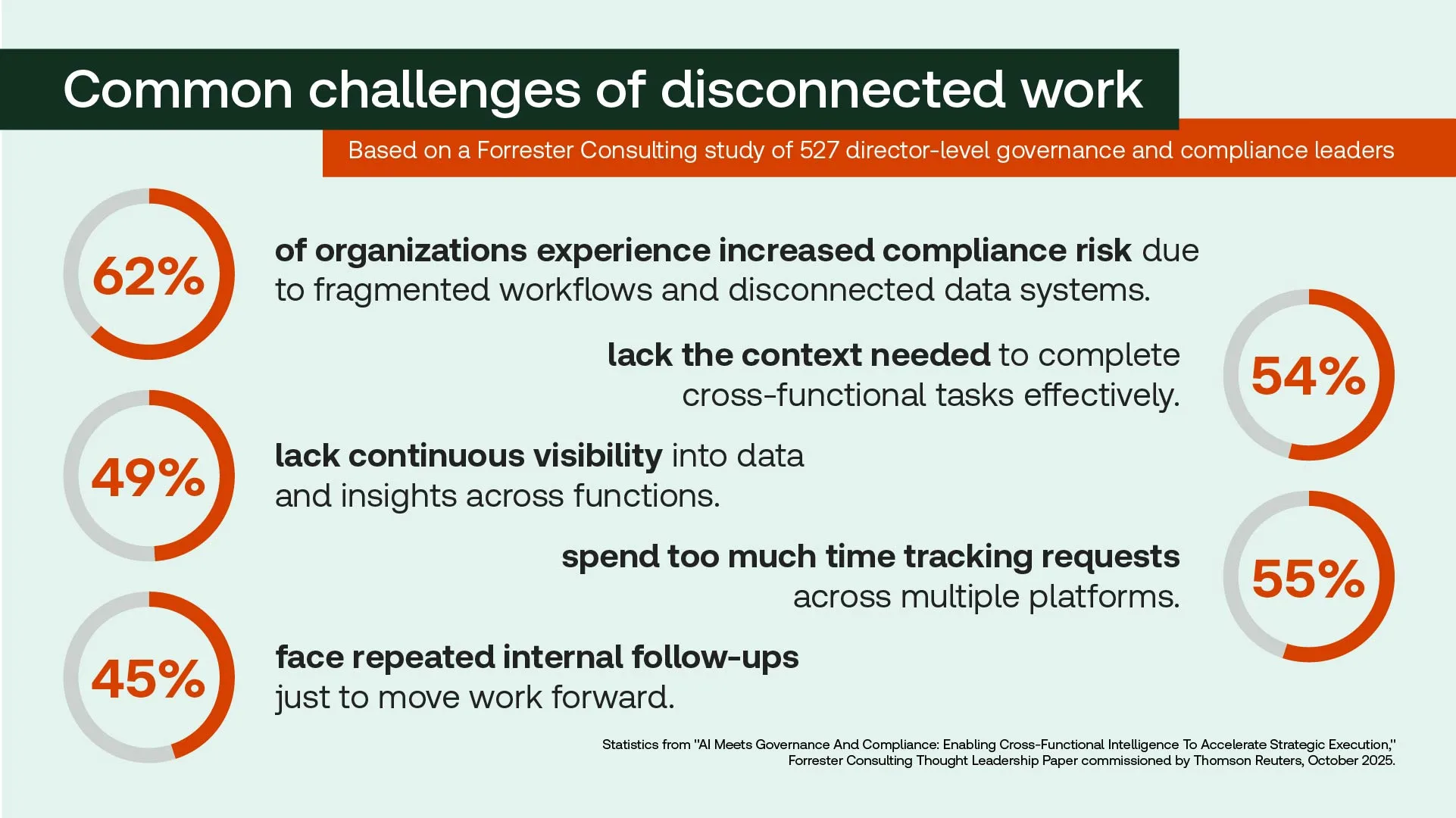
These issues make routine compliance activities more time‑consuming than necessary and increase the likelihood of missed details or inconsistent outputs.
Why integrated workflows matter
Compliance work touches multiple teams, and each one contributes essential context. When workflows stay disconnected, that context gets lost. Integrated systems prevent this by keeping every update, document, and approval within a shared workflow.
Disconnected processes create ripple effects across the business:
- 51% report poor customer experiences linked to compliance inefficiencies (13).
- 53% experience inefficient decision‑making due to fragmented data (13).
- 49% see increased financial risks when workflows aren’t aligned (13).
Integrated workflows reduce these impacts by giving teams a consistent view of work, status, and required inputs. This ensures that processes move forward reliably without relying on emails or repeated check‑ins.
The role of AI in intelligent compliance networks
AI delivers the most value in compliance when it operates inside the workflow — supporting routine tasks, preserving context, and reducing manual effort as work moves between teams.
In traditional environments, teams often rely on manual checks, repeated reviews, and disconnected research tools to complete compliance tasks. Each handoff introduces friction and increases the chance that important details are missed. AI enabled compliance networks change this dynamic by embedding intelligence directly into day-to-day processes.
Within connected workflows, AI helps teams:
- 83% find automated risk and identity analysis valuable (25).
- 77% value data interpretation and summarization (25).
- 68% value the ability to query data across legal, risk, tax, and trade sources (25).
- 66% benefit from natural‑language-driven tax engine configuration (25).
- 64% rely on AI to identify document differences (25).
These capabilities reduce the administrative burden on teams while helping ensure accuracy and completeness. Instead of spending time assembling information or validating inputs, professionals can focus on applying judgment, resolving exceptions, and supporting better informed decisions.
By keeping intelligence aligned with the workflow itself, AI supports a more consistent, repeatable way of working — one that scales as compliance demands increase without adding unnecessary complexity.

Webinar
Forrester’s Insights on AI, Integration, and the Measurable Impact on Legal, Tax & Risk Teams
Learn more ↗
What organizations gain from connected compliance
Teams that adopt connected workflows report improvements that directly affect day‑to‑day operations:
- 79% report better operational efficiency (30).
- 54% see faster decision‑making (30).
- 56% improve coordination across functions (30).
- 71% report stronger communication (30).
Organizations using integrated solutions also demonstrate greater compliance maturity:
- They are two times more likely to use integrated technology across functions (17).
- And three times more likely to use solutions from the same vendor (17).
These gains come from cleaner handoffs, fewer manual steps, and consistent workflows that improve both efficiency and reliability.
Building a foundation for seamless compliance
Improving compliance operations starts with understanding where work slows down and where information gets lost. Successful organizations often begin by:
- identifying manual processes that could be automated
- replacing fragmented tools with interoperable systems
- aligning teams around shared, repeatable workflows
- establishing clear ownership and governance across functions
- setting meaningful performance metrics for efficiency and risk posture
This approach ensures improvements are both sustainable and tailored to how each function operates.
Compliance as a connected and intelligent function
As compliance expectations grow, intelligent compliance networks help organizations stay aligned and prepared. Research shows these environments support important business goals, including:
- managing varying global intellectual property laws (69% find valuable) (27).
- improving global compliance management (66% find valuable) (27).
- managing costs and complexity tied to regulatory changes (61% find valuable) (27).
By modernizing compliance in this way, teams gain clearer insight, more consistent processes, and a system that evolves with regulatory expectations. Organizations ready to take this next step can explore how Thomson Reuters ONESOURCE+, an intelligent compliance network, brings these capabilities together to support long‑term operational resilience and smarter decision‑making.
Sources: Statistics and insights referenced from “AI Meets Governance And Compliance: Enabling Cross-Functional Intelligence To Accelerate Strategic Execution,” Forrester Consulting Thought Leadership Paper commissioned by Thomson Reuters, October 2025.

Special Paper
See how integrated governance and compliance tech improves collaboration, speeds decisions, and boosts agility
Read more ↗
Disclaimer
Thomson Reuters is not a consumer reporting agency, and none of its services or the data contained therein constitute a ‘consumer report’ as such term is defined in the Federal Fair Credit Reporting Act (FCRA), 15 U.S.C. sec. 1681 et seq. The data provided to you may not be used as a factor in consumer debt collection decisioning, establishing a consumer’s eligibility for credit, insurance, employment, government benefits, or housing, or for any other purpose authorized under the FCRA. By accessing one of our services, you agree not to use the service or data for any purpose authorized under the FCRA or in relation to taking an adverse action relating to a consumer application.