Highlights
- Corporate legal teams face increasing workloads with flat budgets, creating execution challenges.
- Intelligent automation accelerates document workflows, research, and routine communication for legal departments.
- Operational efficiency enables legal teams to shift from reactive tasks to strategic partnership.
Your strategic action plan is solid. You’ve identified the pressures, mapped the priorities, and aligned your legal department with business objectives. But here’s where many corporate legal teams hit a wall: translating that strategic vision into daily execution that actually moves the needle.
The challenge isn’t knowing what needs to be done—it’s having the capacity and tools to do it consistently, accurately, and at the speed your business demands.
Jump to ↓
The execution challenge facing corporate legal
Moving from knowing to doing with intelligent automation
The strategic impact of operational efficiency
Implementation that works in the real world

Report
Transforming legal operations in 2025: strategic insights for corporate counsel
Access report ↗
The execution challenge facing corporate legal
Corporate legal departments today operate in a paradox. You’re expected to be more strategic while handling an ever-increasing volume of operational work.
According to the 2026 State of the Corporate Law Department Report, 81% of legal departments report increasing matter volumes, yet 55% report flat or decreasing budgets. You need to provide faster turnaround times while maintaining the quality standards that protect your organization. You’re asked to do more with existing resources while staying ahead of regulatory changes and emerging risks.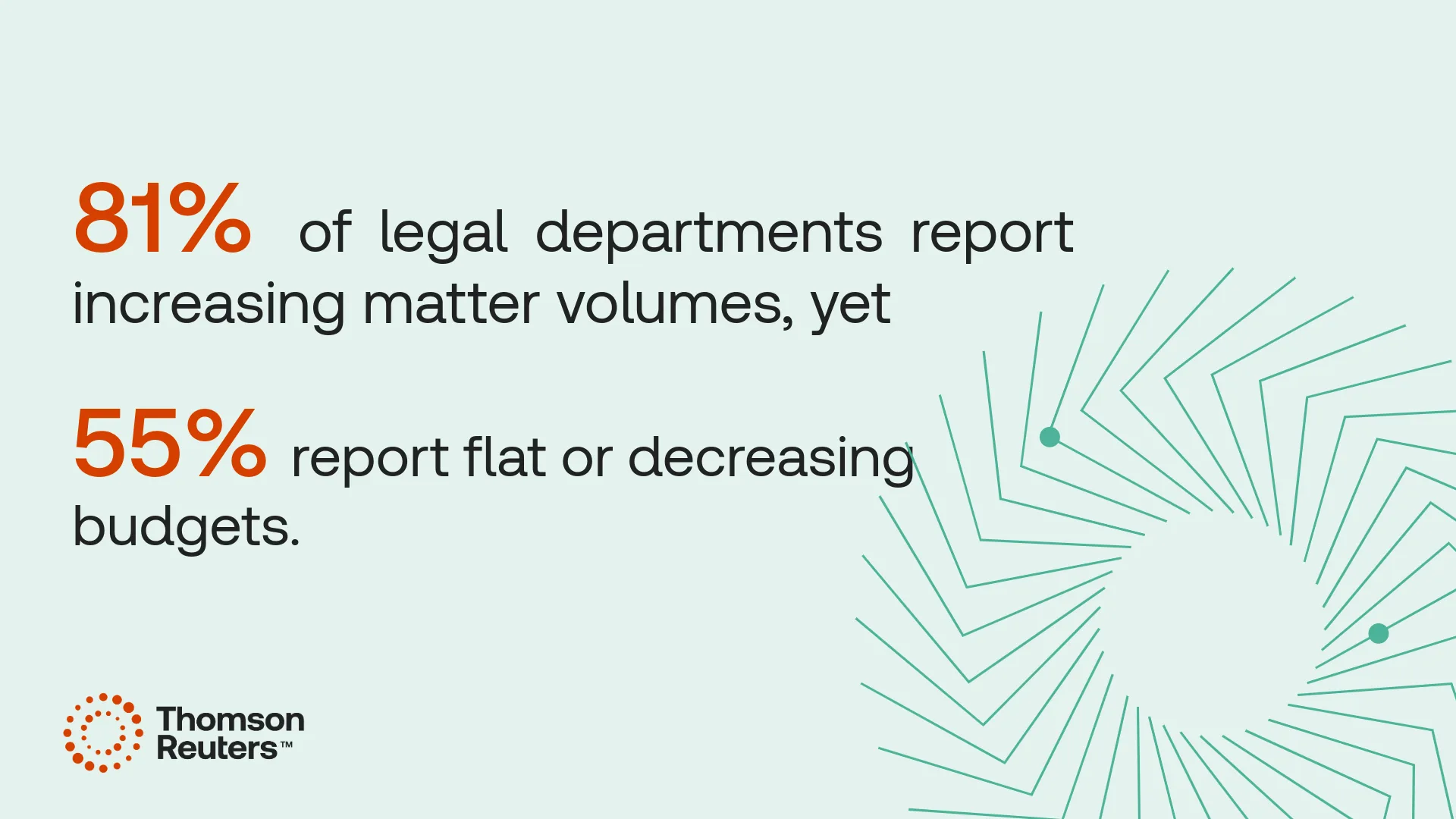
This isn’t just about being busy. It’s about the fundamental tension between strategic value creation and operational excellence. When 60% of your time goes to document review, contract analysis, and routine legal tasks, strategic initiatives get pushed to “when we have bandwidth”—which often means never.
The most successful corporate legal departments we work with have learned to resolve this tension by fundamentally changing how work gets done, not just how it gets prioritized.
As the 2025 Legal Department Operations Index reveals, 82% of respondents indicate their legal department has at least one dedicated legal ops role, reflecting how departments are evolving beyond traditional cost-control functions to encompass systems, processes, and technology optimization.
Moving from knowing to doing with intelligent automation
The difference between a good legal strategy and great legal execution often comes down to one thing: the ability to handle routine work with exceptional efficiency so your team can focus on what truly requires human judgment and expertise.
This is where CoCounsel Legal transforms how corporate legal departments operate. Rather than replacing legal professionals, it amplifies your capabilities in three critical areas that directly impact your ability to execute on strategic objectives.
Accelerating document-heavy workflows
Corporate legal teams deal with volumes of documentation that would have been unimaginable a decade ago. Contract reviews, compliance assessments, due diligence packages, and regulatory filings create constant pressure on your team’s capacity.
The data supports this reality: 56% of legal departments report being under-resourced, with 85% citing increased workload and risk of burnout as the primary consequence. Meanwhile, 73% plan to use advanced technology to automate legal tasks and reduce costs, yet 45% characterize the pace of technology advancement in their departments as “slow.”
CoCounsel Legal’s document analysis capabilities let you process these materials at unprecedented speed without sacrificing thoroughness. When you need to review hundreds of contracts for compliance issues, or analyze acquisition documents for potential risks, or summarize complex regulatory guidance for business stakeholders, you can delegate the initial analysis while maintaining oversight of the final output.
The result isn’t just faster turnaround—it’s more comprehensive analysis. When routine document processing takes 60% less time, your team can dig deeper into the strategic implications and provide more valuable insights to the business.
Enhancing research depth and speed
Legal research in the corporate environment often happens under tight deadlines. A business unit needs guidance on a new regulatory requirement. The executive team wants to understand the legal implications of a potential partnership. A compliance issue emerges that requires immediate analysis of relevant case law and regulations.
Research shows that 68% of GCs rate internal dialogue as their most valuable source of information about emerging risks, while 36% identify technology as a highly valuable source for risk management. This highlights both the critical nature of timely research and the growing role of technology in supporting it.
With traditional research approaches, your team spends hours gathering information before they can even begin providing strategic guidance. CoCounsel Legal changes this dynamic by handling the information gathering and initial analysis, allowing your team to immediately focus on interpretation and strategic recommendations.
When research that previously took days can be completed in hours, your legal department becomes more responsive to business needs and more valuable as a strategic partner.
Streamlining routine communication and documentation
Corporate legal departments generate enormous amounts of written communication: guidance memos, policy updates, training materials, correspondence with external counsel, and documentation of legal positions. This writing work is essential but time-intensive.
The 2026 State of Corporate Law Department Report indicates that 46% expect to bring more work in house, creating additional pressure on internal teams to handle increased documentation and communication demands efficiently.
CoCounsel Legal helps streamline this process by assisting with initial drafts, ensuring consistency across documents, and maintaining professional standards while reducing the time investment required from senior legal professionals. Your team can focus on the strategic content while the system handles much of the structural and formatting work.
The strategic impact of operational efficiency
When your legal department operates with this level of efficiency, the strategic benefits compound quickly. You become more responsive to business needs, increasing your influence in strategic decisions. Your team has bandwidth to proactively identify risks and opportunities rather than just reacting to issues. You can take on more complex projects that directly contribute to business growth.
The data reinforces this connection: while 86% of GCs believe their department is a significant contributor to organizational objectives, only 17% of C-suite executives agree. This visibility gap often stems from legal departments being overwhelmed with operational tasks, limiting their ability to demonstrate strategic value.
Most important, you can shift the conversation from “legal says no” to “here’s how legal can help make this work.” When you’re not constantly behind on operational tasks, you have the capacity to be creative problem-solvers and strategic partners.
Implementation that works in the real world
The most successful CoCounsel Legal implementations we see follow a practical approach that respects how corporate legal departments actually operate. Rather than trying to transform everything at once, leading teams identify specific workflows where efficiency gains will have the biggest impact on their strategic objectives.
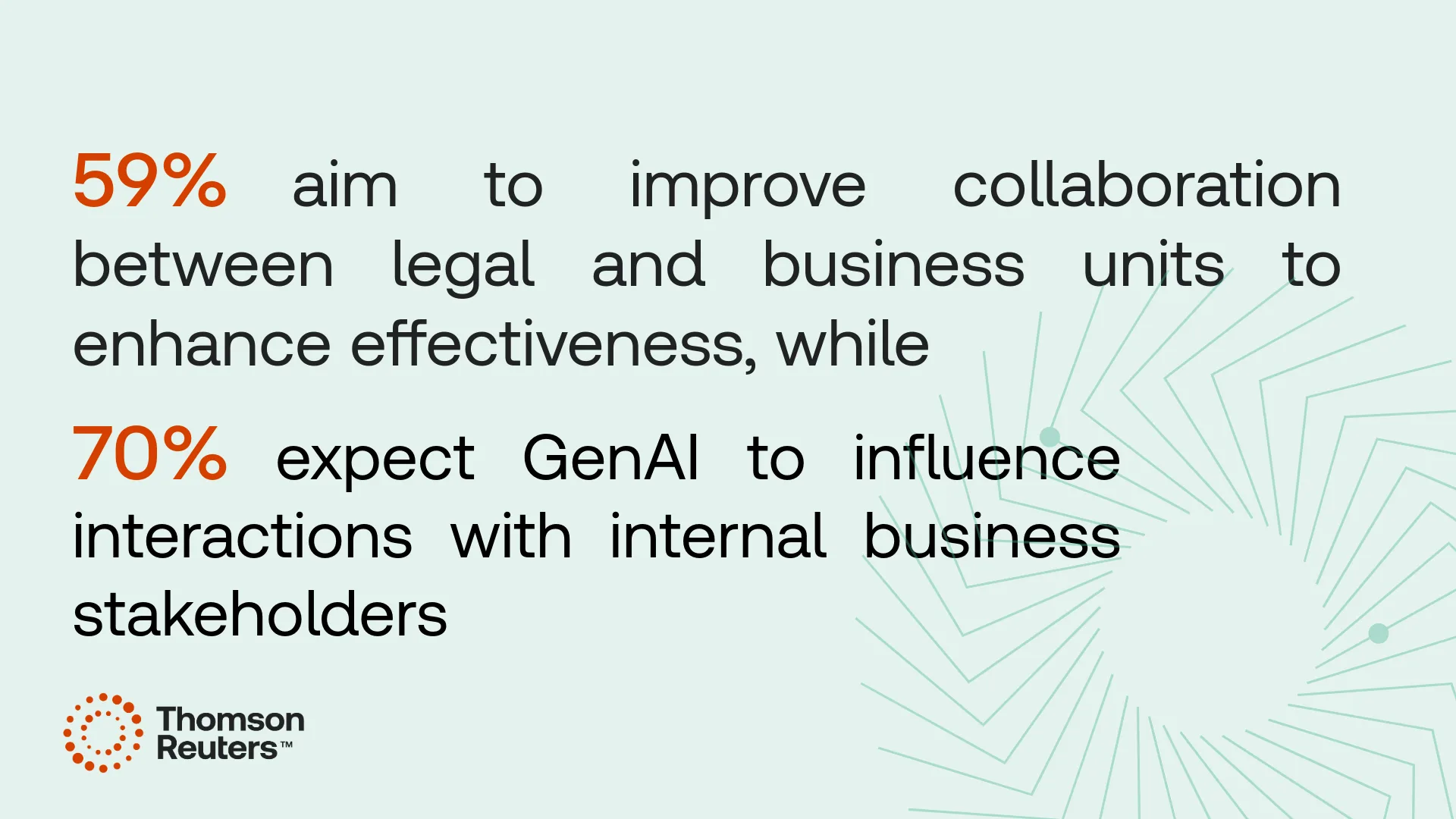
The research supports this measured approach: 59% aim to improve collaboration between legal and business units to enhance effectiveness, while 70% expect GenAI to influence interactions with internal business stakeholders. This suggests that successful implementation focuses on enhancing relationships and workflows rather than wholesale replacement of existing processes.
Start with the work that currently consumes the most time without requiring complex judgment—contract reviews, document summarization, or routine research tasks. As your team becomes comfortable with the enhanced capabilities, you can expand to more complex applications.
The key is maintaining professional oversight while leveraging the system’s ability to handle routine aspects of legal work. Your expertise remains central to every decision, but you’re no longer spending that expertise on tasks that can be handled more efficiently.
Your next strategic move
The corporate legal departments that will thrive in the coming years are those that master this balance between strategic thinking and operational excellence. They’ll be the ones that can respond to business needs with both speed and sophistication, that can proactively identify opportunities while managing day-to-day risks, and that can demonstrate clear value to the organization through measurable impact.
As the 2025 Legal Department Operations Index concludes: “Legal ops is no longer a support function—it’s becoming the operational and strategic backbone of modern legal departments.” The question isn’t whether your legal department needs to evolve—it’s whether you’ll lead that evolution or be forced to catch up later.
Ready to see how operational efficiency can unlock strategic impact? Let’s explore what CoCounsel Legal can do for your specific challenges and objectives.