CoCounsel Legal earns its trust through the attorney-editors who build, review, and test the legal AI.
Highlights
- CoCounsel Legal is built on Fiduciary-Grade AI, designed so lawyers can verify work as they go.
- More than 1,300 attorney-editors from Practical Law and Westlaw shape its content, reasoning, and benchmarks.
- Attorney review of reasoning and output keeps answers accurate, current, and traceable to trusted authority.
A question comes in on an area of law you don’t practice. You run it through an AI tool, and the answer looks polished, confident, and well organized. It reads like it came from someone who knows the area, but you don’t know the area well enough to tell what it left out.
That is the trouble with a lot of AI in legal work: its mistakes rarely look like mistakes. An invented citation or a missed nuance sits inside a confident, well-formatted answer, and nothing on the page flags it. Trust the answer, and a gap can reach the client, the court, or opposing counsel under your name. Check every line yourself without easy access to reliable source materials, and you give back the time the AI was supposed to save.
Jump to ↓
The answer: Fiduciary-Grade AI™ built on legal expertise
Expertise at scale: the attorney-editors behind CoCounsel Legal
Developing the content that CoCounsel Legal draws on
Reviewing the reasoning so it thinks like a lawyer
Benchmarking the output to the standard attorneys expect
Why it matters: expertise you can verify

The answer: Fiduciary-Grade AI™ built on legal expertise
CoCounsel Legal is built on Fiduciary-Grade AI™: AI built to the standard the profession demands, with work lawyers can easily verify as they go. Meeting that standard requires in-depth legal expertise. Attorneys who have practiced law shape the content CoCounsel Legal draws from, review how it reasons, and benchmark the work it produces against the standard lawyers expect.
Expertise at scale: the attorney-editors behind CoCounsel Legal
Most legal AI providers emphasize how fast their systems work and how much time they save. Far fewer maintain a deep bench of legal experts who help build the system, monitor its performance, and keep improving it. CoCounsel Legal stands apart because of its foundation. More than 1,300 attorney-editors from Practical Law and Westlaw embed their legal expertise throughout the product so it can meet the Fiduciary-Grade AI™ standard.
They do this by:
- Developing the content CoCounsel Legal draws on
- Reviewing the reasoning so it thinks like a lawyer
- Benchmarking the output to the standard attorneys expect
Developing the content that CoCounsel Legal draws on
CoCounsel Legal is the only legal AI built on Practical Law and Westlaw, resources lawyers have relied on for decades. What makes that content trustworthy is the attorney-editors behind it. They maintain accurate and current primary law by continuously updating and organizing cases, codes, court rules, regulations, and more, and they write practice notes, checklists, and templates that explain legal and practice developments for practitioners. They monitor changes in the law every hour to ensure the content is accurate, up to date, and easily verifiable. That same editorial work also makes the content easier for the AI in CoCounsel Legal to find and use.
Westlaw attorney-editors summarize each point of law in a court decision, file it under the right topic in the Key Number System, and add editorial analysis to every case in KeyCite. That organization helps the AI in CoCounsel Legal find the most relevant authority faster. It also reads KeyCite’s red and yellow flags, which warn when a case has been overruled or criticized, and takes them into account in its answers.
Practical Law is not only written in plain language so attorneys can read and understand it quickly; it is also honed for AI. CoCounsel Legal searches thousands of Practical Law resources to answer a single question, so editors write and organize each resource to be easy to find and clear about what it covers.
Heather McMaster, Director of Capital Markets & Corporate Governance at Practical Law, calls this making content “AI-ready” and says it goes well beyond making information available to an algorithm. Her team sharpens signposting and shapes each resource to cover an issue completely, so CoCounsel Legal can identify the best resource for the job.
“When CoCounsel goes to find the resource that discusses the issue at hand, it’s finding the one key source that has absolutely everything in it.”
Director of Capital Markets & Corporate Governance at Practical Law Thomson Reuters
Reviewing the reasoning so it thinks like a lawyer
Expert attorney-editors review how CoCounsel Legal’s agents plan and work through complex legal issues, then give feedback so the work ultimately looks like what an experienced attorney and a seasoned researcher would produce: the right authority, read correctly, and the right approach to the matter.
Barbara Harris, an attorney-editor on the Practical Law Labor & Employment team, spent almost 25 years in private practice, most recently at one of the world’s largest global law firms, before joining Thomson Reuters. She has worked on CoCounsel Legal from the earliest days, and she compares the review to a familiar scene.
“In reviewing CoCounsel Legal’s output, I think about what a senior partner might ask an associate when they bring them a work product,” Harris says. “’What did you research? Did you explore all avenues? What was your thinking on this? What sources did you use?’ We go through that same process with CoCounsel Legal to make sure we get it to be thinking more like a lawyer and less like a bot.”
Benchmarking the output to the standard attorneys expect
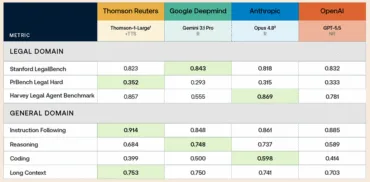
The third part is measurement, and it starts with attorneys writing the answer key. Harris’s team, along with Practical Law attorney-editors, began by drafting what she calls “gold data,” the ideal responses to potential user queries, and then compared CoCounsel Legal’s answers with them. McMaster’s team does the same for capital markets and corporate governance: they write the queries, create the test documents, define what a gold-standard answer contains, and grade the results for quality, accuracy, SEC filing confirmation, and passage citations.
Only an experienced attorney can grade this work, because correctness has several parts. “First of all, and foremost, we are looking at it for legal accuracy,” Harris says. “Is it citing the right law? Is it getting that law correct? Is it encompassing the most recent developments?” Then comes professionalism: is the work at a level “any attorney would be prepared to submit to a court or send to a client?”
Nuance is where the expertise shows. Employment law, Harris says, is “not really a linear practice.” Take the question of whether an employer can lawfully fire and employee. A strong answer must look beyond whether the employee is employed at-will or party to an employment contract. It also needs to consider, for example, whether the employee has taken leave, may have been misclassified as exempt, is the member of any protected class, or has raised a complaint and potentially qualifies as a whistleblower. A reviewer who has never practiced in the area wouldn’t know to look for those issues or notice when an answer leaves them out.
The editors also track progress. Elaine Cedrone, a Senior Associate Editor at Practical Law and a former litigator, remembers an early round of testing in which she ran the same legal question through CoCounsel Legal twice and got two very differently reasoned memos. When her team reran the test months later, the outputs were much more consistent. “We could really see a noticeable difference,” Cedrone says.
Why it matters: expertise you can verify
Complex legal work is highly nuanced and rarely straightforward. Every matter turns on a unique blend of facts, legal analysis, and judgment. That is why attorneys need Fiduciary-Grade AI™ built to the standard the profession demands, with output that is easily verifiable. Attorney expertise is its foundation: attorneys develop the content CoCounsel Legal draws from, review its reasoning, and test its output against what a complete answer requires. The result is work grounded in trusted authority and traceable at every step, so you can review it with confidence, spend less time rebuilding answers, and spend more time applying judgment and moving the matter forward.

CoCounsel Legal
Accelerate your legal work with Fiduciary-Grade AI™ and the new CoCounsel Legal experience
Try Fiduciary‑Grade AI ↗