A four-part series
Highlights
- AI-powered tools transform commercial lending by accelerating due diligence while maintaining rigorous risk standards.
- Investigation platforms uncover hidden ownership networks and relationships that traditional processes often miss.
- Standardized AI workflows improve consistency and operational efficiency across commercial lending teams.
Commercial lending has entered a new era of complexity and competition powered by artificial intelligence and advanced analytics. Commercial lenders face pressure to reach faster outcomes while maintaining rigorous risk assessment standards. Traditional due diligence processes—manual business verification, individual record reviews, and siloed analysis—create bottlenecks that can cost deals and expose institutions to unknown risks. AI-powered investigation tools are transforming how lenders approach these challenges, enabling smarter, faster decision-making without compromising thoroughness.
Jump to ↓
The speed vs. risk dilemma
How AI is changing commercial due diligence
Detecting unknown risk in commercial lending
Improving operational efficiency and consistency across due diligence
Turning better intelligence into better commercial lending outcomes

The speed vs. risk dilemma
Modern commercial lending operates in a highly competitive environment where speed often determines success. However, the pressure to approve loans quickly cannot compromise the thoroughness required to identify potential risks. Fraudulent businesses can easily obtain Secretary of State filings and present legitimate facades while hiding significant red flags in their ownership structures, financial histories, or operational realities.
The challenge intensifies when considering business principals and ownership networks. A company might appear solid based on surface-level documentation, but unknown relationships, undisclosed litigation, or problematic ownership structures can create substantial risks that traditional due diligence processes miss or take too long to uncover.
How AI is changing commercial due diligence
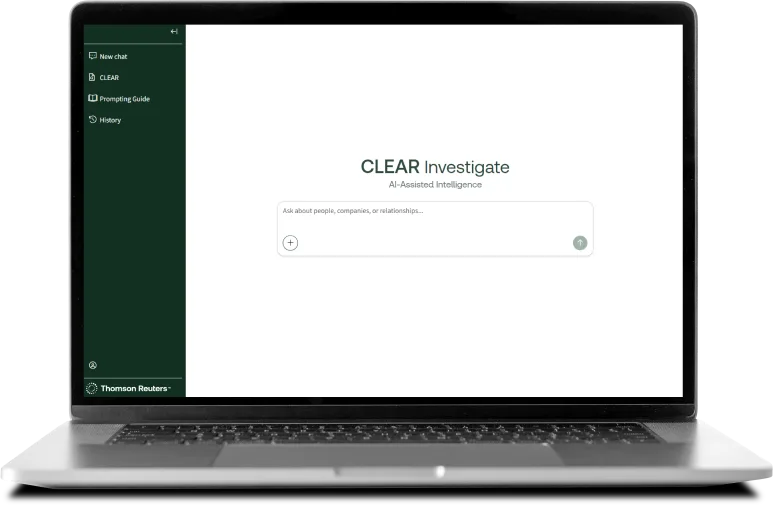
AI-powered investigation workflows can help commercial lenders move from manual information gathering to more connected risk analysis. Instead of navigating multiple databases and piecing together records one by one, teams can use natural language prompts to request a due diligence and risk overview of a company, its principals, and its ownership structure.
The value is not simply faster search. It is the ability to analyze business registrations, corporate filings, ownership structures, litigation history, and regulatory actions together, then surface relevant connections and risk indicators with supporting source documentation. For commercial lending teams, this can help reduce manual review time while improving consistency and confidence in the decision-making process.
Detecting unknown risk in commercial lending
Commercial lending risks often hide in relationships and networks rather than individual business records. A company might have clean financial statements but problematic ownership connections, undisclosed litigation involving principals, or operational relationships with high-risk entities.
AI-powered investigation tools excel at uncovering these unknown connections. They analyze shared officers, affiliated entities, linked addresses, and historical relationships that might not appear in standard business reports. When risks are identified, the system automatically suggests follow-up investigations and provides clear documentation for commercial lending reviews.
Improving operational efficiency and consistency across due diligence
Traditional due diligence processes require extensive training and specialized knowledge. Different investigators might reach different conclusions based on the same information, creating inconsistency in risk assessment. AI-powered tools standardize the investigation process while providing comprehensive analysis that enables thorough commercial lending reviews.
Turning better intelligence into better commercial lending outcomes
Commercial lenders implementing AI-powered due diligence capabilities report significant improvements in decision speed, risk detection accuracy, and operational efficiency. More importantly, they’re building sustainable competitive advantages in an increasingly complex lending environment.
The technology enables lending teams to shift from reactive risk assessment to proactive relationship management. By understanding the complete risk picture of borrowers and their networks, commercial lenders can make more informed pricing decisions, structure appropriate covenants, and build stronger customer relationships based on comprehensive understanding.
Strategic takeaway
Commercial due diligence is evolving from a document-checking process into a more connected, intelligence-led discipline. Lenders that use AI to uncover unknown relationships, accelerate analysis, and strengthen documentation will be better positioned to compete on speed while maintaining the risk standards modern lending requires.
Access to these tools is limited to authorized, vetted professionals.
Thomson Reuters is not a consumer reporting agency and none of its services or the data contained therein constitute a “consumer report” as such term is defined in the Federal Fair Credit Reporting Act (FCRA), 15 U.S.C. sec. 1681 et seq. The data provided to you may not be used as a factor in consumer debt collection decisioning; establishing a consumer’s eligibility for credit, insurance, employment, government benefits, or housing; or for any other purpose authorized under the FCRA. By accessing one of our services, you agree not to use the service or data for any purpose authorized under the FCRA or in relation to taking an adverse action relating to a consumer application.