
How law firms can turn AI efficiency into competitive advantage without sacrificing profitability
Highlights
- AI-driven efficiency is disrupting the traditional billable hour model, forcing law firms to rethink value delivery.
- Clients value transparency, strategic partnership, and clear ROI as AI levels the playing field for smaller firms.
- Alternative pricing models and a four-layer AI success pyramid are key to aligning firm profitability with client value.
As AI transforms how legal work gets done, the fundamental economics of law firm billable hours face disruption. As AI helps lawyers work faster, the traditional billable hour model faces a problem, as greater efficiency doesn’t guarantee higher revenue.
This transformation goes far deeper than simple productivity improvements. It represents a fundamental shift in how legal services create and capture value, forcing both firms and clients to rethink what they’re actually buying and selling in the modern legal marketplace.
Jump to ↓
When efficiency hurts your bottom line
Enhancing client value delivery with AI
The four-layer AI success pyramid and its economic impact
New economics models that align AI efficiency with client value
Your competitive advantage starts today
When efficiency hurts your bottom line
The recent Future of Professionals Report reveals that legal professionals expect to free up nearly 240 hours annually through AI adoption. In the US alone, this contributes to a $32 billion combined annual impact for the legal and tax & accounting sectors.
Yet the traditional model breaks down when firms become more efficient. The more efficiently firms deliver legal work through AI, the less they can charge under hourly billing. This creates a problem where firms invest millions in AI tools that compress 10 hours of work into two, then find themselves either dramatically increasing hourly rates or watching revenue shrink.
Meanwhile, their clients are drowning. Nearly 90% of general counsels say they can’t deliver the strategic impact their companies need because they don’t have enough resources. These legal departments aren’t just looking for faster work; they need someone to take entire problems off their plate.

Future of Professionals Report
Discover how AI is shaping the way professionals work in the most recent Future of Professionals Report.
Download report ↗Enhancing client value delivery with AI
Many law firms think clients want everything faster and cheaper. That’s not quite right.
Corporate legal departments are stuck in an impossible situation. They’re managing regulatory compliance while supporting mergers, employment-related issues, and trying to be strategic business partners. When they hire outside counsel, they need firms that demonstrate clear ROI and deliver strategic partnerships that drive organizational growth.
According to the 2026 State of the Legal Market Report, one in four buyers report never having experienced an outside law firm that delivered excellent value despite premium pricing. This creates disproportionate opportunities for firms that can clearly articulate their value proposition.
For smaller law firms, AI levels the playing field remarkably. Midsize firms can now offer sophisticated document review, comprehensive legal research, and rapid case analysis that previously only large firms could provide. AI enables smaller practices to compete on capability rather than just cost.
Clients increasingly prioritize transparency and predictability. They want to understand how work advances business objectives. When they see their legal departments using AI for routine work at fraction costs, they question why outside firms charging premium rates aren’t delivering similar efficiencies.
The most successful AI implementations maintain a human-centered approach that enhances how lawyers work rather than replacing core aspects of legal expertise. AI should elevate legal service delivery, making lawyers more effective, insightful, and responsive to client needs while unlocking additional value.
This approach addresses the common objection that AI adoption will reduce law firm billable hours. Rather than eliminating revenue opportunities, AI helps recapture productivity already lost to inefficiencies, transforming unbilled work time into billable value.
The four-layer AI success pyramid and its economic impact
Successful AI implementation is essential for creating a competitive advantage that justifies premium pricing. The Future of Professionals Report reveals that organizations with visible AI strategies are 3.9 times more likely to see ROI compared to firms without significant AI adoption plans.
This success follows a four-layer pyramid structure: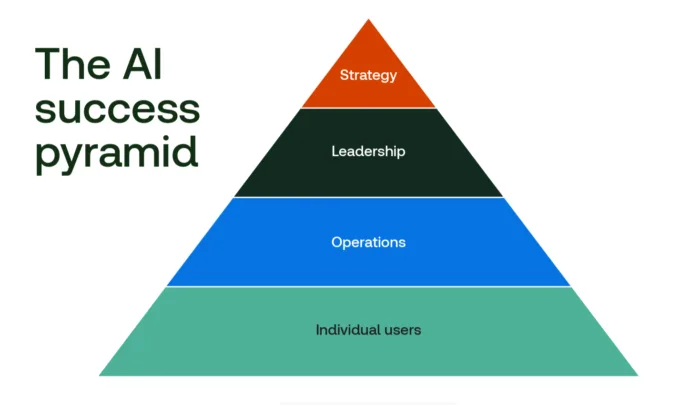
Strategy Layer: Organizations with visible AI strategies are3.5 times as likely to experience revenue growth from AI adoption than those without.
Leadership Layer: Firms where leaders consistently lead by example in AI adoption are 1.7 times as likely to see benefits.
Operations Layer: Successful firms make fundamental changes to work delivery, such as adjusting roles, modifying processes, and experimenting with new service offerings.
Individual Layer: Professionals with good AI knowledge are 2.8 times as likely to see organizational benefits.
Firms that successfully implement across all four layers don’t just work faster. They deliver entirely new forms of value.
New economics models that align AI efficiency with client value
The solution isn’t to choose between efficiency and profitability. Smart firms are creating pricing models where AI-driven efficiency actually helps both the firm and the client.
Several alternative approaches are emerging:
Fixed-fee arrangements for predictable work allow firms to capture AI efficiency benefits while providing clients with cost certainty
Success-based pricing tied to business outcomes shifts the conversation from time spent to results achieved.
Subscription models for ongoing counsel recognize that many clients need continuous access to legal expertise rather than discrete project-based work.
Value-sharing arrangements explicitly split the benefits of AI-driven efficiency between firm and client.
AI transforms what firms can offer clients. Services like continuous monitoring, predictive analysis, and proactive guidance become economically viable when AI reduces delivery costs.
Your competitive advantage starts today
The future belongs to firms that can articulate AI-enhanced value clearly, price it fairly, and deliver it consistently. In a world where efficiency is increasingly commoditized, solving complex business problems, not just legal ones, becomes the ultimate differentiator. Success requires moving from time merchants to strategic partners before market forces demand the change.
CoCounsel Legal is your force multiplier for strategic work. Leverage AI capabilities and trusted legal expertise to deliver predictable outcomes, strategic insights, and measurable business value.

CoCounsel Legal
Work smarter with CoCounsel, seamlessly integrated with Westlaw, Practical Law, Microsoft 365, and DMS partners
Go professional-grade AI ↗