Common Law and case law primer for attorneys, paralegals, or students.
Originally published on November 15, 2022
Highlights
- Common law relies on judicial precedent through the doctrine of stare decisis.
- The U.S. follows common law with exceptions in Louisiana and Puerto Rico.
- Modern legal technology has transformed common law research from days to minutes.
Common law legal systems can trace their roots back many centuries. The common law system as we know it started in England during the Middle Ages.
Today, several countries around the world, including the U.S., Canada, India, and Australia, continue to rely heavily on common law.
Jump to ↓
What is common law?
Sources and development of common law
Does the U.S. use common law or civil law?
Benefits of a common law system
Drawbacks of a common law system
How do you research common law?

White paper
AI-powered legal drafting: the definitive guide for legal professionals
Access white paper ↗
What is common law?
Common law is a body of law based on court decisions rather than codes or statutes. At the center of common law is the judicial doctrine of stare decisis, which means to “stand by things decided.” Under this doctrine, courts follow the rules and principles of prior decisions when deciding cases with arguably similar facts.
Stare decisis can be persuasive or mandatory. A lower court’s decisions may be persuasive, but they are not binding on higher courts. The same is true for decisions from courts in different jurisdictions: State court decisions do not bind federal courts, and decisions from courts of one state do not bind those of another.
Lower courts, however, must follow the precedents of higher courts within their state or federal circuit, a doctrine known as vertical stare decisis. Supreme Court decisions, for example, are binding on all other federal courts and on federal issues in state courts. In horizontal stare decisis, decisions of appellate courts provide some precedent for appellate courts at the same level, but not always as much as precedent from higher to lower courts.
The Supreme Court usually follows its own precedents, with notable exceptions. According to a Congressional report, the Supreme Court “considers the principle of stare decisis to be a discretionary ‘principle of policy,'” that should be balanced against “its views about the merits of the prior decision.” However, the court must find “some special justification — or, at least ‘strong grounds’ — that goes beyond disagreeing with a prior decision’s reasoning to overrule constitutional precedent.”
Sources and development of common law
Common law evolves through judicial opinions issued by appellate courts. These decisions are published and compiled in case reporters, many of which are accessible through Westlaw, including the Atlantic Reporter, North Eastern Reporter, and Federal Reporter series.
Key areas governed primarily by common law include:
- Torts: Historically, tort law has largely developed through case law. For example, Benjamin Cardozo’s majority opinion in Palsgraf v. Long Island Railroad Co., 248 N.Y. 339, 162 N.E. 99 (1928), accessible via Westlaw, refined the concept of duty of care. Common law, however, is not the only source of tort law, as state legislatures and Congress, over time, have been enacting tort statutes.
- Property: Concepts such as easements, covenants, and landlord-tenant obligations often originate in common law, though they may be modified by state statutes.
- Agency and fiduciary duties: Members of corporate boards of directors have fiduciary duties, including the duties of care and loyalty, that primarily stem from common law. Corporations have an extremely limited ability to modify or eliminate these common law fiduciary duties. The Fiduciary Duties of the Board of Directors guide on Practical Law provides an in-depth look at the legal framework that applies to these fiduciary responsibilities.
While legislatures may codify or override common law rules — for example, through the Uniform Commercial Code — courts retain authority to interpret statutes and fill in gaps using common law reasoning.
How is common law different from civil law?
| Type of law | Source | Role of precedent | Codification |
|---|---|---|---|
| Civil law | Codes and statutes | Not binding on other cases | Comprehensive code of statutes |
| Common law | Judicial decisions | Binding from higher-to-lower courts in the same jurisdiction; otherwise, persuasive | Restatements of the law are influential, but not binding. Legislatures may enact binding statutes based on case law. |
When statutes conflict with common law, the statutes are the controlling law.
| Judge’s role | Flexibility or change | Example ruling |
|---|---|---|
| Clear rules for how judges should rule. Typically inquisitorial systems | To change or repeal a statute requires legislative action | Cases based on the Louisiana Civil Code |
| Decisions of appellate judges and Supreme Court justices contribute to the evolution of common law. Typically adversarial systems. | Common law often changes slowly as new decisions add nuance. Larger changes may occur if precedents are overturned. | Palsgraf v. Long Island Railroad Co., 248 N.Y. 339, 162 N.E. 99 (1928) |
Does the U.S. use common law or civil law?
The U.S. has a common law system, originally based on common law rules from England. However, within the U.S., there are exceptions that follow a mixed civil and common law system.
Two jurisdictions maintain a Civil Code:
Louisiana
Louisiana’s Civil Code dates back to 1808, when Louisiana was still a territory. It was originally written in French, though scholars still debate whether the French or Spanish codes were the main influence. Now, the state has a mixed common and civil law system. The Civil Code or Revised Statutes generally govern private disputes, while common law precedents usually govern disputes in the public sector.
Puerto Rico
Puerto Rico also has a mixed system. The territory, which was a Spanish colony for hundreds of years, has a civil law system originally based on the Spanish Civil Code. As in Louisiana, private disputes in Puerto Rico are mostly settled based on civil law. Public and commercial law mostly rely on common law.
Erie doctrine
The Erie doctrine in 1938 abolished federal general common law. In cases where the parties are from different states, a federal court must apply the statutes and the common law of the state where the court is located. However, federal common law still exists in the limited circumstances where it’s authorized by Congress or when needed to protect unique federal interests. These include admiralty law and disputes between states.
Benefits of a common law system
Common law systems can provide:
- Stability and consistency — Outcomes rely on previous decisions rather than subjective and unpredictable personal viewpoints.
- Legitimacy — Adhering to precedents supports the rule of law, the legitimacy of the judicial process, and the court’s role as unbiased decision makers.
- Adaptability — Common law systems allow courts to address situations not originally predicted by lawmakers.
- Flexibility — Common law can respond to social changes. Unlike civil law systems, common law doesn’t require the time-consuming process of lawmakers passing changes in statutes and codes. On the other hand, the evolution of common law can be slow and incremental.
Drawbacks of a common law system
Although a common law system provides many benefits, there also may be trade-offs.
- Potential inconsistency across jurisdictions — Because courts are not bound by precedents from other jurisdictions, case law can develop inconsistently in different regions, making the law less certain and harder to predict.
- Research burden — Researching common law is more complex than researching statutes. It requires more time and presents barriers for people who are not trained legal professionals.
- Verifying that precedent remains good law — Decisions in a case can be modified or overruled by subsequent cases. Before modern legal tech, checking to see that a precedent was still valid was a time-consuming task.
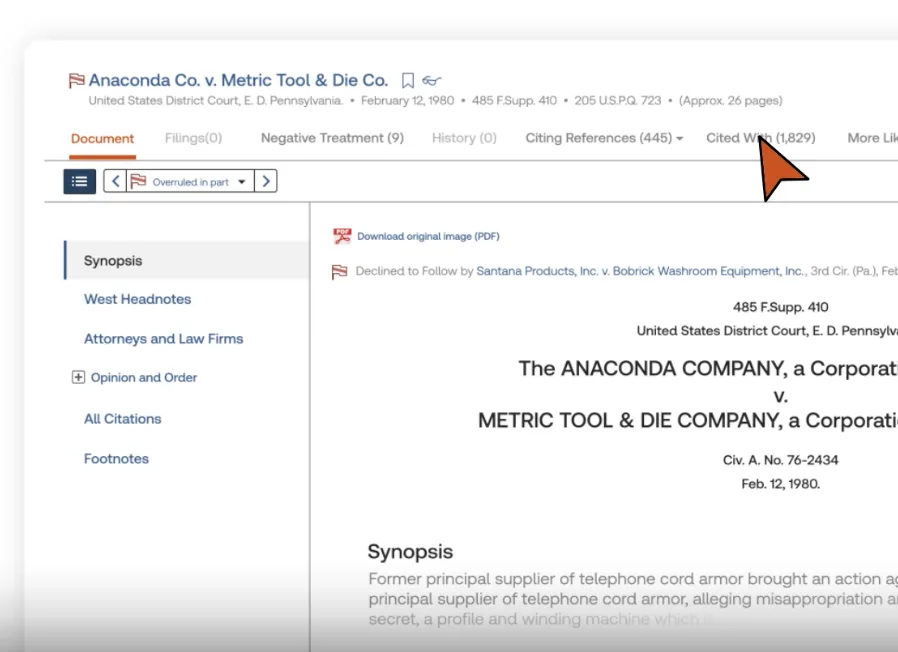
Westlaw Advantage
Pinpoint the exact legal point invalidated in a case to avoid overlooking other valid legal principles with KeyCite Overruled in Part
Westlaw Advantage features ↗How do you research common law?
When conducting legal research in a common law legal system, you’ll usually need to start by finding legal precedents. You’ll have to search for relevant case law.
The process used to be time-consuming and arduous. It typically required long hours in the law library poring over countless case reporters and practice guides, hoping you would eventually stumble across the perfect case.
Legal technology has made a huge difference. Researching case law is now easier and faster. Today’s legal tech can help you finish many research tasks in minutes that used to take hours or days.
Being effective in a common law system
Litigators, transactional attorneys, and all legal professionals need a robust understanding of the U.S. common law system. They also need efficient and accurate tools for researching relevant precedents and to be confident in results.
Attorneys can rely on the comprehensive primary law and authoritative secondary sources of Westlaw Advantage, as well as the maintained practice guidance in Practical Law in their common law practice.
Get those verifiable and authoritative answers all in one platform with CoCounsel Legal.