Why being ‘almost right’ is a liability. A buyer's guide framework to evaluate and vet vendors.
Highlights
- Fiduciary-Grade AI™ sets a new, defensible standard for legal professionals deploying AI in high-stakes environments.
- Legal AI solutions must deliver authoritative content, rigorous privacy, expert involvement, and transparent, verifiable outputs.
- Thomson Reuters CoCounsel exemplifies Fiduciary-Grade AI, supporting legal workflows with accuracy, accountability, and security.
Every year, courts sanction attorneys for citing cases that don’t exist. Bar associations issue reprimands for memoranda built on invented authorities. Clients fire firms over contract errors that passed through multiple reviews undetected. These are consequences already being documented, and the profession is only beginning to grapple with what happens when AI gets it almost right.
That qualifier, “almost”, is the defining challenge. General-purpose tools are impressively capable, but “impressive” is not the same standard as “defensible.”
As legal teams move from piloting AI to deploying it at scale, the conversation must shift from whether AI is useful to whether the AI being deployed meets the professional standard the work demands.
That standard and framework is Fiduciary-Grade AI™.
Jump to ↓
Why ‘almost right’ is a legal liability
Defining Fiduciary-Grade AI™: the new standard for law
The four pillars of Fiduciary-Grade AI™
Key capabilities to look for in a legal AI solution
Red flags in vendor conversation
A framework for pre-deployment evaluation
The standard that defines the profession
CoCounsel Legal: Fiduciary-Grade™ AI in practice
Ready to see Fiduciary-Grade AI™ in action?
Why ‘almost right’ is a legal liability
The risks of general-purpose AI in legal work are not theoretical. They stem directly from how large language models are built.
Most AI tools are trained on broad datasets – the open internet, synthesized text, public documents – and optimized to produce fluent, confident-sounding outputs.
They are not inherently designed around the legal profession’s standards for source authority, citation, and professional verification. They do not know when they don’t know something. And because their outputs are often grammatically polished and contextually plausible, errors are easy to miss in review – particularly in high-volume or time-pressured environments.
The consequences of those errors are not abstract:
- A hallucinated case citation that reaches a court filing is grounds for sanctions, attorney discipline, or adverse rulings.
- A contract clause that “almost” reflects governing law can create substantial liability on execution.
- A regulatory memo that “mostly” captures an agency’s current position can lead to material non-compliance.
In each scenario, the professional – not the AI vendor – bears the accountability.
This is the foundational problem with applying general-purpose AI to legal work: the tool operates without a duty of care, but the professional using it does not. Every output that informs legal advice, shapes a contract, or supports a filing must meet the standard of the professional who signs off on it. An AI that performs well on average cannot meet a standard that is set by the stakes of the individual matter.
The legal profession has always recognized that accuracy is non-negotiable. Fiduciary-Grade AI is the standard that brings AI into alignment with that recognition.
Defining Fiduciary-Grade AI: the new standard for law
Fiduciary-Grade AI is Thomson Reuters’ standard for how AI should work in high-stakes professions. It is AI designed for professionals with duties of care and regulatory oversight – drawing on authoritative, domain-specific content; protected by rigorous privacy and security safeguards; shaped by subject-matter experts; and designed to produce transparent outputs that can be verified.
In regulated professions that prioritize accuracy, accountability, and trust, AI must be built to this standard: real, factual, authoritative sources; traceable reasoning; and transparent outputs that are ready for human review under professional and regulatory expectations.
Critically, Fiduciary-Grade AI is defined not just by what it produces, but by what it is allowed to access, retain, and rely upon in generating outputs that inform professional judgment.
This distinction matters. A tool that draws on the right content and produces wrong outputs is dangerous. A tool that draws on the wrong content and produces fluent outputs is equally dangerous – perhaps more so, because the error is harder to detect.
The standard applies equally to the AI’s design, its training, its data governance, and its ongoing refinement by qualified professionals. Building accurate and reliable AI at this level is not a one-time engineering achievement. It requires an institutional commitment – maintained continuously – to the standards that define trustworthy professional practice.
The four pillars of Fiduciary-Grade AI
Fiduciary-Grade AI rests on four core pillars. Understanding each one helps legal buyers ask the right questions of any vendor.
Pillar 1: Authoritative, domain-specific content. The AI must derive its outputs from curated, verified legal sources – not the open internet. Every material output must be traceable to a source that a qualified professional can independently locate, cite, verify, and trust. This means grounding in primary legal authorities: case law, statutes, regulations, legislative history, and practice guidance built by legal experts – not summaries scraped from secondary websites.
Pillar 2: Rigorous privacy and security by design. Client confidentiality is a professional obligation, not a preference. When privacy is paramount, Fiduciary-Grade AI is built to protect it – making privacy and security structural features of the system’s architecture, not policy overlays or configurable options. The question for any vendor is not “do you have a security policy?” but “is security load-bearing in your architecture?”
Pillar 3: Subject-matter expert involvement. Professional workflows must be designed, tested, and continuously refined with meaningful involvement from credentialed legal professionals. Attorney-editors, legal specialists, engineering leaders, and AI reliability experts embedded in development are what separate an AI that handles legal concepts correctly from one that merely handles them plausibly.
Pillar 4: Transparent, verifiable outputs. The AI must provide a reviewable trail of what it did and what it relied upon – sufficient for a qualified professional, regulator, court, or auditor to evaluate the basis for the output and determine whether the result is reliable and defensible. Explainability is not a UX feature. It is a professional requirement.
Key capabilities to look for in a legal AI solution
When evaluating specific tools, the Fiduciary-Grade standard translates into concrete capabilities legal buyers should insist upon before signing any contract.
Grounded legal research with primary source attribution. The tool must cite verifiable sources from authoritative legal databases – not synthesize from unverified web content. Ask vendors to demonstrate source attribution on a research query relevant to your practice areas. If the tool cannot surface the primary authority behind each assertion, it does not meet the standard.
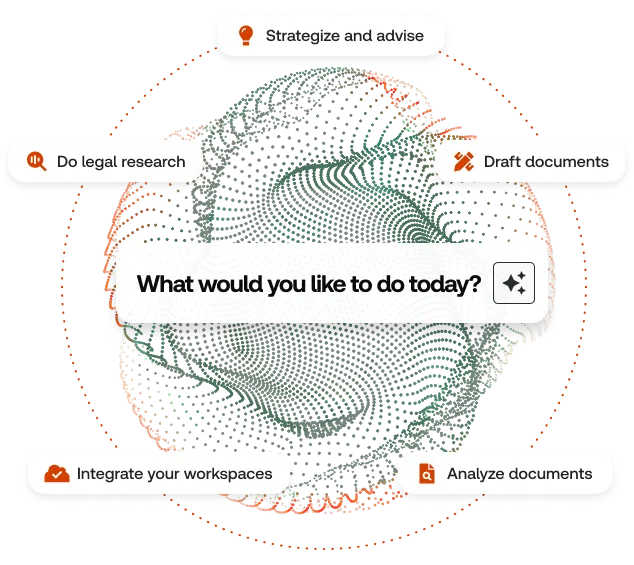
Seamless workflow integration, not bolt-on tooling. The strongest legal AI solutions don’t answer isolated queries – they assist throughout complex, multi-step legal workflows. From research through analysis to drafting, the best tools complete legal work faster by uniting research, analysis, and drafting in one seamless experience. Evaluating purpose-built agentic AI means understanding how it handles task sequencing, escalation to human review, and integration with your existing matter management environment.
Document automation with compliance guardrails. For contract drafting, review, and refinement, leading tools can automate tasks from clause creation to accessing a repository of proven documents – while ensuring compliance and accuracy. The differentiating question is whether the tool’s suggestions are grounded in legally authoritative language, or generated from general statistical patterns in publicly available contracts.
Security architecture that protects client data. Ask vendors directly: Is data isolation structural or configurable per-tenant? What happens to confidential matter information after a session terminates? Does the AI model learn from your inputs? A vendor who cannot answer these questions precisely does not have security by design.
Red flags in vendor conversations
Knowing what good looks like is as important as knowing what to reject. Several patterns in vendor conversations should prompt serious concern:
- Black-box outputs with no source attribution: If an AI tool provides answers without surfacing the underlying sources and reasoning chain, it cannot be reviewed, verified, or defended. Treat this as a serious red flag.
- Vague or evasive data handling answers: A vendor who says “your data is secure” without specifying the architecture of that security, the retention policies, and the model training implications does not have a privacy-by-design system. Ask for documentation.
- No credentialed legal expert involvement in training or refinement: Tools built entirely by engineers without ongoing involvement from practicing attorneys, legal editors, and domain specialists are optimized for fluency – not legal accuracy. Ask for specifics on how legal experts shape the product’s ongoing quality assurance.
- Broad ethics compliance claims without specifics: “Compliant with attorney ethics rules” is not a meaningful claim without specifics regarding confidentiality, competence, and supervision obligations under ABA Model Rules and applicable state rules. Demand details.
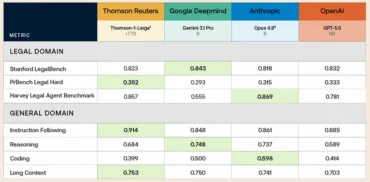
- Generic benchmarks instead of practice-specific performance data: An AI that scores well on broad reasoning benchmarks may still perform poorly on the jurisdiction-specific, practice-area-specific queries that define your work. Insist on testing the tool against your firm’s actual workflow and matter types before deployment.
A framework for pre-deployment evaluation
Rigorous pre-deployment evaluation is not optional – it is a risk management obligation. A structured framework should cover five dimensions:
- Data provenance. Where does the model’s legal knowledge come from? Is it grounded on primary legal sources, or do its outputs rely on secondary summaries and open-web content? This reveals whether the tool meets Pillar 1 of the Fiduciary-Grade standard.
- Accountability design. A well-designed system must recognize its limits, surface uncertainty explicitly, and bring professionals back into the loop rather than generating outputs that overstate reliability. Ask vendors to demonstrate scenarios where the AI declines to answer or escalates to human review. If it never does, that is a red flag.
- Practice-specific testing. A rigorous approach to evaluating LLMs for legal tasks should test the model against your firm’s actual workflows, matter types, and jurisdiction requirements – not just generic demonstrations. Deployment decisions made on curated demos can conceal significant gaps in real-world performance.
- Measurable baseline. Adoption decisions should be driven by data: time on task, quality measures, error rates, and profitability metrics. Define your measurement criteria before deployment, not after.
- Integration fit. Evaluate how the solution integrates with your document management, practice management, and research environments. The best tools augment existing workflows – they don’t disrupt them.
How Thomson Reuters evaluates legal AI
Thomson Reuters evaluates legal AI through CoCoBench, its internal legal AI evaluation standard. CoCoBench tests whether an AI system can complete real legal tasks to a fiduciary-grade standard, not just answer isolated prompts. Built on hundreds of attorney-authored tasks across research, drafting, review, and revision, it includes gold-standard responses written and reviewed by practicing attorneys.
More than 100 legal subject-matter experts and TR Labs researchers contributed to its development, representing more than 15,000 hours of work, and Thomson Reuters uses a fixed core dataset to track performance over time.
What ‘good’ looks like
As AI moves from experimentation into everyday professional use, a higher standard is required. AI for legal professionals must meet the accountability standards built into the profession itself.
When an AI solution meets the Fiduciary-Grade standard, it delivers:
- Outputs you can defend – to a client, a regulator, or a court
- Reasoning you can trace – to authoritative primary sources, not probabilistic synthesis
- Privacy you can guarantee – by architecture, not policy
- Accountability that stays human – the AI supports judgment; professionals own the outcome
Fiduciary-Grade AI is AI a partner can stand behind in a client meeting, and a legal operations director can implement with confidence.
The standard that defines the profession
The emergence of AI does not lower the bar in legal practice – it raises the obligation to apply every new tool rigorously. The profession’s accountability standards were not designed for a world of paper and telephone. They were designed for a world in which clients trust legal professionals with their most consequential decisions. That world has not changed. The tools available in it have.
The question for law firms is not whether to adopt AI – it is which standard to hold it to. For legal professionals navigating that decision, a tool that produces impressive outputs on average is not the same as a tool that produces defensible outputs on demand. In legal practice, “on demand” means every time, on every matter, for every client who depends on the result.
Fiduciary-Grade AI provides the answer: authoritative content, transparent outputs, human accountability, and privacy by design.
CoCounsel Legal: Fiduciary-Grade AI in practice
CoCounsel Legal is Thomson Reuters’ purpose-built AI for law firms – and the market’s most complete expression of the Fiduciary-Grade standard in practice.
Where other tools make promises, CoCounsel delivers against each pillar of the standard in ways that are concrete, verifiable, and built for the demands of professional legal work:
- Authoritative content grounded in Westlaw. Research outputs are grounded in Westlaw and linked to authoritative legal sources, helping attorneys verify assertions against primary legal authority.
- Privacy and security by architecture. Client matter data is protected by isolation built into the system’s structure, not configuration settings – so confidentiality obligations under Rule 1.6 are honored by design, not by policy that can shift.
- Built and refined by legal experts. CoCounsel is continuously developed with Thomson Reuters’ attorney-editors and legal specialists – professionals who have spent decades ensuring legal information meets the accuracy standards practitioners depend on.
- Transparent, reviewable outputs. Outputs are designed to surface supporting sources and provide a reviewable trail, helping supervising attorneys evaluate the basis for the result and meet their obligations under Model Rules 5.1 and 5.3.
The result is AI a managing partner can review with confidence, supervise responsibly, and stand behind when the stakes are high.
In legal work, “almost right” has never been good enough. The AI your firm deploys should be held to the same standard.
Ready to see Fiduciary-Grade AI in action?
Thomson Reuters CoCounsel is purpose-built for legal professionals who cannot afford to be almost right. Explore CoCounsel Legal to see how Fiduciary-Grade AI supports your firm’s research, drafting, and workflow needs – with the accuracy, accountability, and security that the most demanding legal work requires.
CoCounsel Legal brings together grounded legal research, intelligent drafting, and document review in a single platform built to the standards your practice demands. Source-grounded outputs. Transparent review paths. Clear data protections.