There's a new model in legal AI. Unlike the general-purpose models that dominate the headlines, this one serves the work you actually do.
Highlights
- Thomson is Thomson Reuters' domain-specific LLM, trained on Westlaw, Practical Law, Checkpoint, and Reuters content.
- Tabular Analysis, its first deployment in CoCounsel Legal, reviews up to 10,000 documents against 100 questions.
- Fiduciary-Grade AI™ means your data stays private, never trains the model, and every answer is traceable.
Meet Thomson, the large language model from Thomson Reuters, trained specifically on the legal, tax, and compliance content the profession has relied on for decades. It’s the first AI model trained on the authoritative content professionals already trust: Westlaw, Practical Law, Checkpoint, and Reuters. It now powers capabilities inside CoCounsel Legal.
The difference is not simply what Thomson knows. It is what legal professionals can trust it to do. That starts with how the model was built.
Jump to ↓
What makes Thomson different from a general-purpose LLM
Why legal work needs its own AI model
How Tabular Analysis puts Thomson to work in CoCounsel Legal
What Fiduciary-Grade AI™ means for your firm
Built for the work that matters
What makes Thomson different from a general-purpose LLM
Thomson is an in-house, domain-specific large language model that Thomson Reuters built for use in its AI tools. Thomson Reuters trained it on the company’s own content, the same Westlaw and Practical Law material that lawyers cite every day, and validated it in-house before it ever reached a customer.
That training foundation is the point. A general-purpose model approximates legal reasoning from whatever it absorbed from the open internet. Thomson Reuters tuned Thomson to its own standards, then trained it exclusively on its own content, and finally trained it to work directly with its research tools.
The result is a model that reasons from trusted legal authority and expert practice guidance on every matter, not from a general-purpose approximation of it.
How Thomson fits into the broader product picture matters too. In the architecture of Thomson Reuters’ legal AI, Thomson is a dedicated spoke off the CoCounsel Legal hub. CoCounsel Legal remains multi-model by design: Thomson is applied where domain accuracy matters most, and other leading models handle tasks where raw reasoning power is the priority.
The right model for the right job. The first job is high-volume document review. For a deeper look at how legal LLMs are architected for this kind of work, the reasoning and tool-calling research is worth reading.
Why legal work needs its own AI model
The case for a purpose-built model starts with a simple observation: legal work is not general work. A contract review, a due-diligence sweep, and a compliance comparison each demand precision that a general-purpose model cannot deliver.
When the stakes are a client’s matter, “plausible-sounding” is not the same as “correct,” and a model that guesses is a liability.
A legal-trained LLM closes that gap because the sources and standards of the profession shaped it. Thomson reasons from authoritative primary law and trusted practice guidance, the content Westlaw and Practical Law have built over decades, rather than from the open web. That grounding is what makes purpose-built legal AI fundamentally different from a consumer tool wrapped in a legal interface.
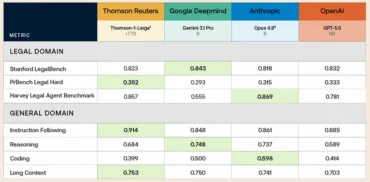
The way you evaluate the model should change too. The right question isn’t only “how capable is it?” but “how well does it perform on the tasks lawyers actually hand it?” Thomson Reuters benchmarked the model against leading general-purpose models before deployment.
The methodology behind evaluating LLMs for legal tasks matters as much as the benchmarks themselves. For firms weighing options, the complete AI legal solution is the broader picture of how a purpose-built model fits into a full legal AI platform.
The training data is what sets Thomson apart from the rest of the field. Other legal AI vendors are building their own models too. The difference is the training data. Thomson draws on the primary law and practice guidance the profession has trusted for decades, not on synthetic data or public web scrapes.
How Tabular Analysis puts Thomson to work in CoCounsel Legal
Thomson’s first public deployment is Tabular Analysis, a CoCounsel Legal capability built for high-volume, structured document review.
The workflow is concrete: review up to 10,000 documents and ask up to 100 questions. You get back a sortable table that you can filter and sort, and you can keep adding questions and documents as the matter develops without starting over. Every answer traces back to a clickable footnote so you can validate the source quickly.
This is where a purpose-built model’s advantage becomes visible: the analysis is grounded in how lawyers actually reason through documents, not in how a general-purpose model approximates it. For teams that already rely on AI in legal research, Tabular Analysis extends that speed into the highest-volume, most tedious part of a matter.
That speed turns into something a firm can measure. This is also where the product earns its place. If you’re evaluating how legal AI fits into your firm’s workflows, Tabular Analysis is the capability to see in action. It turns a model into measurable hours saved on document review.
What Fiduciary-Grade AI™ means for your firm
Trust is the threshold for any tool that touches a client’s matter, and Thomson meets it.
Thomson Reuters describes the model as Fiduciary-Grade AI™: built to the standard the legal profession demands, at a fraction of the typical cost of a frontier model. That standard rests on a few commitments worth naming:
- Your data always stays your data. Secure and private, never exposed to outside access.
- Your inputs never feed model training. What you upload stays in your environment.
- Every answer is traceable to its source. No black-box output. You can validate before you rely on it.
Those commitments are what separate Fiduciary-Grade legal AI from consumer tools. A model trained on in-house legal content, deployed inside a platform built for lawyers, and held to a fiduciary standard is a different category of tool. One designed to be reviewed, cited, and signed. The ingredients of accurate and trustworthy AI are not abstract. They are the difference between a model you can trust on a matter and one you cannot.
Built for the work that matters
Legal work is not general work, and the model behind it should not be either. Thomson is the answer Thomson Reuters built to that problem. CoCounsel Legal is where you use it.

Resource
Learn more about CoCounsel Legal, Tabular Analysis, and how Thomson powers the experience
Learn more ↗