Every credit agreement protection answers a deal that went wrong. This pair shows how one loophole led to the next.
Highlights
- J.Crew blockers now appear in half of deals, a record high that followed years of lender pushback.
- Pluralsight blockers close the gap J.Crew language missed by covering non-guarantor restricted subsidiaries as well as unrestricted ones.
- Each blocker answers the last deal, so precedents that stop at unrestricted subsidiaries may already be a step behind.
Every credit agreement protection answers a deal that went wrong. This pair shows how one loophole led to the next.
Lenders write protections after the fact. A borrower finds a gap, uses it, and the market rewrites the documents so it can’t happen again. J.Crew and Pluralsight blockers are a clear example of that cycle: two terms, nearly a decade apart, tied to the same weakness. According to Noetica’s H1 2026 Capital Markets Radar Report, both are now at record highs.
Jump to ↓
The 2016 deal that opened the door
From lender ask to market norm
How the Pluralsight blocker works
What this means for your next deal

The 2016 deal that opened the door
In 2016, J.Crew was facing financial trouble. It used its unrestricted subsidiary capacity to move material intellectual property, including trademarks, out of the credit group. That released creditors’ security interest in those assets. J.Crew then raised new financing secured by the same IP, which effectively put existing lenders behind the new money.
It was an early liability management transaction, and lenders took note. Their answer, the J.Crew blocker, has two parts: a ban on moving material IP to unrestricted subsidiaries, and a ban on designating IP-holding subsidiaries as unrestricted.
From lender ask to market norm
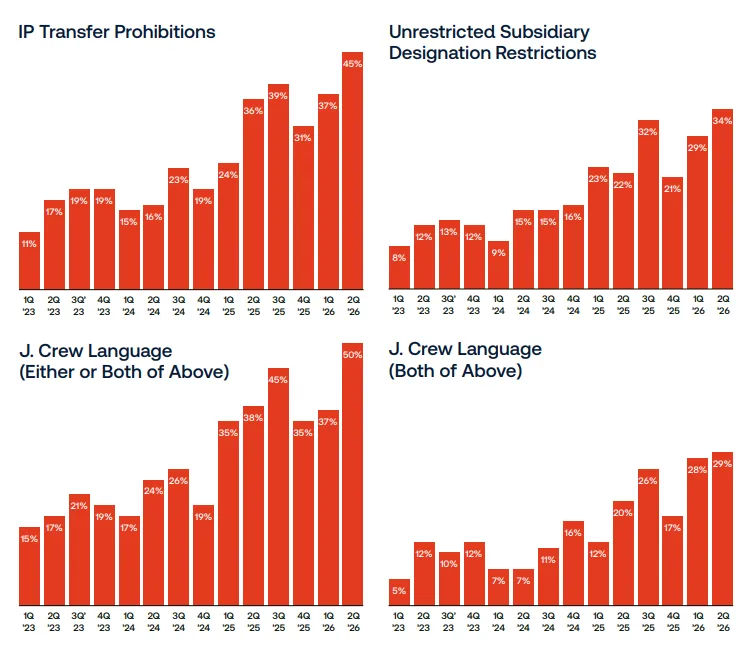
That language is no longer a stretch request. J.Crew protections appeared in 15% of deals in Q1 2023. In Q2 2026, they appeared in half, passing the previous high of 45% in Q3 2025.
The way that half breaks down is worth a closer look. Only 29% of deals in Q2 2026 included both parts of the protection. That means roughly one in five deals carried one part without the other, and in those deals the route the missing part would have closed is still open.
The gap nobody drafted for
J.Crew blockers were built around unrestricted subsidiaries, because that’s where J.Crew sent its IP. That focus left a gap. In 2024, Pluralsight carried out a liability management transaction that moved material IP into a non-guarantor subsidiary, a destination traditional J.Crew language didn’t reach.
The protection hadn’t failed. It had done exactly what it was written to do. It just hadn’t been written for this. Lenders had closed the door J.Crew walked through, and Pluralsight found the next one open.
How the Pluralsight blocker works
Lenders followed a similar playbook to J. Crew and closed the loophole the Pluralsight deal exposed. The Pluralsight blocker bars transfers of material IP or other assets to any party outside the loan group, covering both unrestricted subsidiaries and non-guarantor restricted subsidiaries.
The test shifts from what a subsidiary is called to whether it guarantees the loan. That keeps core value inside the group lenders can reach.
Still early, and moving fast
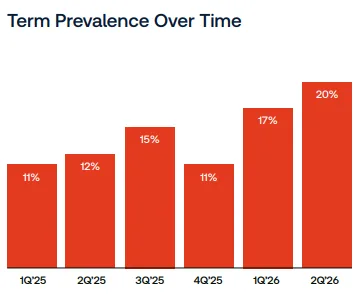
The Pluralsight blocker is newer and less common than its predecessor. It appeared in 11% of deals in Q4 2025 and 20% in Q2 2026. It has started showing up in some private credit deals, but it hasn’t reached the spread of J.Crew language — yet. If the earlier term’s path is any guide, the gap between them may not last. J.Crew language went from aggressive lender ask to expected term, and a protection that’s emerging today can follow the same route.
What this means for your next deal
The pattern matters more than either term. Each blocker answers the last deal, and the H1 2026 data suggests lenders are done waiting for the next one. They’re layering narrow protections alongside broad ones to close every door at once.
Whichever side of the table you’re on, check whether your precedent stops at unrestricted subsidiaries. If it does, it may already be a step behind.
See how your precedents compare to what’s market now. Download the full H1 2026 Capital Markets Radar Report today.