Highlights
- Modern skip tracing platforms replace fragmented, manual searches with unified, real‑time data access.
- Advanced capabilities like intuitive dashboards, machine‑learning‑powered analytics, and batch processing dramatically increase efficiency.
- Built‑in compliance safeguards and transparent sourcing support regulatory requirements.
Investigation work has always required patience, persistence, and sharp analytical thinking. But in today’s environment, those qualities alone aren’t enough. Teams face growing volumes of data scattered across countless sources—corporate registries, public records, proprietary databases, and real-time feeds—each requiring separate logins, different search syntaxes, and manual correlation of results.
This fragmentation creates bottlenecks that slow investigations when time is critical. The manual approach that worked decades ago now represents a competitive disadvantage in an environment where subjects can disappear quickly and opportunities narrow by the hour. Modern investigation teams need technology that matches the pace of today’s challenges.
Jump to ↓
From manual searches to intelligent investigation
Four capabilities that define modern skip tracing
Compliance and the path forward
From manual searches to intelligent investigation
Traditional skip tracing compounded this challenge through labor-intensive processes. Investigators would start with a name or old address and begin tedious work across multiple databases, each with its own interface and documentation requirements. Verifying single pieces of information meant visiting half a dozen separate websites, with challenges multiplying when subjects had common names, used aliases, or moved frequently.
Modern platforms take a different approach. Rather than requiring investigators to hunt across disparate systems, these solutions aggregate public and proprietary records into a single interface. Search once, and the platform queries multiple sources simultaneously, delivering consolidated results that would have taken hours to compile manually.
This shift matters because investigation work is about finding the right information, quickly enough to take action. Whether you’re locating a debtor, verifying a customer’s identity, or tracking down beneficiaries, speed and accuracy determine success for enhanced skip tracing.
Four capabilities that define modern skip tracing
1. Real-time data access with source transparency
Outdated information is worse than no information at all. Modern skip tracing platforms use real-time gateways to ensure investigators work with current data rather than stale records that may be months or years old. A phone number that worked last quarter may be disconnected today; an address from last year may no longer house your subject.
Equally important is knowing where that data comes from. Source transparency allows investigators to verify the reliability of their findings and meet documentation requirements for compliance reporting. When you can show exactly which databases contributed to your results, you build confidence with stakeholders and satisfy regulatory scrutiny.
2. Intuitive dashboards that surface critical details immediately
The best platforms deliver insight, not just data. Contact views display connected phone numbers, addresses, and aliases without separate searches. Critical details like death flags and partial license numbers appear instantly.
Interactive address maps let investigators assess locations visually, zoom to specific properties, and view street-level imagery. This spatial context often reveals patterns that lists of addresses alone would miss. Is the subject moving frequently within a small geographic area? Are multiple associates connected to the same address? Visual representation makes these patterns obvious.
Associate Analytics takes this further by revealing relatives and associates connected to an individual, along with how they’re connected—shared addresses, phone numbers, or other relationships. Rather than manually tracking these connections across separate searches, investigators can explore networks with a single click.
3. Advanced analytics powered by machine learning
Even with bits of information, modern skip tracing platforms can identify subjects through flexible search criteria backed by machine learning. Start with an old phone number, a maiden name, or a previous address, and the system applies intelligent algorithms to find current information.
This capability proves invaluable when subjects have deliberately obscured their trail. Traditional searches would hit dead ends; AI-powered entity resolution finds connections that manual analysis might miss. The technology amplifies investigative instincts, handling the tedious data correlation work so investigators can focus on strategy and analysis.
4. Scalability for high-volume operations
Individual searches matter, but many organizations need to process hundreds or thousands of subjects efficiently. Batch Services address this requirement, allowing teams to upload large volumes for automated processing with ongoing monitoring to keep results current.
Using CLEAR, I was able to locate the missing family in just a few minutes.
Financial Services Firm
This quote was obtained by UserEvidence Survey, 2025 for Thomson Reuters® CLEAR Skip Tracing
That is a time-saving transformation with Thomson Reuters® CLEAR Skip Tracing. Cutting manual review by two-thirds means teams can redirect hours toward higher-value tasks, accelerate decision-making, and keep pace with growing business demands instead of falling behind.
Measuring real-world impact
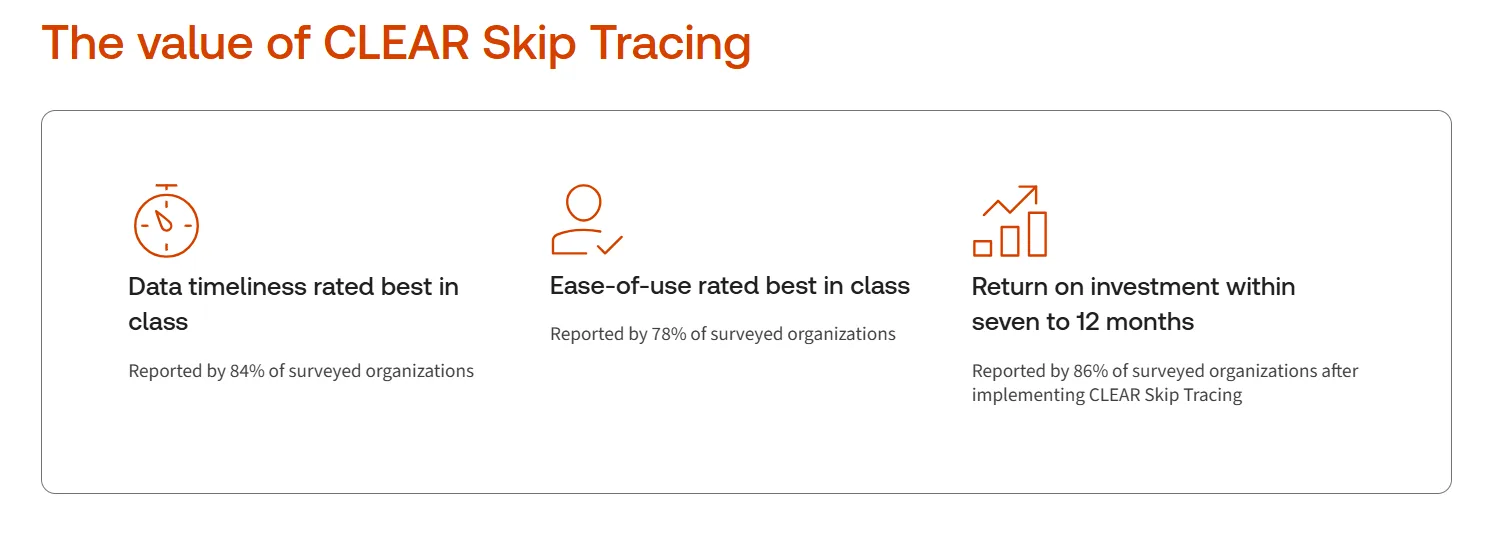
The value of modern skip tracing platforms shows up in measurable outcomes. According to recent survey data, 94% of users reported increased skip tracing efficiency of at least 25% after implementation.1 That efficiency translates directly to operational capacity—the same team can handle more cases or dedicate more time to complex investigations requiring human judgment.
Accuracy matters as much as speed. The same research found that 83% of users reported improved recovery rates of at least 25% and reduced defaults.1 Better data quality, combined with advanced analytics that surface hidden connections, means investigators find subjects who would have remained hidden using traditional methods.
Users consistently report time savings in their daily workflows. One fraud analyst at a large enterprise noted that connection analytics provided by their platform saves “about 30 minutes to one hour a day.” Across a team of ten investigators, that’s 50-100 hours per week redirected from data gathering to strategic investigation work.
This data was obtained by UserEvidence Survey, 2025 for Thomson Reuters® CLEAR Skip Tracing
Compliance and the path forward
Investigation work involves sensitive personal information subject to strict regulations, making compliance as critical as efficiency and accuracy. Modern platforms build compliance safeguards directly into their architecture, including documentation capabilities that create audit trails, transparent sourcing, and customizable report generation that meets specific regulatory requirements.
As regulations evolve, integrated platforms can update compliance protocols centrally rather than requiring each user to track changes and modify workflows individually.
Key questions for your organization
The trajectory is clear: investigation work will involve larger data volumes, more complex fraud, and stricter compliance. Teams using manual processes and disconnected systems will fall behind, while those adopting modern, integrated platforms will meet growing demands with existing resources.
For organizations evaluating skip tracing capabilities, start with honest assessment:
- How much time does your team spend on manual data gathering versus strategic analysis?
- How often do investigations stall because of incomplete information?
- How confident are you in documenting compliance with evolving regulations?
Your answers reveal whether your current approach still serves your needs, or whether it’s time to explore what modern skip tracing platforms deliver.

Disclaimer
Thomson Reuters is not a consumer reporting agency, and none of its services or the data contained therein constitute a ‘consumer report’ as such term is defined in the Federal Fair Credit Reporting Act (FCRA), 15 U.S.C. sec. 1681 et seq. The data provided to you may not be used as a factor in consumer debt collection decisioning, establishing a consumer’s eligibility for credit, insurance, employment, government benefits, or housing, or for any other purpose authorized under the FCRA. By accessing one of our services, you agree not to use the service or data for any purpose authorized under the FCRA or in relation to taking an adverse action relating to a consumer application.