
Firms are rushing to adopt AI — but few have paused to check whether they're actually built to make it work.
Highlights
- Successful AI adoption depends on assessing firms across five critical dimensions, not just deploying tools.
- Strategic alignment, data readiness, technology enablement, risk management, and culture all shape whether AI delivers value.
- Honest assessment of current capabilities is the first step toward turning AI investment into measurable impact.
Generative AI has arrived in legal practice with remarkable speed, but enthusiasm for the technology has outpaced genuine transformation. Law firm leaders face a fundamental challenge: the gap between deploying AI tools and actually achieving meaningful business impact continues to widen.
Moving from early experimentation to sustained competitive advantage requires more than sophisticated technology. It demands that firms deliberately build the capabilities needed to make AI effective. Firms of all sizes have moved past the question of whether to adopt AI. The more pressing question is whether their organizations are truly prepared to extract value from it.
This isn’t about readiness in the abstract. It’s about confronting specific gaps in strategic alignment, data infrastructure, risk management, and cultural change—gaps that prevent even well-funded AI initiatives from delivering results.
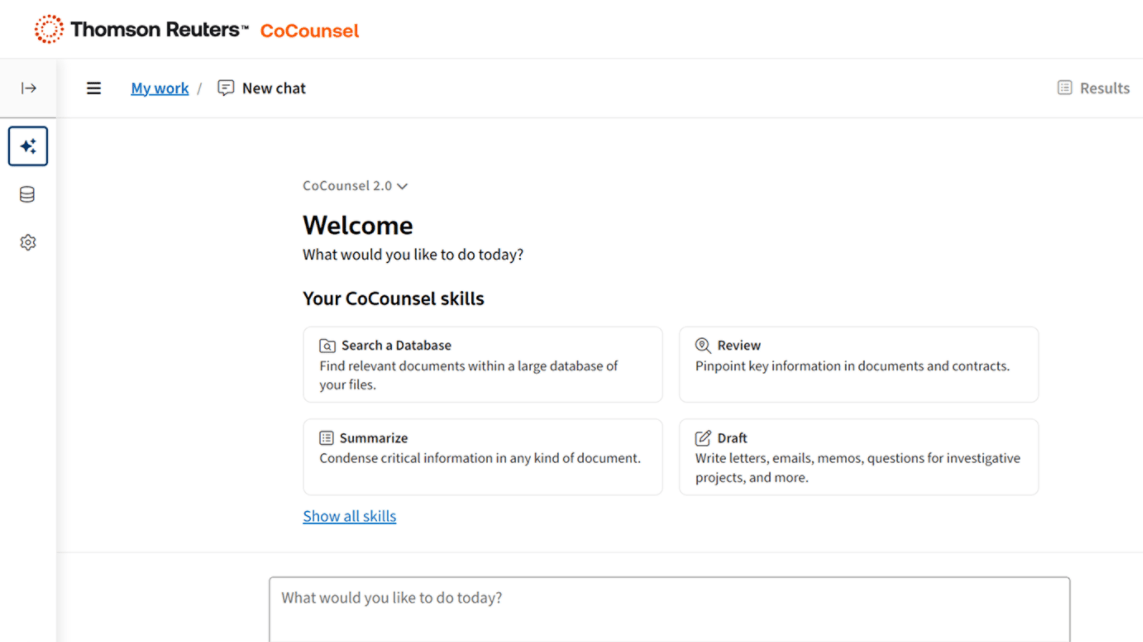
CoCounsel Legal
Try a demo to assess the impact of a Fiduciary‑Grade AI™ solution for your firm
Test impact today ↗
The five critical dimensions
The firms that will dominate the next era of legal practice are those whose leaders recognize that while enthusiastic adoption is essential, converting AI investment into measurable returns requires more. Successful AI implementation requires assessing the firm across five critical dimensions and confronting the areas where capability, confidence, and alignment are still missing. Here’s what that assessment should examine.
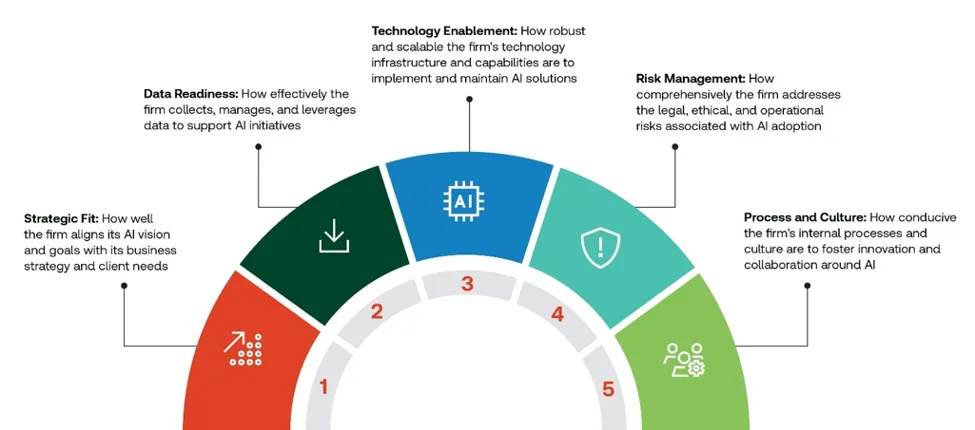
Strategic alignment
Beyond having an AI strategy document, does your leadership team share a clear understanding of specific business outcomes AI should support? Can your practice group leaders articulate how AI initiatives connect to the goals of their groups? Most importantly, do your attorneys have confidence in their ability to explain to clients how AI brings value to the work being delivered?
A unified vision, supported by clear accountability, helps translate AI ambition into focused execution. Without this alignment, even the most sophisticated technology investments fail to generate meaningful returns.
Data readiness
As AI tools become more common, a firm’s exemplar work product and institutional data can become meaningful differentiators. Firms must treat their data as a strategic asset.
Firms of all sizes generate massive amounts of data every day, but is it accessible, accurate, and actionable? In most firms, information is scattered across multiple systems, with no single source of truth. This fragmentation undermines AI effectiveness and prevents firms from leveraging their institutional knowledge as a competitive advantage.
Technology enablement
AI tools cannot deliver value without the infrastructure to make them effective. Your firm must develop a clear provider strategy that aligns tool selection with your business priorities and avoids costly vendor lock-in. You’ll need a technology architecture capable of integrating AI into your existing systems without disruption. And critically, your team must have the technical expertise to actually embed AI into workflows—not just deploy it.
Has your firm established these foundational elements, or does your current infrastructure still lack the technical capability to support integrated AI adoption? Without them, even sophisticated AI tools will underdeliver and create new risks rather than value.
Risk management
The legal profession’s ethical obligations create distinctive challenges for AI implementation that many leaders underestimate. The standards legal professionals expect from AI are clear. Among those surveyed for the 2026 Future of Professionals Report, 96% say it must safeguard confidential data, 94% say its outputs must be grounded in authoritative content, and 90% say it must produce reasoning that can be explained and defended.
Has your firm developed comprehensive frameworks to manage AI-related professional responsibility concerns and do those frameworks provide attorneys with confidence to use AI responsibly in client work? Without clear risk management protocols, even well-intentioned AI initiatives can expose firms to liability, erode client trust, and damage your firm’s reputation in the market. Perhaps not surprisingly, AI adoption accelerates when firms pair innovation with practical risk management. Clear policies, governance frameworks, and usage guidelines reduce uncertainty and provide attorneys with the confidence they need to move from experimentation to meaningful integration.
Process and culture
Perhaps most critically, AI success depends heavily on cultural change, yet many leaders assume this shift will occur organically. It does not. Attorneys increasingly recognize that adoption is more difficult than anticipated.
Has your firm adopted a deliberate change management approach and has it redesigned processes and workflows to incorporate AI in a way that also accounts for pricing, staffing, and how work is delivered? Cultural transformation requires intentional effort and consistent communication. This means investing in upskilling programs, directly addressing attorneys’ concerns about job displacement, and consistently reinforcing that AI competency is now essential to staying competitive.
From assessment to action
Honest assessment is where transformation begins. The firms that win will be those that confront the reality of their current state across all five dimensions, not the ones that merely deploy the most sophisticated tools or invest the largest budgets. A strategy-driven approach means understanding where you actually are before deciding where you need to go.
The gap between leadership perception and operational reality is the space where competitive advantage lives. Law firms of all sizes that take an honest inventory across these five dimensions will be better positioned to translate AI investment into real, measurable impact than those that rely on adoption alone.
Remember the fictional firm from our first article—the one that discovered too late that widespread AI use wasn’t translating into business value and was beginning to cost them work? In our next installment, we’ll follow its transformation and examine the specific actions that turned AI from an underperforming investment into a competitive differentiator.

Thomson Reuters AI Accelerate
Accelerating AI adoption: The transformation service that guides legal leaders from experimentation to lasting ROI
Learn more ↗Lisa Burtch
 Lisa Burtch is a Project Specialist who helps law firms move from strategy to execution through technology adoption and process improvement. She leads initiatives such as AI impact diagnostics, proof of concept implementations, and workflow redesign, with a focus on collaboration and measurable outcomes. Drawing on experience across legal operations, legal education, and business development, Lisa brings a practical and well-rounded perspective to driving transformation.
Tom Snavely

Tom Snavely is a Principal in the Transformation Services and Thomson Reuters Institute’s Advisory Services Team, bringing over 20 years of experience leading strategic transformations across diverse industries. He spent more than a decade in a leadership role within the Strategy Team at an AmLaw 50 law firm, where he helped shape and execute firmwide initiatives.
Tom works closely with law firm executives on high-impact strategic priorities, including AI strategy and readiness, firm combinations, client feedback programs, talent retention, client growth, and service excellence. His work spans all legal practice areas and operational teams, consistently driving revenue growth and cost efficiencies through innovative and often unconventional approaches.
His methodology centers on delivering clarity and actionable insights by objectively interpreting client feedback, analyzing financial performance, and leveraging market intelligence. Tom holds an MBA from the University of St. Thomas and is a frequent speaker at industry webinars and conferences, where he shares practical strategies for aligning organizational culture with strategic goals.
Eric Lein
 Eric is a business process analyst and systems thinker with over a decade of experience helping organizations move from process ambiguity to operational clarity through workflow redesign and transformation. Drawing on an MBA and Psychology degree, as an experienced practitioner in Design Thinking, Six Sigma, and Lean, Eric brings both analytical rigor and a human-centered lens to organizational change. He has worked with law firms at every level from AI strategy workshops with firm leadership to process documentation with front-line teams to drive measurable transformation across the business.