Greatest points of differentiation between: CoCounsel Legal, Clio, Harvey, Legora, Lexis+ with Protégé, and general-purpose AI models such as Claude and ChatGPT
Highlights
- Head-to-head redline analysis helps legal teams evaluate the best legal AI platforms
- Evaluation focuses on legal research, brand and trust, practice management, and published pricing
- Comparisons cover both features and the architecture underneath them
In beta testing ahead of launch, lawyers stopped comparing CoCounsel Legal to other AI solutions. They started comparing it to working with a senior associate.
That is a high bar, and every major provider in legal technology now claims to clear it. Trusted content. Domain expertise. Verifiable output. Examine any vendor site and you might encounter all three.
So, who is right and which solution is the best?
This legal AI redline comparison guide helps you see for yourself the fine print and nuances in language and definitions.
Jump to ↓
How to use the comparison charts
Similar claims, sharper standard
CoCounsel Legal
Fiduciary-Grade AI™ built to the standard the legal profession demands
CoCounsel Legal in action<br /> ↗
How to use the comparison charts
In each section you’ll find head-to-head comparison charts. Each covers the points of differentiation that change the outcome of substantive legal work such as research, drafting, document review, and the defensibility of what you hand to a client or file with a court.
- A green checkmark (✓) means the capability exists
- An orange checkmark (✓) means partial capability exists
- A crossed circle (⊗) means it does not, or not in a form that supports substantive legal work
You’ll see View redline comparison where a redline asset is available. Competitor descriptions link to that vendor’s own published material or to independent trade coverage, so you can check them yourself.
Feature example content here ✓ (View redline comparison)
Another feature or example content here ✓ (View redline comparison)
Example content here ✓
Example content here ⊗
Similar claims, sharper standard
How do you choose the best legal AI tools when every provider makes similar claims along the lines of reliable content, domain expertise, and verifiable output?
Start by reframing each claim with more precision and the differences get sharper:
- Reframe ‘reliable content’ to ‘trusted content, used as a reasoning engine’ where:
- You can see who wrote it, how often it’s updated, and the update history behind it.
- Reframe ‘domain expertise’ to ‘AI built to the standard the profession demands’ where:
- Expert legal judgment is built into how the platform reasons through every matter. This is Fiduciary-Grade AI™, the standard that lets your firm stake its reputation on the work product.
- Reframe ‘verifiable output’ to ‘Defensibility’ where:
- AI shows its work. You can see the reasoning path, click every source, and confirm the authority is still good law.
These three elements come up again and again because they are the questions that surface later — under deadline, in front of a partner, or in front of a judge.
Related to this, it is important to know how well established your AI provider’s access to content is. Useful questions:
- Who owns the content the answers come from?
- If a content license lapses or a funding round changes strategy, what happens to your workflow?
CoCounsel Legal vs. Clio Work
CoCounsel Legal
Built for substantive legal work. It reasons from Westlaw and Practical Law guidance, uses KeyCite as part of its research, and will soon fully connect to practice management through the Smokeball partnership.
Clio Work
Clio offers strong practice management capabilities but does not reason from Westlaw and Practical Law content.
Legal research
Legal content the AI reasons from ✓ (yes)
CoCounsel Legal draws research from Westlaw and Practical Law content that is also how the agent reasons at every step. (View redline comparison)
Legal content the AI reasons from ✓ (partial)
Clio Work draws research from Clio Library.

Why this matters
The difference is what sits on top of the content. Westlaw’s attorney-written headnotes and the West Key Number System give the agent a structured path through the law, and KeyCite is part of the toolset the agent uses as it researches.
Clio’s Cert: negative treatment only, and no trial-level decisions. Clio describes its own workflow as Ask Vincent and validate in Library.
For a deeper research-focused comparison between Clio Work and CoCounsel Legal, read Redline comparison for AI legal research at small law firms.
Brand and trust
Track record in legal ✓ (yes)
Thomson Reuters has served legal professionals for more than 150 years, and Westlaw has been online since 1975. (View redline comparison)
Customer data not used for training ✓ (yes)
CoCounsel Legal is a legal AI where your content and prompts are not used to train it or its models, and third-party model providers are contractually prohibited from training on them.
Track record in legal ✓ (partial)
Clio was founded in 2008 as a practice management company and added legal research through its $1 billion acquisition of vLex, completed in 2025.
Customer data not used for training ✓ (yes)
Clio Work is a legal AI where AI model providers work under zero-retention agreements and never use firm data for training.
Why this matters
Westlaw content has been built and maintained by Thomson Reuters attorney-editors for decades, and that editorial work is what CoCounsel Legal reasons from.
Practice management
Practice management ✓ (partial)
Practice management comes through the Thomson Reuters and Smokeball partnership, which requires subscriptions to both, with add-ons for some features, pairing legal AI with cloud matter management, time capture, and billing. (View redline comparison)
Smokeball holds 4.8 out of 5 from 360 reviews on Capterra.
*All ratings are current as of the publication date
Practice management ✓ (yes)
Practice management comes from Clio Manage, which is sold separately or bundled with Clio Work, pairing legal AI with matter management, invoicing, and client communications.
Clio holds 4.7 out of 5 from 1,751 reviews on Capterra.
*All ratings are current as of the publication date
Why this matters
Practice management is what Clio built first and does well. The question is which direction you want to solve from:
- A practice management platform that is adding legal research capabilities, or
- Westlaw- and Practical Law-powered AI connected to cloud practice management through the Thomson Reuters and Smokeball partnership.
- Since May 2026, joint subscribers can connect their Smokeball documents directly to the classic version of CoCounsel Legal. This integration should be coming to the next generation of CoCounsel Legal in November.
- As of October 28, 2026, joint Smokeball Archie and CoCounsel Legal or Westlaw Advantage subscribers can use Westlaw Deep Research directly in Smokeball.
Few combinations of technology in the small to mid-size law firm market will bring together this depth of legal content and AI capability with this breadth of practice management functionality through the Thomson Reuters and Smokeball partnership.
CoCounsel Legal vs. General-purpose AI models
CoCounsel Legal uses leading large language models as part of a broader legal system.
⊗ What this is not: a model-versus-model comparison
✓ What this is: General-purpose horizontal AI infrastructure plus tools versus CoCounsel Legal as a Fiduciary-Grade AI system built for professional legal work.
For example:
- Claude: general-purpose AI for running the business
- CoCounsel: Fiduciary-Grade AI for professional legal work
Thomson Reuters and Anthropic are the only combination that delivers both.
Legal research
Legal content the AI reasons from ✓ (yes)
CoCounsel Legal draws research from Westlaw and Practical Law content that is also how the agent reasons at every step. (View redline comparison)
Legal content the AI reasons from ✓ (partial)
Claude and ChatGPT are general-purpose AI where legal content arrives through connectors, such as Claude for Legal’s research connectors and Astra for Law’s legal search index built on CourtListener.
Why this matters
What Fiduciary-Grade AI ensures is that the work product is grounded in authoritative content the firm already trusts, validated by a citator before it reaches you, and traceable to its sources.
Brand, trust, vendor risk
Track record in legal ✓ (yes)
Thomson Reuters has served legal professionals for more than 150 years, and Westlaw has been online since 1975
Customer data not used for training ✓ (yes)
CoCounsel Legal is a legal AI where your content and prompts are not used to train it or its models, and third-party model providers are contractually prohibited from training on them.
Track record in legal ✓ (partial)
Anthropic launched Claude for Legal in May 2026, and OpenAI launched Astra for Law in September 2026.
Customer data not used for training ✓ (partial)
Claude and ChatGPT are general-purpose AI where business and enterprise plans exclude customer data from training, while consumer plans depend on each user’s settings.
Why this matters
CoCounsel Legal’s no-training on data is universal to all CoCounsel Legal plans, while with general-purpose AI, the protection depends on which tier the firm procures, and any employee who uses a personal consumer subscription for client work falls outside that protection.
The risk isn’t the enterprise product; it’s the shadow AI problem where attorneys use personal accounts for convenience.
Practice management
Practice management ✓ (partial)
Practice management comes through the Thomson Reuters and Smokeball partnership, which requires both subscriptions, pairing legal AI with cloud matter management, time capture, and billing. (View redline comparison)
Practice management ⊗ (no)
Claude and ChatGPT are general-purpose AI assistants, not practice management systems.
Why this matters
CoCounsel Legal takes a partnership route: Thomson Reuters and Smokeball are building the integration together, so Westlaw- and Practical Law-powered AI works alongside cloud matter management, time capture, and billing with both vendors supporting it.
CoCounsel Legal vs. Harvey
CoCounsel Legal
CoCounsel Legal’s planning, theory formation, and citation validation all run against 1.9 billion Westlaw and Practical Law documents that Thomson Reuters owns.
Harvey
A capable, fast-growing enterprise platform with strong document-set review and a mature custom workflow builder.
Legal research
Legal content the AI reasons from ✓ (yes)
CoCounsel Legal draws research from Westlaw and Practical Law content that is also how the agent reasons at every step. (View redline comparison)
Legal content the AI reasons from ✓ (partial)
Harvey draws research from public U.S. court opinions and licensed statutes and regulations, with premium case law through paid partners.
Why this matters
Harvey assembles legal sources from several places: a corpus of public U.S. court opinions, Wolters Kluwer statutes and regulations, citation mapping in Harvey Graph, Midpage content with a subscription, and LexisNexis content through Ask LexisNexis.
CoCounsel Legal gives you an agent that reasons with Westlaw and Practical Law content Thomson Reuters owns and maintains.
Harvey’s own legal research guide makes the case for a citator: confirming good law means running each authority through one, and it names Shepard’s and KeyCite as the established tools.
For more research-focused comparisons, see Redline comparison for AI legal research at small law firms.
Brand and trust
Track record in legal ✓ (yes)
Thomson Reuters has served legal professionals for more than 150 years, and Westlaw has been online since 1975. (View redline comparison)
CoCounsel holds a 4.8 out of 5 rating from 114 reviews on G2.
*All ratings are current as of the publication date
Customer data not used for training ✓ (yes)
CoCounsel Legal is a legal AI where your content and prompts are not used to train it or its models, and third-party model providers are contractually prohibited from training on them.
Track record in legal ✓ (partial)
Harvey was founded in 2022 and raised $550 million at a $15.5 billion valuation in September 2026.
Harvey holds a 4.2 out of 5 rating from 34 reviews on G2.
*All ratings are current as of the publication date
Customer data not used for training ✓ (yes)
Harvey is a legal AI where inputs, outputs, and documents are not used to train underlying models, backed by SOC 2 Type II, ISO 27001, ISO 27701, ISO 42001, and AIUC-1 certifications.
Why this matters
Harvey is well funded, growing quickly, and has strong security credentials. Customers rate both platforms well.
Before you build client workflows on any platform, ask who owns the content the answers come from, and what happens to your workflows if a content license lapses or a funding round changes strategy.
Practice management
Practice management ✓ (partial)
Practice management comes through the Thomson Reuters and Smokeball partnership, which requires both subscriptions, pairing legal AI with cloud matter management, time capture, and billing. (View redline comparison)
Practice management ✓ (partial)
Practice management comes through its Connector Library in which Intapp covers ethical walls, and Aderant covers time and billing, rather than offering practice management itself.
Why this matters
Harvey’s connectors suit large firms that already run their own time, billing, and matter systems. For small and mid-size firms that want legal AI and practice management working together, CoCounsel Legal connects to Smokeball.
CoCounsel Legal vs. Legora
CoCounsel Legal
CoCounsel Legal brings together 1.9 billion Westlaw and Practical Law documents, the editorial layer that enhances them, KeyCite validation, and an agent built to reason over all three. Research, drafting, and citation integrity sit inside one system, so verifying the work is the default path rather than a separate step.
Legora
A fast-growing platform that now collects U.S. appellate case law from courts and official sources and licenses statutes and regulations from Wolters Kluwer. Its legal ontology is in limited beta, with general availability expected in Q4 2026, and it has announced an AI-native citator without a release date.
Legal research
Legal content the AI reasons from ✓ (yes)
CoCounsel Legal draws research from Westlaw and Practical Law content that is also how the agent reasons at every step. (View redline comparison)
Legal content the AI reasons from ✓ (partial)
Legora draws research from U.S. appellate case law collected directly from courts and official sources, with comprehensive trial-court opinions still on its roadmap and statutes licensed from Wolters Kluwer.
Why this matters
Both of us now say citation integrity matters. The difference is a citator in production versus one that has been announced. Legora names the obstacle itself: “In the US, access to citable case law is constrained by the companies that own the official reporters.” KeyCite has been relied on by courts and firms for decades, and with a citator the track record is the product.
Brand and trust
Track record in legal ✓ (yes)
Thomson Reuters has served legal professionals for more than 150 years, and Westlaw has been online since 1975. (View redline comparison)
CoCounsel holds a 4.8 out of 5 rating from 114 reviews on G2.
*All ratings are current as of the publication date
Customer data not used for training ✓ (yes)
CoCounsel Legal is a legal AI where your content and prompts are not used to train it or its models, and third-party model providers are contractually prohibited from training on them.
Track record in legal ✓ (partial)
Legora was founded in 2023 and raised $550 million at an $8.8 billion valuation in October 2026, with more than 1,000 employees across 18 offices.
Legora holds a 4.3 out of 5 rating from 47 reviews on G2.
*All ratings are current as of the publication date
Customer data not used for training ✓ (yes)
Legora is a legal AI where your data is not used to train or fine-tune any AI models, backed by ISO 27001, ISO 42001, and SOC 2 Type II certifications.
Why this matters
Legora’s investment is serious: a $550 million raise in October 2026, more than 1,000 employees, and a legal ontology in development. That scale is arriving fast.
Thomson Reuters already has the editorial operation, support, and track record in place. Ask any vendor how its roadmap would change if its funding or content partnerships did.
Practice management
Practice management ✓ (partial)
Practice management comes through the Thomson Reuters and Smokeball partnership, which requires both subscriptions, pairing legal AI with cloud matter management, time capture, and billing. (See redline comparison)
Practice management ✓ (partial)
Legora has announced integrations with Intapp Time and Laurel rather than offering practice management itself.
Why this matters
Legora isn’t a practice management system. Its integrations let work done in Legora flow into time capture and billing tools a firm already uses. CoCounsel Legal takes a partnership approach, pairing Fiduciary-Grade AI with Smokeball’s cloud practice management.
CoCounsel Legal vs. Lexis+ with Protégé
CoCounsel Legal
Grounded in 1.9 billion Westlaw and Practical Law documents with attorney-authored headnotes and the Key Number System. KeyCite good-law validation runs inside the agent’s reasoning, and in Deep Research, Verify then checks whether the authority actually supports the point.
Lexis+ with Protégé
Both platforms own significant primary law. The differences are in structure and depth of verification. Shepard’s Verify confirms a cited authority “exists and is retrievable at the point of use.”
Legal research
Editorially authored and classified content ✓ (yes)
Westlaw headnotes are written by attorney-editors and classified under the West Key Number System — a universal index of topics and Key Numbers, consistent across every jurisdiction. (View redline comparison)
Editorially authored and classified content ✓ (partial)
LexisNexis headnotes are written by attorney-editors under a 29-step editorial process in the language of the court and classified under Lexis Topics — a platform-specific index not organized against a universal digest outline.
Why this matters
Both platforms own significant primary law and both employ attorney-editors to create headnotes. The difference is the classification system underneath:
Westlaw headnotes are classified under the West Key Number System — a universal digest outline, consistent across every jurisdiction, with approximately 400 topics and 100,000 key numbers — that lets the AI reason across issues precisely. In practice, one key number surfaces the same legal issue in every jurisdiction, giving the AI a structured path to analogous authority across jurisdictions.
Lexis headnotes are classified under Lexis Topics, a platform-specific system that uses descriptive phrases rather than a numbered digest outline.
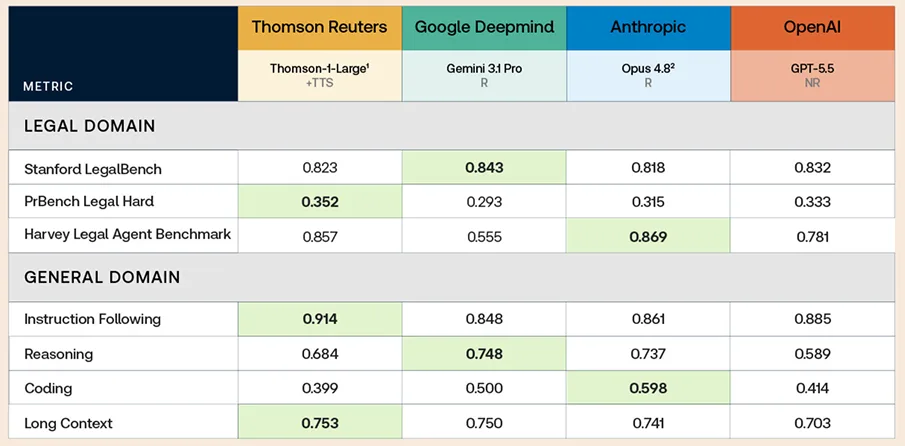
Meet Thomson, our proprietary LLM
#1 on the hardest legal benchmark. Purpose-built for legal, tax, and regulatory work.
Receive future updates ↗
Brand and trust
Track record in legal ✓ (yes)
Thomson Reuters has served legal professionals for more than 150 years, and Westlaw has been online since 1975. (View redline comparison)
CoCounsel holds a 4.8 out of 5 rating from 114 reviews on G2.
*All ratings are current as of the publication date
Customer data not used for training ✓ (yes)
CoCounsel Legal is a legal AI where your content and prompts are not used to train it or its models, and third-party model providers are contractually prohibited from training on them.
Track record in legal ✓ (yes)
LexisNexis has offered online legal research since 1973. LexisNexis holds 4.0 out of 5 from 133 reviews on G2.
*All ratings are current as of the publication date
Customer data not used for training ✓ (yes)
Lexis+ with Protégé is a legal AI where LexisNexis states it never uses customer data to train AI models.
Why this matters
Thomson Reuters and LexisNexis have both served the legal profession for decades, so the brand question here is about direction. CoCounsel Legal keeps Westlaw content, KeyCite, and the agent that reasons over them in one system.
Practice management
Practice management ✓ (partial)
Practice management comes through the Thomson Reuters and Smokeball partnership, which requires both subscriptions, pairing legal AI with cloud matter management, time capture, and billing. (View redline comparison)
Practice management ✓ (partial)
Lexis+ with Protégé is a legal AI where practice management isn’t part of the product, and its integrations focus on Microsoft 365 and document management.
Why this matters
Practice management isn’t part of Lexis+ with Protégé. CoCounsel Legal connects to cloud practice management through the Thomson Reuters and Smokeball partnership.
Pricing
Pricing transparency is itself a differentiator, and it varies widely across this set.
Published pricing? ✓ Yes
- Pricing for 1-10 attorney law firms available.See CoCounsel Legal plans
Published pricing? ⊗ No
- No available published Clio Work pricing.
- Free trials available.
Published pricing? ⊗ No
- Quote-based and add-on for Ask LexisNexis.
Published pricing? ⊗ No
- Consumption-based pricing is now the default model for Agent Pro (launched June 2026), where cost scales with usage rather than a flat subscription.
- Third-party buyer guides report quote-based, demo-gated, seat minimums, and no public free trial.
Published pricing? ⊗ No
- Quote-based, and free trials available.
Published pricing? ✓ Yes
- Low per-seat cost.
- The cost that matters is the review, rework, and risk it transfers to you.
When you compare, compare the total cost of ownership, including:
- License
- Implementation
- Workflow building
- Training
- Hours your team spends verifying output
The cheapest tool on the invoice is often the most expensive one on the matter.
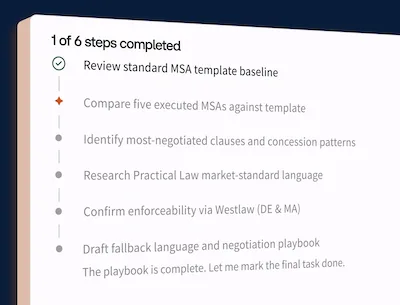
An investment that gets stronger over time
New capabilities, expanding content paired with Fiduciary-Grade AI
See CoCounsel Legal plans ↗