
Automatic guarantee releases let borrowers shed guarantors with a well-placed share transfer, but lenders are catching on, and “anti-PetSmart” clauses are making a quiet comeback.
Highlights
- Automatic guarantee releases let subsidiary guarantors drop their guarantee the moment they stop being wholly owned — sometimes triggered by transferring just one share.
- Automatic release prevalence jumped from 3% of deals in Q3 2023 to 17% in Q3 2024.
- 'Anti-PetSmart' protections against this loophole grew alongside it, from 5% to 19% of deals over the same period.
What if you could stop paying your mortgage, and keep your house, just by selling your front door? Welcome to the world of “Automatic Guarantee Releases” in corporate credit.

Report
Navigate capital market dynamics with confidence
See if your guarantees can be released early ↗
The front door loophole
When someone takes out a mortgage, the basic arrangement is simple: make payments, and the bank doesn’t foreclose. But what if the mortgage agreement also said that selling any part of the house released the bank’s ability to foreclose altogether? The homeowner’s leverage becomes obvious: sell the front door, stop paying, and keep the house.
“Automatic guarantee releases” work the same way for subsidiary guarantors — they release the guarantee the moment a subsidiary ceases being wholly owned by the credit group. In many cases, all it takes is transferring a single share of subsidiary stock for lenders to lose a significant portion of their credit support.
Two trends rising together
Certain deals include “anti-PetSmart” terms in response — named for the 2018 maneuver in which PetSmart quietly moved a large stake in its valuable subsidiary Chewy out of the credit group, stripping collateral from lenders using loopholes in its loan documents. These terms either restrict the automatic release of non-wholly-owned subsidiary guarantors, or require that any transaction resulting in a non-wholly-owned subsidiary have a bona fide business purpose.
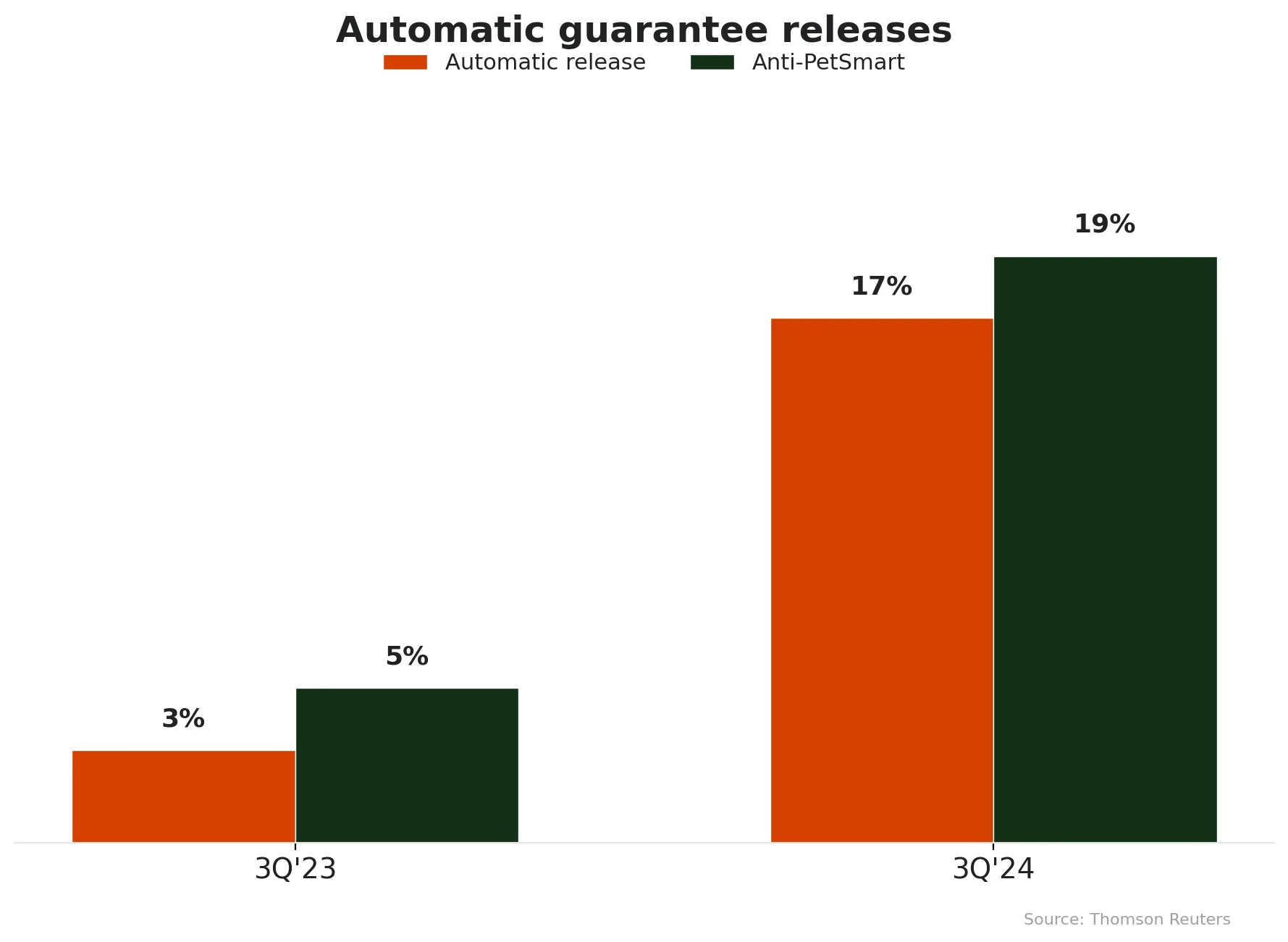
In Q3 2024, 17% of publicly filed high-yield credit agreements automatically released subsidiary guarantors that ceased to be wholly owned — a sharp increase from just 3% in the same quarter of 2023. But the rise in automatic releases was matched almost step for step by anti-PetSmart protections, which grew from 5% to 19% over the same period. Lenders appear to be closing the loophole nearly as fast as it opens.
For more deal-term benchmarking like this, explore the latest Capital Markets Radar Report from Noetica, now part of Thomson Reuters.