
Please remain calm as the incremental debt exits ahead of you
Highlights
- Incremental debt terms typically require that new debt not mature earlier than existing debt, protecting original lenders' place in line.
- 'Inside maturity' baskets carve out an exception, letting a portion of incremental debt mature before the existing debt.
- Across a sample of 86 high-yield credit agreements in Q3 2023 and 53 in Q3 2024, zero publicly filed deals included this carveout in either quarter.
Most people will let someone rushing for a flight cut ahead of them in the security line. But would you still grant that favor if you were also at risk of missing your own flight? That’s the dilemma facing lenders with “Inside Maturity Incremental Debt” in credit deals.

Report
Navigate capital market dynamics with confidence
See what's inside your incremental debt terms ↗The standard protection, and its exception
“Incremental debt” terms permit a borrower to incur additional debt while current debt is outstanding. There are good reasons to allow this: more available capital typically increases growth opportunities and decreases the likelihood of default. These terms routinely include a standard safeguard, though — incremental debt may not have an earlier maturity date than the original debt, ensuring the new debt doesn’t jeopardize the original lenders’ repayment.
Recent deals have introduced an exception to that safeguard: an “inside maturity basket” permits a portion of incremental debt to mature before the original debt. If the borrower runs into trouble, the inside-maturity debt gets paid back first, leaving original lenders chasing a plane that’s already left the gate.
Where the term actually shows up
Noetica’s technology analyzes deal data nightly, adding relevant data points to a knowledge graph of more than 100 million deal terms. So far, this particular term change has stayed confined to private markets.
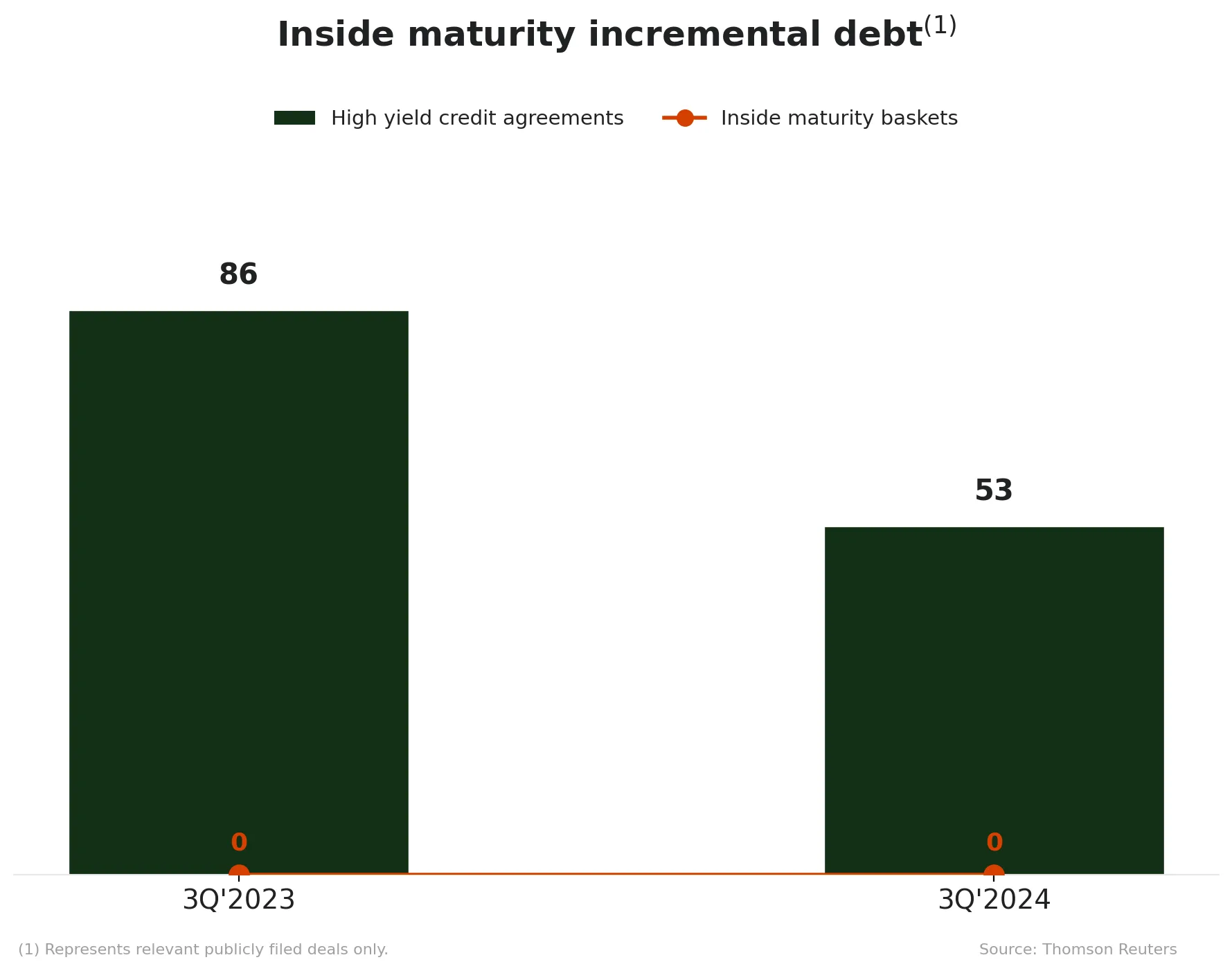
Across both Q3 2023 and Q3 2024, zero publicly filed high-yield credit agreements permitted this type of earlier-maturing debt — out of 86 and 53 deals reviewed, respectively. For now, the term remains a private-markets phenomenon, but it’s worth watching for signs it starts crossing over.
For more deal-term benchmarking like this, explore the latest Capital Markets Radar Report from Noetica, now part of Thomson Reuters.