
Greatest points of differentiation between: CoCounsel Legal, Clio, Lexis+ with Protégé, and general-purpose AI models such as Claude and ChatGPT
Highlights
- Objective, head-to-head redline analysis supports small law teams in making informed decisions about a legal research AI solution
- Evaluation focuses on authoritative content, expertise, and defensibility
AI tools for research tasks are not all the same, but Fiduciary‑Grade AI™ is Thomson Reuters standard for how AI should work in high‑stakes professions.
This blog is structured as a guide for legal researchers, technologists, or partners in small firms evaluating AI options for legal research.
In each section, you’ll find charts with redline comparisons that highlight the points of differentiation that directly affect substantive legal research outcomes.
Please take note of the following template which you will see throughout the guide. You may click on “view redline comparison” where applicable.
Example comparison template:
Heading ✓
Example content here — see full comparisons below. (View redline comparison)
Heading ✓
Example content here — see full comparisons below.
Heading ⊗
Example content here — see full comparisons below.
Heading ✓
Example content here — see full comparisons below.
Heading ⊗
Example content here — see full comparisons below.
Heading ✓
Example content here — see full comparisons below.
Jump to ↓
How to choose the right legal research AI
CoCounsel Legal
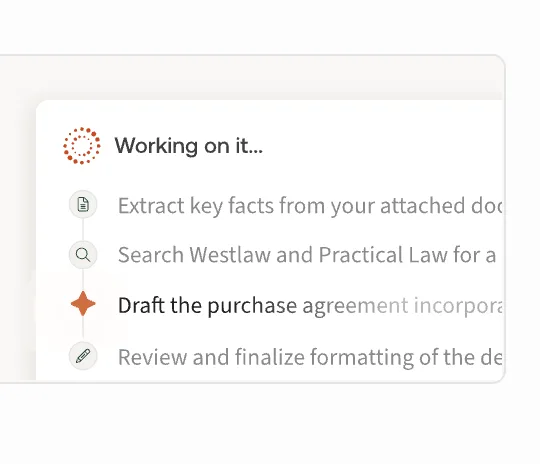
Research, cite with confidence, and defend every argument with Fiduciary-Grade AI™ AI grounded in Westlaw and Practical Law content your small firm already trusts
Win back the hours you lose to research ↗
CoCounsel Legal vs. Clio Work
CoCounsel Legal
Deep Research in CoCounsel Legal reasons, plans, and delivers Fiduciary-Grade AI legal research grounded in Westlaw and Practical Law content that’s supported by more than 1,200 full-time attorney-editors.
Clio Work
Vincent by Clio performs research using Clio Library, the legal data collection acquired from vLex. Vincent will answer natural-language questions using Agentic Mode.
Content quality
Editorial coverage ✓
Research grounded in Westlaw for primary law, select secondary sources and current awareness; and in Practical Law, for know-how and current practice.
Westlaw editorial enhancements include 100+ years of continuous updates, including Headnotes, Notes on Decisions, indexes, and the Key Number System. (View redline comparison)
Know-how guidance ✓
CoCounsel with access to Practical Law resources created and maintained by over 650 expert attorneys globally. (View redline comparison)
Editorial Coverage ✓
Research grounded in Clio Library content and some exclusive publications. Includes primary law content acquired through the Vlex acquisition, and U.S. materials largely sourced from FastCase which provides broad, basic, and free research.
Know-how guidance ✓
Vincent with access to Clio Library’s books, journals, legal commentary, and practice guides; but no access to expert know-how guidance material

Why this matters in research
Agentic legal research must be transparent and grounded in the right content that’s current, accurate, and verifiable to support ethical obligations, no matter your firm size.
Deep research
Deep research capability ✓
Deep Research can 1) reason through complexity, 2) access and verify legal content, and 3) provide transparency in how conclusions are reached.
Deep Research is grounded in authoritative Westlaw and Practical Law content. (View redline comparison)
Deep research capability ✓
Clio Work, powered by Vincent uses agentic mode to plan and execute workflow steps autonomously.
Clio Work, powered by Vincent is grounded in Clio Library, which includes AI-generated case analysis.
Why this matters:
Bona fide deep research capability can deliver on multi-jurisdictional compliance questions, complex statutory interpretations, and urgent motion research. You can monitor progress on how CoCounsel Legal is being reimagined to a fully agentic infrastructure.
Defensibility
Headnotes ✓
Westlaw attorney editors identify the important issues of law in a case and provide descriptions summarizing the facts, holding, and reasoning being applied. Headnotes by editors have been written and maintained for over 100 years. (View redline comparison)
Citator ✓
KeyCite, the industry’s most comprehensive citation service, ensures cases, statutes, and regulations are good law by relying on 100 years of editorial enhancements.
Negative treatment ✓
KeyCite provides flags for multiple levels of negative treatment.
- Yellow flags indicate a case has negative references but has not been reversed or overruled.
- Red flags warn that at least one of the points of the case is no longer good law.
- Red-striped flags indicate that a case has been partially overruled and provides direct access to the relevant language in the overruling case.
- Blue-striped flags signals a case in the federal appeals process.
KeyCite also provides a KeyCite Overruling Risk icon where there is a possibility of implicit negative treatment and KeyCite Cited With, identifying cases that have a pattern of being cited together.
Headnotes ✓
Clio Library uses Vincent AI to provide automated headnotes in a Case Analysis block.
Citator ✓
Clio’s US Case Citator (formerly known as CERT) uses citation analysis, chronological tracking, and color-coded signals to verify the status and authority of legal decisions.
Negative treatment ✓
Clio’s citator aims to identify the most negative treatment available for a case and focuses on red/warning and orange/questioned treatments. It relies on citation frequency to ensure analysis is grounded in authority. Clio’s AI uses citation analysis, chronological tracking, and color-coded signals to verify the status and authority of legal decisions.
Why this matters:
Your citator is your best protection against hallucinations and one of the strongest pillars underneath your legal arguments. You need a citator that provides accurate, and up-to-date cites you can both rely on and verify quickly.
CoCounsel Legal vs. Lexis+ with Protégé
CoCounsel Legal
CoCounsel Legal Deep Research reasons, plans, and delivers Fiduciary-Grade AI legal research.
It allows smaller teams to find an answer to a legal question and be confident that the research is supported by trusted editorial content and verifiable. It also supports small firms to get up to speed quickly.
Lexis+ with Protégé
Deep Research is available in Best Fit mode, where the AI chooses the LLM model to be used, and functions on OpenAI o3 and GPT-5 only. It is only available when web sources are selected as grounding content.
Content quality
Editorial coverage ✓
Research grounded in Westlaw for primary law, select secondary sources and current awareness, with editorial enhancements that include 100+ years of continuous updates, including Headnotes, Notes on Decisions, indexes, and the Key Number System. (View redline comparison)
Know-how guidance ✓
Practical Law resources are created and maintained in a rigorous editorial process by more than 650 full-time attorney-editors. (View redline comparison)
Editorial Coverage ✓
Research grounded in LexisNexis content, for primary law, select secondary sources and current awareness, with editorial enhancements including LexisNexis headnotes and Shephard’s citing decisions.
Know-how guidance ✓
Lexis Practical Guidance resources created by a mix of internal editors and external contributor base.
Why this matters in research
You need research grounded in authoritative sources, to have the strongest, most defensible work-product.
– Verified G2 User in Legal Services, Small Business (50 or fewer emp.)
Deep research
Deep research capability ✓
Deep Research in CoCounsel was the legal industry’s first agentic AI research capability — built to reason, plan, and deliver comprehensive legal research results grounded in Westlaw and Practical Law content. (View redline comparison)
Deep research capability ✓
Lexis’s deep research capability is available only in Best Fit mode, where the AI chooses the model, and runs only on OpenAI o3 and GPT-5. It is only available when web sources are selected as grounding content.
Why this matters in research
You want a research tool that can take your query, explain how it will execute that project, and deliver a transparent report with citations and reasoning.
Defensibility
Defensibility and easy verification ✓
Deep Research responses are always grounded in Westlaw and Practical Law content, not web sources. Sources are always hyperlinked and KeyCite verification is always integrated. (View redline comparison)
Defensibility and easy verification ✓
Deep research on Lexis+ with Protégé appears to be available only when web sources are selected.
Why this matters in research
Every lawyer has an ethical duty to validate AI-generated research output.
Deep Research in CoCounsel Legal is always grounded in trusted content and hyperlinks to its sources, so you can confirm output accuracy.
CoCounsel Legal vs. General-purpose AI models
General-purpose AI
General-purpose AI models such as Claude and ChatGPT provide powerful AI foundations; they’re horizontal AI infrastructures plus tools.
It’s great for broad knowledge work and experimentation. The best such tools offer MCP connectors to hook into standard business productivity software, the firm’s own tools and data repositories, and third party AI tools.
CoCounsel Legal
CoCounsel Legal can build vertically on top of AI foundations like Claude, offering easy access to Westlaw Deep Research capabilities that are engineered to think like a lawyer, grounded in authority, and defensible by design.
CoCounsel Legal vs. Claude
CoCounsel Legal uses leading frontier models like Claude as part of a larger Fiduciary-Grade AI solution.
This is not a model comparison between: Claude models versus CoCounsel Legal models.
Claude itself is a powerful frontier AI model suitable for a broad range of run-the-business tasks and a growing library of integrations.
Firms should not think of using CoCounsel Legal or Claude, but instead improve their business workflows with Claude and accelerate their legal research tasks with the power, grounding, and defensibility of CoCounsel Legal.
For the comparison below, we’re focusing on legal research taskswhere:
- Small firms need to know where answers came from
- How to trace them back to sources, and
- What the underlying legal argument is
Data
Data privacy and security ✓
Built for legal professionals working with sensitive legal and business information.
Customer data is not used to train AI models, and data is encrypted both in transit and at rest.(View redline comparison)
Data privacy and security ✓
Built for broad knowledge work and as a configurable AI ecosystem.
Customers using consumer plans may be responsible for configuring and monitoring privacy settings, implementation choices and security controls to ensure protection of sensitive legal and business information.
Why this matters in research
In legal, trust means certainty about the proper handling of sensitive client and business data.
Content quality
Accuracy ✓
CoCounsel Legal produces Deep Research responses grounded in Westlaw primary law, select secondary sources and current awareness, and Practical Law know-how maintained by more than 650 full-time attorney-editors. (View redline comparison)
Legal specific ✓
Great for high-stakes legal work since 1,200 full-time attorney-editors continually maintain and update Westlaw and Practical Law content as the foundation for legal research questions. (View redline comparison)
Westlaw Deep Research offers an MCP integration with Claude which provides access to Thomson Reuters Fiduciary-Grade AI through Claude.
Accuracy ✓
Claude produces responses grounded in general web content rather than authoritative proprietary legal research sources.
Legal specific ✓
Great for experimentation and non-technical legal work but lacks proprietary expert content needed for high-stakes contexts if used natively.
Why this matters in research
Claude is a capable general-purpose AI assistant and can help firms accelerate their business processes and manage many of their workflows.
For high-stakes legal output, however, legal buyers must distinguish between models that deliver fluent, plausible outputs based on vast Internet sources and Fiduciary-Grade AI grounded in trusted legal content and legal editorial oversight.
Defensibility
User verification design ✓
Built-in design to support transparent, citation-backed legal work making user’s verification process natural and easy. Deep Research outputs are grounded in Westlaw and Practical Law content. (View redline comparison)
Citations ✓
Provides consistent citations throughout, and in research workflows those citations connect directly into the Westlaw ecosystem, including verification tools like KeyCite and editorial enhancements such as the Key Number System.
Process ✓
When users check and verify citations, the validity of the answers they find is reinforced by process, not just interface design.
User verification design ✓
Optional feature to support citations with most Claude models. Its outputs can use MCP connectors for multiple legal research tools, including Deep Research in CoCounsel Legal. (View redline comparison)
Citations ✓
Customers must enable citations as a feature for supplied documents, and in research workflows those citations may not be grounded in authoritative content or verified. (View redline comparison)
Process ✓
Verification process is generally more manual and less legally structured.
For example, Claude Cowork may require more user verification, rework, and manual quality control.
Why this matters in research
Lawyers need citations you can check and a chain of reasoning you can follow, based on the sources small law firms already trust.
CoCounsel Legal vs. ChatGPT
Courts are increasingly sanctioning lawyers for unverified AI‑generated court filings, with over 1,300 identified cases worldwide. Penalties include fines ranging from a few thousand dollars to six‑figure penalties, along with dismissals, public reprimands, filing restrictions, and disciplinary referrals.
ChatGPT
General-purpose LLM tools, of which ChatGPT is an example, rely on training data and web content rather than authoritative content to generate outputs.
It’s great for broad knowledge work and experimentation. The best such tools offer MCP connectors to hook into standard business productivity software, the firm’s own tools and data repositories, and third party AI tools.
CoCounsel Legal
CoCounsel costs more upfront than a basic chatbot, but it’s built for legal work; grounded in authoritative content, Deep Research verification processes, citations for you to confirm accuracy.
Data use and security
Training ✓
No data is used for training AI models.
Encryption ✓
All data is encrypted in-transit and at-rest.
Training ✓
For customers using consumer subscriptions, data may be stored and used for model training unless user actively opts-out.
Encryption ✓
All data is encrypted in-transit and at-rest.
Why this matters in research
Small firms like yours need to be sure their vendors will handle their sensitive client data in ways that support an attorney’s ethical obligations.
Content quality
Source ✓
Answers are grounded in trusted Westlaw and Practical Law content. (View redline comparison)
Deep research ✓
Conducts agentic deep research using trusted Westlaw and Practical Law content. (View redline comparison)
Westlaw Deep Research offers an MCP integration with Claude which provides access to Thomson Reuters Fiduciary-Grade AI through Claude.
Source ⊗
Answers are drawn from a general internet dataset.
Deep research ✓
Conducts agentic deep research but cannot access proprietary legal databases.
Why this matters in research
Non-paid content is risky because it uses information off the general web.
For example, your answers are not tied to current law, they are tied to web pages. Even ChatGPT Pro cannot access proprietary content that is crucial for research outcomes.
On the other hand, Deep Research only uses content from Westlaw and Practical Law, is tested by legal experts, and leverages exclusive content like KeyCite, Key Numbers, Precision Research, and Notes of Decisions; resources you cannot get through ChatGPT Pro.
Defensibility
User verification design ✓
Layers validation of cited resources from Westlaw and Practical Law content. (View redline comparison)
User verification design ⊗
Lacks validation of cited resources with no access to authoritative legal databases.
Why this matters in research
You need to be able to trace your argument back to specific citations and know whether those citations are still good law. ChatGPT cannot provide that level of legal rigor.
How do I choose the right legal research AI for my small law firm?
Choose Fiduciary-Grade AI that balances primary-law coverage and citation accuracy with strong explainability, secure data handling, and seamless integration into your firm’s workflow.
Prioritize trialing tools against real firm queries, how to partner with an AI provider, and score them with a simple rubric before buying.
Quick decision checklist, or how to evaluate
- Ask the right questions around privacy and client confidentiality
- Recognize that there is a consistent gap between how systems perform on traditional benchmarks and how they perform on real legal tasks
- Use reliable legal research benchmarks such as CoCoBench, a framework designed to evaluate AI systems designed to support legal work
- Avoid the pitfall of simply comparing features A vs. B
- Take into account how to measure ROI
- Consider third-party reviews and awards, such as the American Association of Law Libraries New Product Award
For further research, read this full legal tool evaluation guide.
Pricing
Choose the option that best suits your small law practice. See which CoCounsel Legal plan serves your goals and budget for Fiduciary-Grade AI for legal research.

White paper
How small and midsize firms are recouping their AI investment and expanding capacity without adding headcount.
See the ROI small firms are getting from legal AI ↗