What happens when practitioners build the AI, not just advise on it. A fundamentally different model for legal technology.

In legal work, precision is non-negotiable. Attorneys remain accountable for every output, and even small errors can affect case outcomes. A missed precedent, unsupported argument, or flawed analysis can change the direction of a matter.
That accountability demands a higher standard for artificial intelligence. Thomson Reuters defines this as Fiduciary-Grade AI™, built for professionals who operate under duties of care, regulatory oversight, and real-world liability. It’s the foundation behind our partnership with Sterne, Kessler, Goldstein & Fox.
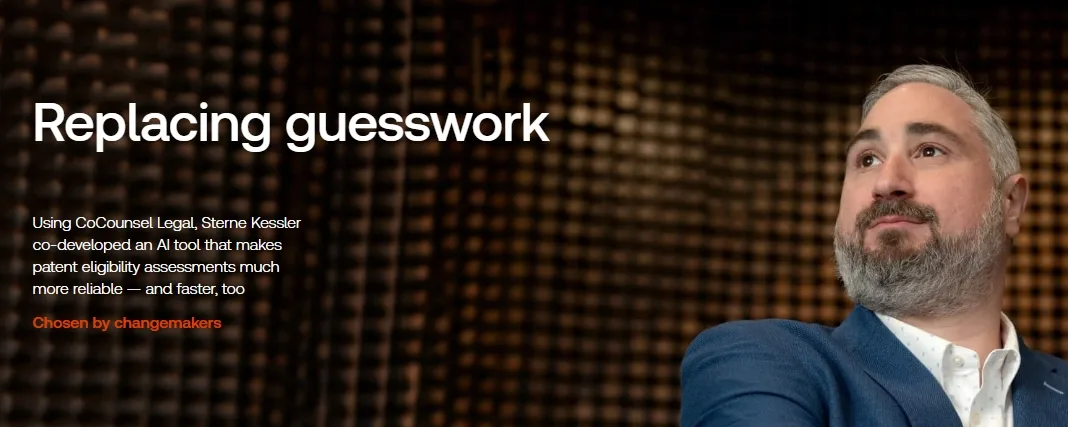
The result is the Patent Claim Eligibility Analyzer, an AI-driven workflow inside CoCounsel Legal that helps attorneys evaluate Section 101 patent eligibility using trusted legal content and practitioner-driven analysis. It demonstrates how Fiduciary-Grade AI supports legal work that must be accurate, transparent, and defensible in practice.
Jump to ↓
| Why Section 101 demands a higher standard |
| Practitioner-built AI outperforms traditional models |
| How legal teams analyze Section 101 using CoCounsel Legal |
| Fiduciary-Grade AI built for legal professionals |
| Turning internal intelligence into scalable legal AI solutions |
Why Section 101 demands a higher standard
Section 101 patent eligibility often determines litigation outcomes, sitting at the center of most utility patent disputes and shaping the trajectory of a case early on. In practice, the analysis is difficult to manage because key concepts lack precise definitions. Outcomes depend heavily on how precedent is identified and applied. Missing a critical case or misinterpreting prior rulings can weaken an argument from the start. At the same time, clients expect fast answers within fixed-fee structures, making it difficult to navigate or explain that uncertainty.
For both patent owners and defendants, the workflow is similar and resource-intensive. Teams often assign a junior associate, spend hours or days identifying relevant precedents, and still question whether they captured everything. This process introduces variability and makes consistent, high-quality outcomes harder to achieve. These constraints show where traditional methods fall short and where a more structured, defensible approach is needed.
Practitioner-built AI outperforms traditional models
Traditional legal technology often follows a familiar pattern. Technologists identify a problem, build a solution, and bring it to market, with practitioners contributing after development. That model can fall short in workflows like patent eligibility analysis, where legal reasoning and precedent interpretation are central to the outcome.
The Patent Claim Eligibility Analyzer applies a practitioner-built approach designed to address these gaps. It guides attorneys through Section 101 analysis by connecting claims to relevant case law, assessing precedent, and explaining how prior decisions support or challenge eligibility positions. Instead of relying on manual, time-intensive research, it creates a more consistent and transparent way to evaluate complex questions while aligning analysis to how the courts assess patent eligibility.
Thomson Reuters contributes AI capabilities, legal expertise, and authoritative content to structure and refine each step. Fiduciary-Grade AI improves legal outcomes by centering credentialed subject matter experts in workflow design and delivering the legal grounding required for defensible analysis.
How legal teams analyze Section 101 using CoCounsel Legal
Within CoCounsel Legal, the Patent Claim Eligibility Analyzer relies on a curated corpus of approximately 200 highly relevant Federal Circuit Section 101 decisions. Experts selected these cases based on factual and analytical relevance, and Thomson Reuters editorial teams reviewed and enhanced them using the same standards that underpin Westlaw.
To identify the most relevant precedent, the analyzer uses semantic claim-to-case matching to compare patent claims against Federal Circuit decisions. This approach goes beyond traditional keyword search by surfacing cases based on factual similarity and legal reasoning, helping attorneys identify more relevant precedent earlier in the analysis.
The workflow aligns with how IP teams already operate in practice:
- Enter a patent claim directly into CoCounsel Legal
- CoCounsel applies the same Step 1 and Step 2 framework used by courts
- The system identifies relevant decisions using semantic analysis instead of keyword search, surfacing cases with similar fact patterns from the curated Thomson Reuters and Sterne Kessler dataset
- The tool explains why each case applies by linking claim language to legal reasoning and outcomes
- Each citation connects directly to Westlaw for independent verification.
The analyzer does not replace an attorney’s judgment. It creates a faster, more consistent, and more defensible foundation, helping teams reduce variability and align around the same analysis.
Fiduciary-Grade AI built for legal professionals
Fiduciary-Grade AI requires authoritative content, expert-driven design, transparent reasoning, and verifiable outputs. The Patent Claim Eligibility Analyzer delivers across all these dimensions:
- Authoritative content: A curated and editorially reviewed corpus of Section 101 decisions grounds every output in trusted, authoritative legal content
- Expert-driven design: Sterne Kessler IP litigators helped shape each analytical step
- Transparent reasoning: The system explains why each cited case applies
- Verifiable sources: Every citation links directly to Westlaw
As AI expands into regulated work, the key question is no longer whether a system can produce an answer. Professionals must be able to validate that answer and stand behind it. The tool enables attorneys to verify results, trace underlying reasoning, and build arguments they can confidently defend. The system supports this by operating within a controlled environment designed for legal work, where customer data is not used to train underlying models.
Turning internal intelligence into scalable legal AI solutions
This co-developed solution shows what becomes possible when firms turn internal intelligence into repeatable, scalable legal workflows. Additional workflows are already in development across other complex areas of patent law, extending this model across the patent lifecycle.
As the partnership between Thomson Reuters and Sterne Kessler continues to grow, the principles behind Fiduciary-Grade AI will help shape how legal AI is developed and applied in professional work, enabling attorneys to spend more time on strategy, client advice, and high-impact case development.
See how Thomson Reuters and Sterne Kessler are making patent eligibility analysis faster and more reliable in our recent case study.