When choosing AI tools, legal professionals must use technology built on expert-curated, authoritative sources
Highlights
- Three attorneys were fined $5,000 for citing AI-generated fictitious cases in a lawsuit.
- Legal professionals spend 40-60% of time on document work, seeking AI efficiency.
- CoCounsel Legal uses verified Westlaw and Practical Law content with a 1,200+ attorney-editor oversight team.
In February 2025, a court fined three attorneys $5,000 for citing fictitious cases in a personal injury lawsuit against Walmart. The attorneys admitted these citations were fabricated by an AI tool they relied on. This, however, isn’t an isolated incident in the legal industry — it’s a warning sign for every law firm considering AI assistance.
Legal professionals dedicate 40 to 60% of their time to drafting, analyzing, and reviewing documents. Many turn to AI tools hoping to reclaim some of those hours. But the quality of AI-generated results depends entirely on where that AI gets its information. Not all AI tools are built for professional-grade work, and the difference between a helpful assistant and a liability risk often comes down to one thing: content sources.
Jump to ↓
Where public AI tools fall short
The expertise behind professional-grade AI
How AI source quality affects your work
Where public AI tools fall short
The legal industry has moved quickly to adopt generative AI (GenAI). Recent research shows that 28% of law firms and 23% of corporate legal departments now use these tools in their workflows, aiming to provide services more quickly without compromising quality.
Some lawyers reach for free public AI tools like ChatGPT. These tools are easy to access but create serious risks, as they often produce incorrect or even hallucinated results.
Generic AI tools create four major gaps for legal professionals:
- Lack of authoritative content. Many AI assistants use large language models (LLMs) that pull from content sources across the internet. These sources aren’t necessarily verified or legally sound.
- Opaque sourcing. AI results often appear without citations. Attorneys can’t verify or trust output when they don’t know where it came from.
- Training data from non-legal sources. AI models trained on internet data are prone to misunderstanding legal terms, misapplying rules, and returning irrelevant content.
- Missing compliance safeguards. Many AI tools don’t meet the data security and privacy standards that top-tier law firms and government agencies require.
Tools built for general use simply can’t meet domain-specific legal needs. Attorneys end up verifying every output, which is both time-consuming and counterproductive. Overall, legal work demands a higher level of accuracy and reliability than what general AI tools can offer.
The expertise behind professional-grade AI
Authoritative content makes the difference between useful and unreliable AI. Thomson Reuters CoCounsel Legal, the most trusted all-in-one AI solution for the legal industry, delivers insights by building legal-specific capabilities on a foundation of deep, accurate, and current Westlaw and Practical Law content — always supported by human expertise.
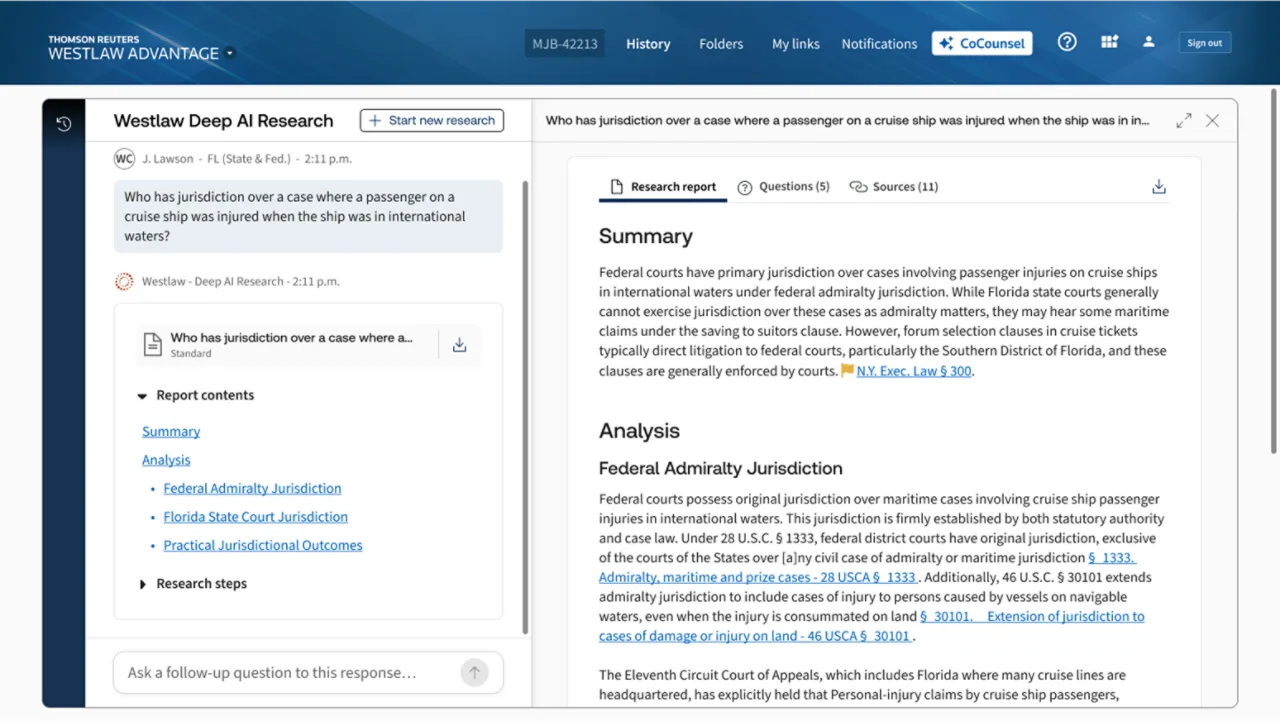
More than 1,200 attorney-editors and legal specialists verify that CoCounsel Legal customers receive answers based on the most current and jurisdictionally relevant content.
Our team curates, updates, and refines information continuously, so legal professionals can trust the accuracy and applicability of every source. Over 1,000 data scientists, AI engineers, and machine-learning experts build and optimize the platform, applying their industry-leading expertise to develop and maintain its capabilities.
How AI source quality affects your work
AI content sources directly impact your professional outcomes. When AI draws from open internet data, it misinterprets legal terms and provides results without citations. But CoCounsel Legal delivers scenario-specific legal knowledge authored by practicing attorneys. It understands and applies legal strategy and nuance, ultimately operating like a skilled research assistant.
With CoCounsel Legal, legal professionals can quickly:
- Find complete legal citations, sources, and information
- Conduct in-depth analyses of legal documents
- Transform dense legal documents into concise summaries
- Comb through litigation documents to discover hidden insights
- Identify potential counterarguments with supporting legal authority
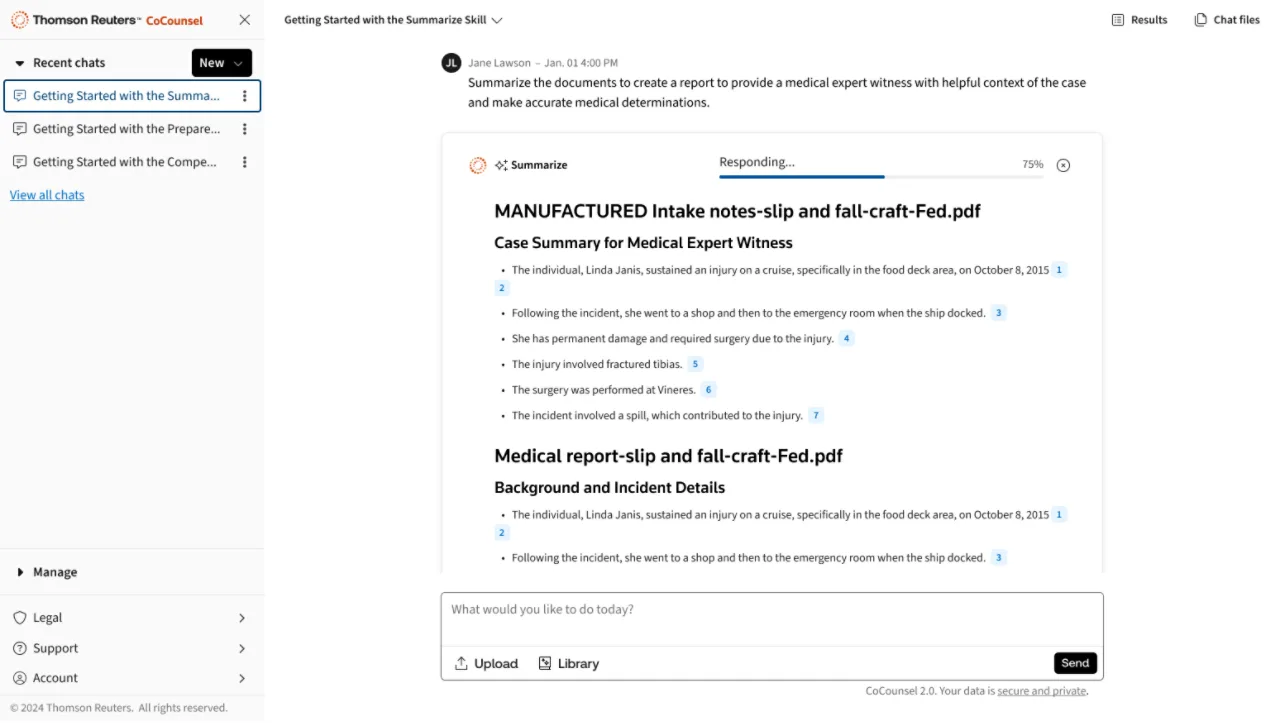
CoCounsel Legal harnesses both GenAI and agentic AI to deliver more capabilities than any other AI legal solution. Agentic AI understands and systematically works to achieve established goals by creating workflows that plan and carry out the best steps for each project. Human-in-the-loop oversight governs every function for safety, accuracy, and accountability.
Whether researching precedent, reviewing contracts, or drafting motions, CoCounsel Legal ensures results are defensible, verifiable, and aligned with the highest professional standards.
Choosing AI you can trust
As AI reshapes how legal professionals work, law firms, corporate legal departments, and government agencies must decide which AI legal solution to trust. Choosing CoCounsel Legal means more than adopting current legal technology. It means practicing law with confidence in a digital age where precision, expertise, and trust define professional excellence.
Learn more about CoCounsel Legal and see how trusted content transforms your AI results.