Discover how leading legal teams are cutting research time while maintaining full attorney oversight
Highlights
- Agentic AI enables autonomous execution of complex multi-step legal workflows with attorney oversight.
- CoCounsel automates discovery drafting while attorneys maintain control over strategy and final output.
- Westlaw's AI Deep Research delivers comprehensive legal reports in minutes with transparent reasoning.
Agentic AI represents a fundamental shift in how legal professionals approach their work—moving from AI as a reactive assistant to AI as an autonomous collaborator capable of handling complex, multi-step workflows.
But how does this legal technology actually work in practice? The answer lies in examining real implementations across some of the most labor-intensive areas of legal work: discovery and legal research.
Jump to ↓
Transforming discovery: From guided workflows to autonomous execution
Legal research reimagined: Westlaw’s AI Deep Research
What this means for your practice
Transforming discovery: From guided workflows to autonomous execution
Discovery is one of the most labor-intensive phases of litigation, making it a natural candidate for agentic AI for legal deployment. Of course, attorney oversight remains critical. Before agentic AI, CoCounsel reduced the burden of drafting discovery requests and responses through guided workflows.
Using the Draft Discovery Requests workflow, an attorney uploads the complaint and relevant case documents, identifies the requesting and responding parties, and provides optional strategic context. CoCounsel then generates initial drafts of interrogatories, requests for production, and requests for admission based on the attorney’s input and Practical Law templates.
On the response side, CoCounsel’s Respond to Discovery workflow enables attorneys to draft fact-based answers to incoming interrogatories, requests for production, and requests for admission, including tailored objection language. This workflow also includes the Review Documents skill to analyze documents for information that could potentially be responsive to discovery requests.
What makes these AI-enabled workflows significant is their deliberate design as a midpoint between traditional manual drafting and full automation. The attorney sets the parameters, CoCounsel does the heavy lifting within those boundaries, and the output is delivered in an editable Word document or refinable in CoCounsel’s editor. Footnotes function as a verification tool and a defensible record of how each request or response was derived.
Agentic AI is expected to take these capabilities significantly further. Where current guided workflows follow a predefined sequence of steps, the next version of CoCounsel Legal will autonomously plan and execute multi-step legal tasks and adapt its approach as new information emerges—all while showing chain-of-thought reasoning and linking to sources.
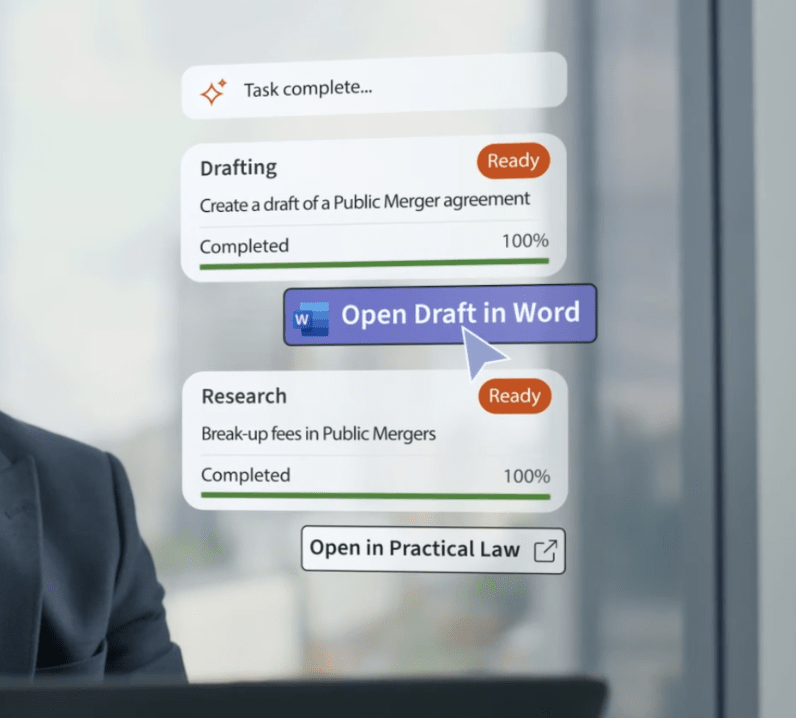
For discovery, this means an attorney could describe a litigation scenario in plain language and have the system draft discovery requests, review case documents for supporting facts, identify potential areas of factual dispute, and refine its output based on what it finds—orchestrating research, document review, and drafting capabilities in a single workflow. The AI handles labor-intensive execution, while attorneys retain control over strategy, judgment, and final work product, but now accomplishes far more complex tasks between human touchpoints.
Legal research reimagined: Westlaw’s AI Deep Research
Westlaw’s AI Deep Research shows how agentic AI for legal can be operationalized in one of the profession’s most foundational workflows, without sacrificing attorney oversight.
Case study: Westlaw’s AI Deep Research puts agentic AI to work—with attorneys still in the driver’s seat
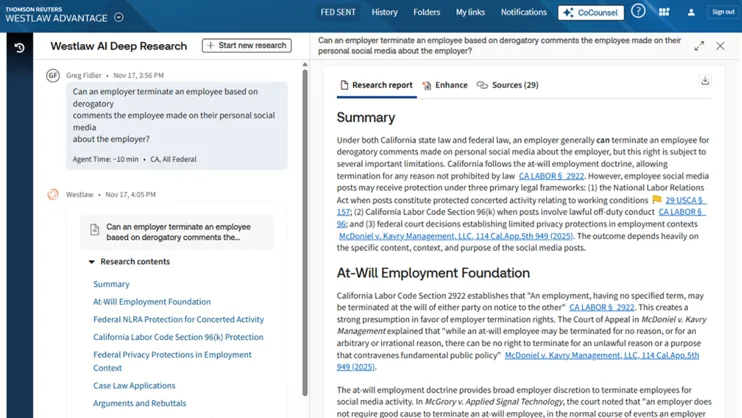
Westlaw’s AI Deep Research is an illustration of agentic AI applied to legal research. This tool transforms legal questions into a comprehensive, well-reasoned research report. Multiple AI agents work in parallel or in sequence, quickly, collaborating in ways a single linear AI process cannot. The system doesn’t just retrieve information—it creates multistep plans, revises plans as new findings emerge, identifies key precedents, uses additional tool, and generates, verifies, and refines reports.
The research draws from the vast amount of authoritative legal content in Westlaw: statutes, regulations, and case law form the core, supplemented by secondary sources and administrative decisions for context and commentary. Where relevant and available within the user’s subscription, Practical Law content is pulled in as well.
The practical payoff is significant. As one legal professional put it, AI Deep Research produces reports in ten minutes that are of comparable quality to what you’d expect from a first or second-year associate. Another user mentioned that the work product “would have taken me multiple days to write if I’d been doing it myself.” At scale, that kind of time savings changes what a legal team can take on.
Human judgment anchors the process. Attorneys create the research query, select the jurisdiction, and choose the depth of the report. These choices actively shape which agents are activated and the guidelines they work within.
The typical output includes not just the research report, but arguments from both sides of the issue, along with rebuttals—the kind of analysis that typically requires significant time to perform.
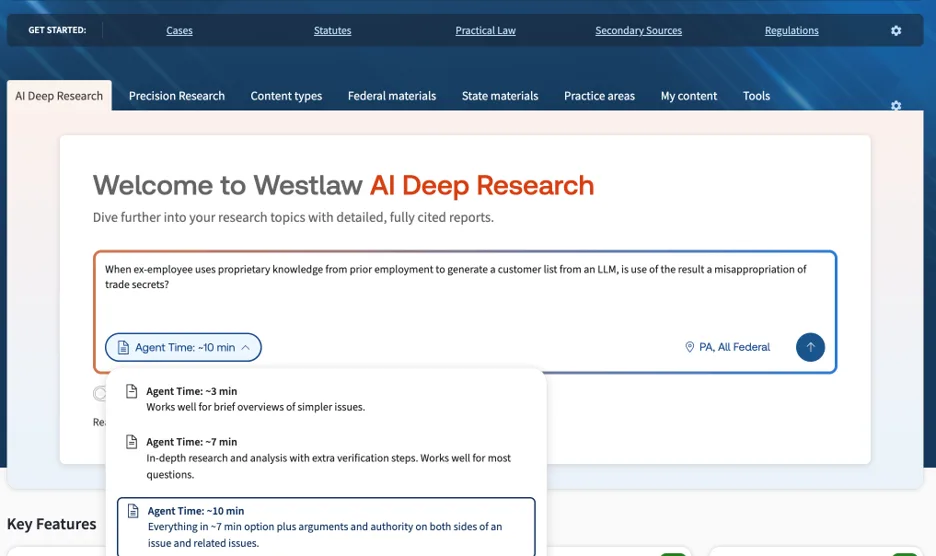
Within these in-depth reports, a separate dedicated AI agent reviews the drafted report sentence by sentence, checks citation-statement alignment, and rewrites sections where needed to reduce error rates.
How the research actually comes together
From the moment the attorney submits a query, the process is visible and transparent. A research plan appears in real time, laying out how the system intends to approach the question and then agents begin executing on it, step-by-step, surfacing key findings along the way.
Crucially, the plan isn’t static. As the agents discover new information, they revise their approach, exploring different avenues, selecting appropriate research tools, reporting findings, and iterating based on what each step reveals. The difference is that this happens dynamically and concurrently across multiple agents working in parallel.
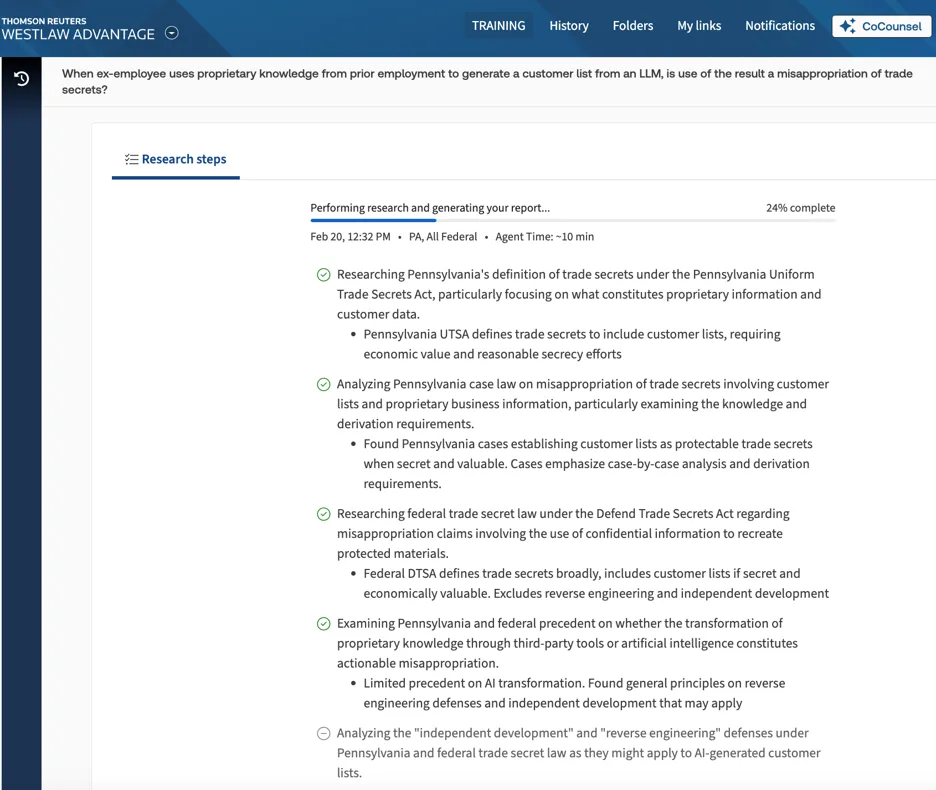
Real-time visibility into the reasoning process provides documentation of how research was conducted, serving as both a verification mechanism and a defensible audit trail.
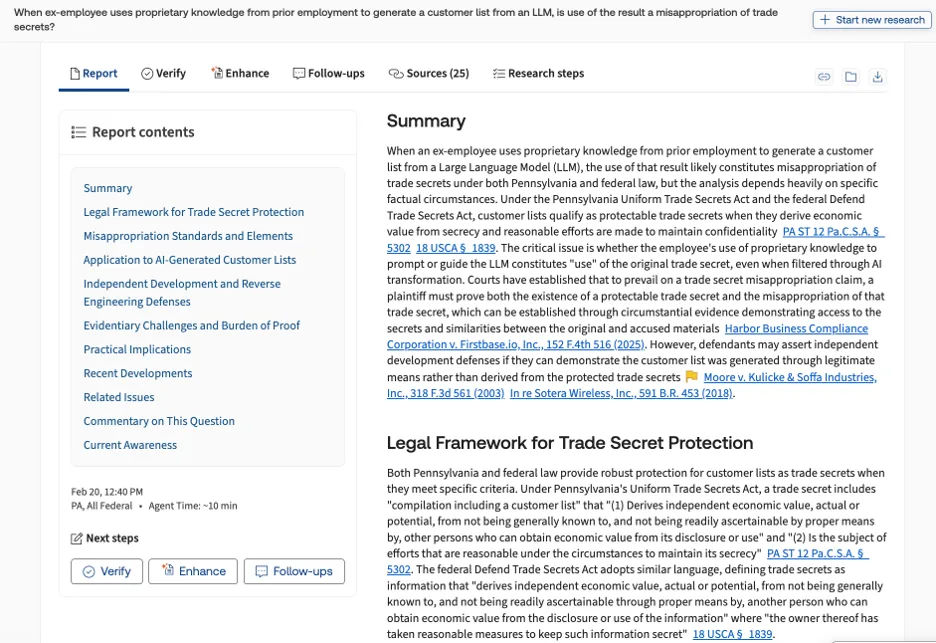
The system identifies moments where research could go in multiple directions and surfaces those decision points through a feature called Enhance, which poses clarifying questions to the attorney. The attorney’s answers shape and refine the final report. This is a meaningful design choice: rather than treating attorney judgment as a quality-control step at the end, it builds that judgment into the research itself.
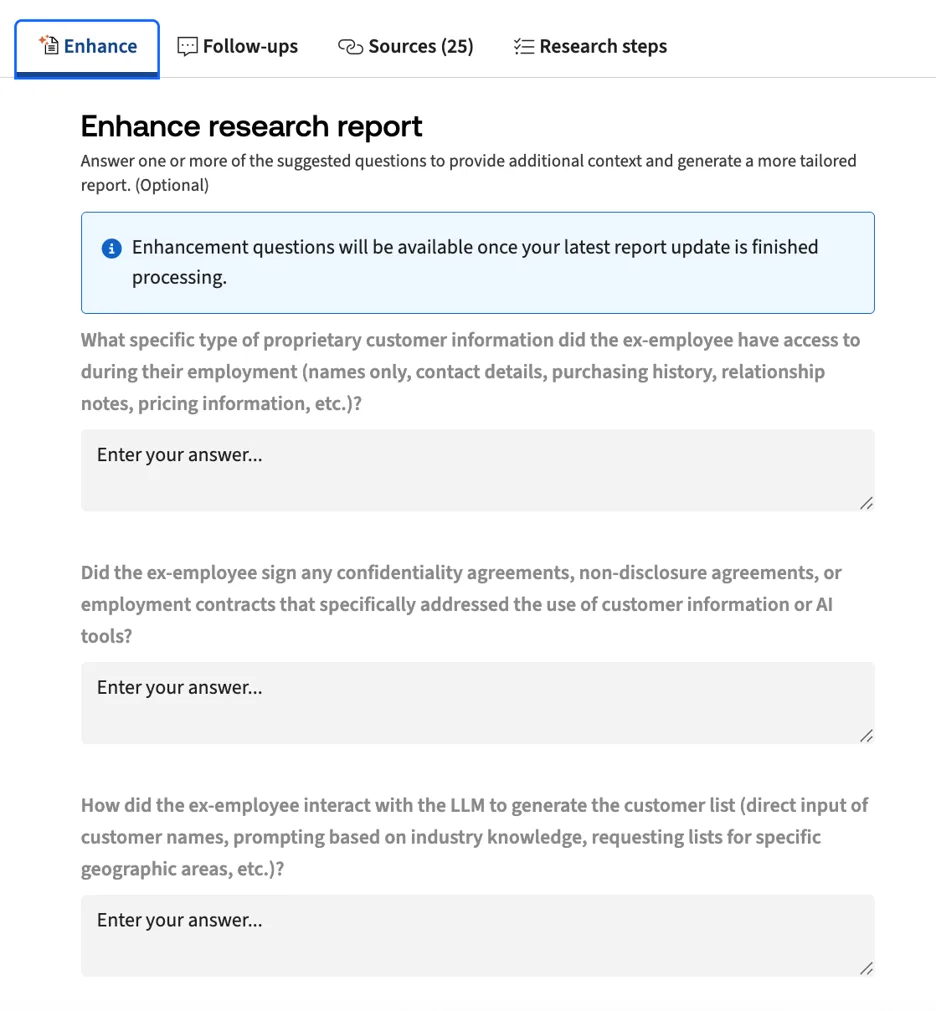
When the final report is delivered, citations appear throughout, each clickable and linked directly to the Westlaw source. Attorneys can verify not just that a source exists, but that the AI’s interpretation is accurate. AI Deep Research skills are regularly tested and audited by legal professionals against known correct outputs, providing ongoing performance checks. Attorneys can also ask follow-up questions directly, allowing the research to continue as a dialogue rather than a one-time transaction.
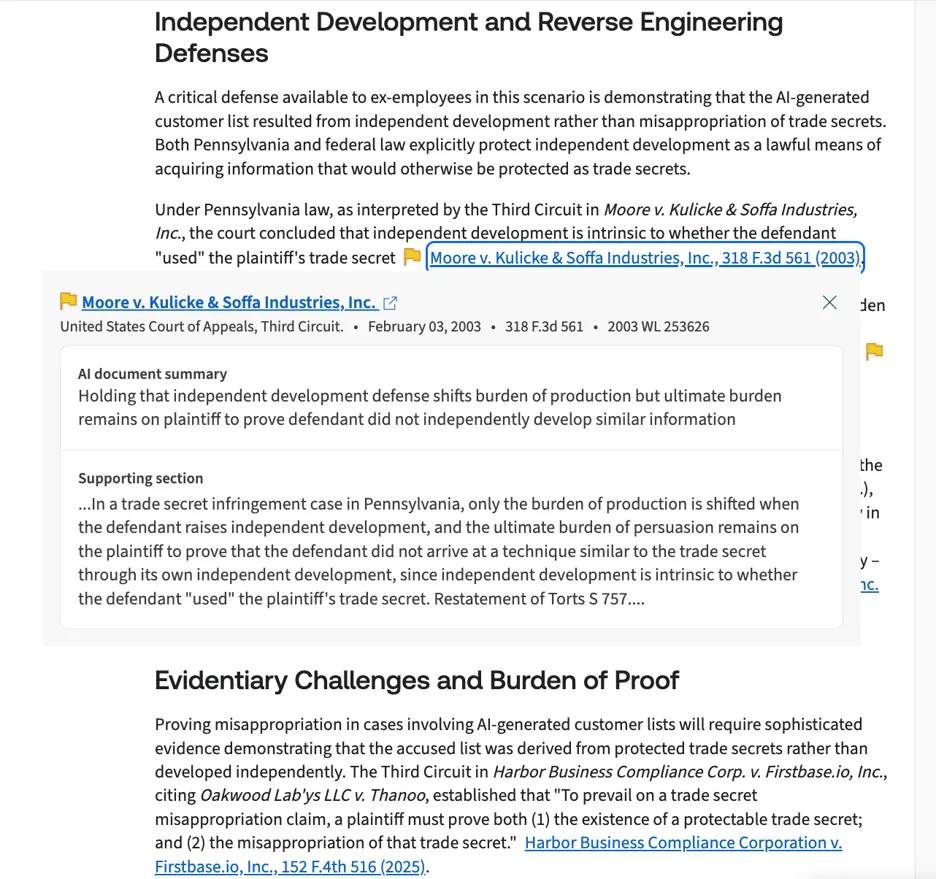
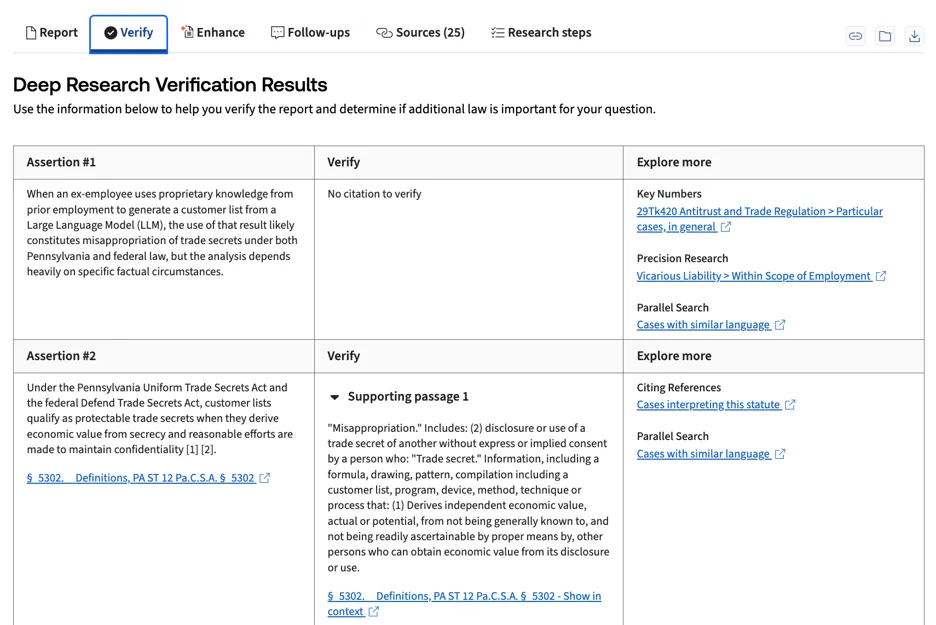
AI Deep Research also includes a Verify feature, adding another layer of validation assistance. Verify surfaces the exact supporting language from authoritative sources for each legal claim the AI has made, providing evidence attorneys need to confirm the AI’s reasoning quickly and confidently, alongside tools like KeyCite and Parallel Search for deeper exploration. This granular traceability is a professional safeguard.
These features don’t replace attorney review. They make review and validation faster, more targeted, and more reliable, keeping the human meaningfully in the loop without making oversight feel like a burden.
What this means for your practice
Agentic AI is already here and already proving its worth. The shift from generative to agentic AI doesn’t require attorneys to surrender control. It requires redesigning what meaningful human-in-the-loop control looks like at a higher level of automation. Attorneys still set parameters, shape inquiries, review output, and make judgment calls that matter.
For firms willing to leverage these new legal technology tools, the opportunity is real: faster research, stronger work product, and a competitive edge that compounds over time. Agentic AI can be built with the accountability and rigor that the legal profession demands—and it’s transforming workflows right now.
Discover how agentic AI can transform your legal workflows. Explore CoCounsel Legal and see how autonomous, multi-step capabilities can accelerate your discovery and research—with you in control.
CoCounsel Legal
AI, trusted content, and expert insights from Westlaw and Practical Law resources
Jumpstart legal research ↗