What happened when our own legal team became Customer Zero for CoCounsel: 33 order forms to 3, AI-generated playbooks, and a new deal-desk model
Highlights
- Thomson Reuters legal team reduced 33 order forms to 3 using AI-powered contract analysis.
- AI-generated playbooks enable deal desks to self-serve, freeing lawyers for strategic work.
- Customer Zero approach demonstrates how legal departments can transform from cost centers to competitive advantages.
When our new CLO Norie Campbell started, the mandate was clear from CEO Steve Hasker.
“This is your time to shape this organization,” he told her. “You have a unique opportunity to lead the way. Go for it.”
It was an invitation — and a challenge. The legal function at a global enterprise wasn’t going to transform itself. Someone had to pick a path and commit to it. Campbell accepted.
That’s a mandate many CLOs dream of. But it’s also the mandate the market is giving every legal leader right now — whether your CEO says it out loud or not.
Jump to ↓
The Mandate
Widespread Adoption, Limited Transformation
How It Started: Bertil Majer and the Contract Transformation
The Bigger Picture: What This Means for CLOs Everywhere

White paper
AI-powered legal drafting: The definitive guide for legal professionals
Access white paper ↗
The Mandate
When our new CLO Norie Campbell started, the mandate was clear from CEO Steve Hasker.
“This is your time to shape this organization,” he told her. “You have a unique opportunity to lead the way. Go for it.”
It was an invitation — and a challenge. The legal function at a global enterprise wasn’t going to transform itself. Someone had to pick a path and commit to it. Campbell accepted.
That’s a mandate many CLOs dream of. But it’s also the mandate the market is giving every legal leader right now — whether your CEO says it out loud or not.
The Paradox Every GCO Faces
For decades, the General Counsel’s Office occupied a familiar position in the corporate hierarchy: essential but invisible. Cost control. Risk mitigation. The department that says “no”, so the company doesn’t get sued.
But the world has evolved. Legal departments are expected to be strategic partners. To enable growth, not just prevent loss. To move at the speed of business, not the speed of billable hours.
The data confirms the gap: 86% of GCs say their department is a significant contributor to business objectives. Only 17% of the C-Suite agree. In fact, 42% of executives say legal contributes little or nothing at all.
The gap between what legal was and what it needs to become is the paradox every CLO faces. Campbell decided to close it — not with incremental improvements, but with a fundamental reimagining of how legal work gets done.
This is the story of how one enterprise legal function became Customer Zero for its own AI transformation — and what it learned along the way. It’s also a playbook any legal leader can adapt.
Widespread Adoption, Limited Transformation
AI adoption is now widespread, but meaningful transformation remains uncommon. Thomson Reuters Future of Professionals 2026 found that 35% of professionals whose organizations have an AI strategy say it is not visible in their day-to-day work. The strategy may exist in a presentation or leadership message, but it has not yet changed how work is assigned, completed, reviewed, or measured.
Professionals are not waiting for that gap to close. Thirty-four percent use AI tools their organizations have not sanctioned, creating a layer of shadow AI that leaders may not be able to see, govern, or support. That behavior is not simply a technology issue. It is a signal that people see the potential of AI, but do not yet have the approved tools, workflows, training, or direction required to use it consistently and responsibly.
At the same time, the pressure to move faster is coming from every direction. Fifty-five percent of professionals feel talent pressure to act faster on AI, 58% feel stakeholder pressure, and 60% feel financial pressure. Legal departments experience the stakeholder dimension most acutely, at 61%. Leaders are being asked to demonstrate progress while managing risk, preserving professional standards, and supporting teams already under strain.
If that tension feels familiar, you are not alone. Thomson Reuters has confronted the same execution gap inside its own General Counsel’s Office. What follows is not a claim that the journey is finished. It is an account of how one legal function began moving from scattered adoption toward transformation and what others may be able to learn from the experience.
How It Started: Bertil Majer and the Contract Transformation
Under Campbell’s mandate, leaders across the GCO began identifying where AI could fundamentally change how legal delivers value. Bertil Majer, Deputy General Counsel, saw his opportunity in contracts.
When Bertil Majer joined Thomson Reuters as Deputy General Counsel and leader of the GCO’s Customers & Commercial practice in 2025, he noticed something that didn’t add up. The company had transformed into an AI-powered SaaS business — acquiring CaseText, launching CoCounsel, embedding generative AI across its products. But the contracts customers signed? They still looked like agreements from a legacy content provider.
“The contract doesn’t look like a SaaS contract at all,” Majer recalls. “It looks like a content provider contract. It looks very almost old-fashioned, dare I say.”
This wasn’t a legal problem. It was a business transformation opportunity.
The Problem with “Good Enough”
Thomson Reuters Customers and Commercial legal team — about 40 lawyers globally — supports every customer contract negotiation across the company. The team had 33 different order forms, countless clause variations, and contracts scattered across account executives’ laptops and personal drives. Fixing it would take four moves: rewrite the underlying terms for a modern, refocus on the customer relationship, simplify the order forms, build a single contracting hub, and redesign approvals so routine matters resolve at the point of contact.
The old model was linear: draft a clause, perfect it, then draft the next document, then the next. End-of-quarter meant chaos — lawyers chasing deadlines, doing one-off solutions for individual customers, red lines flying back and forth at the last minute.
“We can’t throw headcount at problems,” Majer says. “That’s why you need to front-load the whole customer experience.”
From 33 Order Forms to 3
The transformation started with the mission of simplification accelerated through trusted AI tools. Using CoCounsel to analyze years of negotiations, the team identified patterns: which concessions were they making anyway? Which terms caused the most friction?
They consolidated 33 order forms down to 3 — a 91% reduction in contract complexity.
Thomson Reuters’ GCO includes roughly 80 lawyers working across multiple practice areas and geographies. The contracting transformation gives that global function one standard to operate against in every market, allowing knowledge developed in one part of the organization to strengthen work across the whole. The team is creating that consistency and reach without adding headcount while expanding the leverage of its existing legal talent rather than simply asking people to do more.
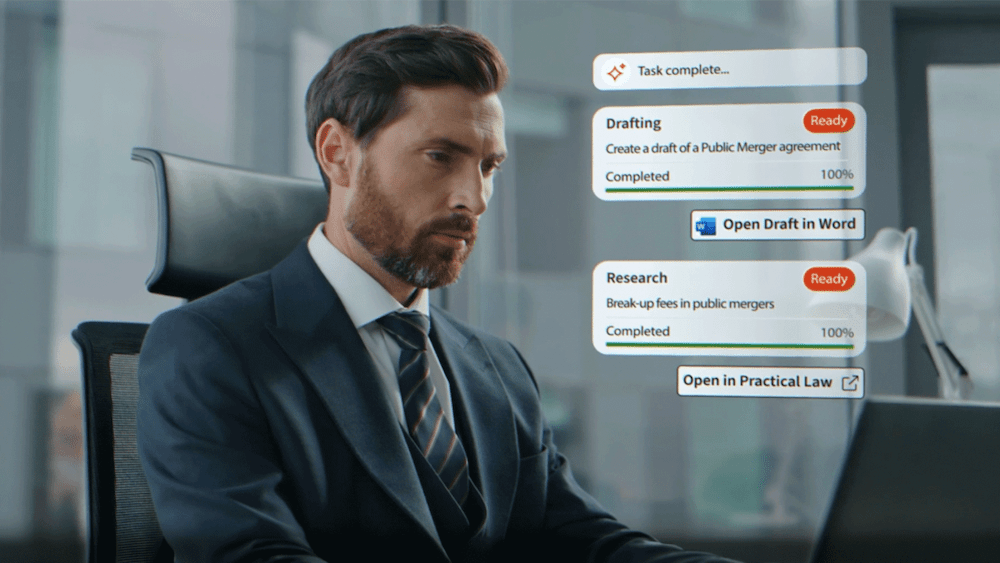
Then they compiled institutional knowledge from across the department and used CoCounsel to generate playbooks. The deal desk — now serving as “air traffic controllers” for every contract — got a self-service toolbox. Legal only gets involved when the deal desk runs out of tools.
“We generated that playbook from all of the experience we had across the company,” Majer explains. “Now we can really concentrate on the strategic things — the big tickets, the complex contractual setups.”
“Like Having Another Intelligent Brain”
For Alexandra Graydon, Associate General Counsel leading the Knowledge and Policy team, the transformation shows up in daily work.
In the old model, drafting was sequential: write the clause, then the customer pushback analysis, then the fallbacks, then the FAQ for sales, then the talking points. One task at a time.
Now? The entire cascade happens at once.
“I need these clauses, I need to understand what the customer’s pushback might be, I need fallbacks, I need FAQs for sales, I need talking points,” Graydon describes. “You’ve got four, five, six different outputs aimed at different audiences — and you just press the button and it does it.”
A task that used to take a full day now takes an hour. But it’s not just speed.
“It’s like having another intelligent brain working on the task,” she says. “It gives me ideas, it sees gaps, it picks up on things I don’t see.”
Why Trusted Content Matters
Majer tested multiple AI tools before committing — including legal-focused platforms like Harvey and Legora. Some made strong first impressions, particularly in their go-to-market approach.
“Harvey felt more compelling initially — not because it was more performant, but because they made a bigger effort to get to me as a CLO,” Majer admits. “They brought along an incredible team of experts that spoke exactly my language.”
But when it came to high-stakes legal work — the kind where your professional reputation is on the line — the foundation mattered more than the interface.
“If your job is on the line, you need to hedge your risks,” Majer says. “What I found with CoCounsel was that even outside of the US and UK, where case law coverage is thinner, the results were reliable. On the surface, there are shinier toys. But if you look beyond that, you find something you can rely on.”
For legal professionals, that is what Fiduciary-Grade AI™ means in practice: proprietary legal content paired with enterprise-grade AI, built for work that must be defensible.
Beyond Efficiency
The story here isn’t just about saving time — though that’s a byproduct. It’s about what legal can become when it’s not buried in administrative work.
“The most powerful thing is not that CoCounsel can draft a clause,” Majer reflects. “It’s that it can help us redesign how the global legal function works.”
The goal is closing a perception gap that haunts in-house legal everywhere. When CLOs are asked how relevant they are to the business, 80% say very relevant. When CEOs are asked the same question? Only 17% agree.
“I’d like to get that number up,” Majer says. “I want internal stakeholders to be almost proud to have a legal department that is nimble, fast, agile, pragmatic. Finding solutions, not just flagging risks.”
The Proof Point
What makes this story useful isn’t the technology alone. It’s the experience behind it.
This isn’t a demo environment. It’s a global enterprise with real stakeholders, real commercial pressures, real negotiations, and real adoption challenges. The team has lived those challenges and is sharing what it learned as the transformation continues.
“We don’t ask anyone to believe some promise,” Majer says. “We can show them now as a Customer Zero that we own that transformational journey. We have proof points to show this is really working.”
As Customer Zero, the team is using that experience to support other legal departments — testing Fiduciary-Grade AI™ under the same conditions its customers work in.. The journey has revealed what CLOs look for, where friction can slow progress, and which practical changes can help AI become part of the way work actually gets done.
“Suddenly, I’m not just a cost center,” Majer says. “I am also Customer Zero. This legal team is now interesting and important for how we sell to Corporates. We can bring value way beyond contract negotiations.”
That’s the broader opportunity: legal becoming a source of competitive advantage, not simply overhead.
The Bigger Picture: What This Means for CLOs Everywhere
This story isn’t being shared to say “look how smart we are.” It’s being shared because we know exactly where most legal departments are right now.
Most CLOs are stuck in what we call “the messy middle” — they’ve run pilots, seen demos, maybe even had some wins. But they haven’t cracked the code on scaling AI across the function. They haven’t figured out how to move from “interesting experiment” to “this is how we work now.”
That’s what makes this story valuable. Not the specific tools or the specific metrics — but the playbook for getting from pilot to transformation.
This experience also connects to GCO 2030, a broader framework for envisioning how AI may reshape the future legal department. At its center is a Tech-forward Mindset, supported by five connected transformation archetypes:
- Seamless Integrator,
- Empowering Peer,
- Global Leverage
- Scaled Enablement, and
- Advisory Plus
Rather than prescribe one destination, the framework gives legal leaders a shared language for deciding what they want their functions to become and where to focus investment as they move from adoption to transformation.
The question isn’t whether AI will change legal work. It is how each legal department can navigate that change in a way that reflects its people, responsibilities, risk profile, and ambitions.
We understand the pressure because we are working through it ourselves — from aligning strategy and workflows to supporting adoption across a global function. We are still learning, and we want to share those lessons openly. If your legal department is navigating the same messy middle, let’s take the journey together.