
Lenders will usually let a borrower pay shareholders out of unexpected equity windfalls — that's easy money nobody was counting on. A newer basket skips the windfall part entirely.
Highlights
- Equity Proceeds Dividends let borrowers pay shareholders from the cash raised in an equity sale, which lenders weren't counting on anyway.
- Market-Cap Dividends go further, permitting annual payouts of 6-7% of market cap with no equity sale and no new cash required.
- Market-Cap Dividend baskets appeared in 4% of publicly filed high-yield credit agreements in Q3 2024, up from 0% in Q3 2023.
Jump to ↓
From equity windfalls to market-cap baskets
By Dan Wertman — originally published on the Noetica blog, now part of Thomson Reuters. November 2024.
It’s generally easier to part with cash you didn’t anticipate you’d have — found money spends differently than earned money. That psychology is exactly what sits behind “Equity Proceeds Dividends” in credit deals.

From equity windfalls to market-cap baskets
“Equity Proceeds Dividends” are payments to shareholders permitted under a credit agreement, funded from the proceeds of equity sales. Lenders are normally deeply concerned about cash leaving a borrower — especially cash that isn’t improving the business or generating more cash to pay them back. But equity proceeds are, from a lender’s perspective, closer to found money: they weren’t counting on that cash flow for their own payments, so they’re routinely willing to let it go back out the door.
“Market-Cap Dividends” stretch that logic well past its original justification. These restricted payment baskets, typically set at 6-7% of the borrower’s market capitalization, can usually be paid out every year — without requiring any actual sale of stock, and without any corresponding inflow of cash. There’s no windfall to justify the payout; the basket exists purely because the borrower’s stock is worth more on paper.
How common are they
In the current credit cycle, these terms have remained relatively rare, but the trend points up. In Q3 2024, 4% of publicly filed high-yield credit agreements included Market-Cap Dividend baskets, compared to zero deals in Q3 2023.
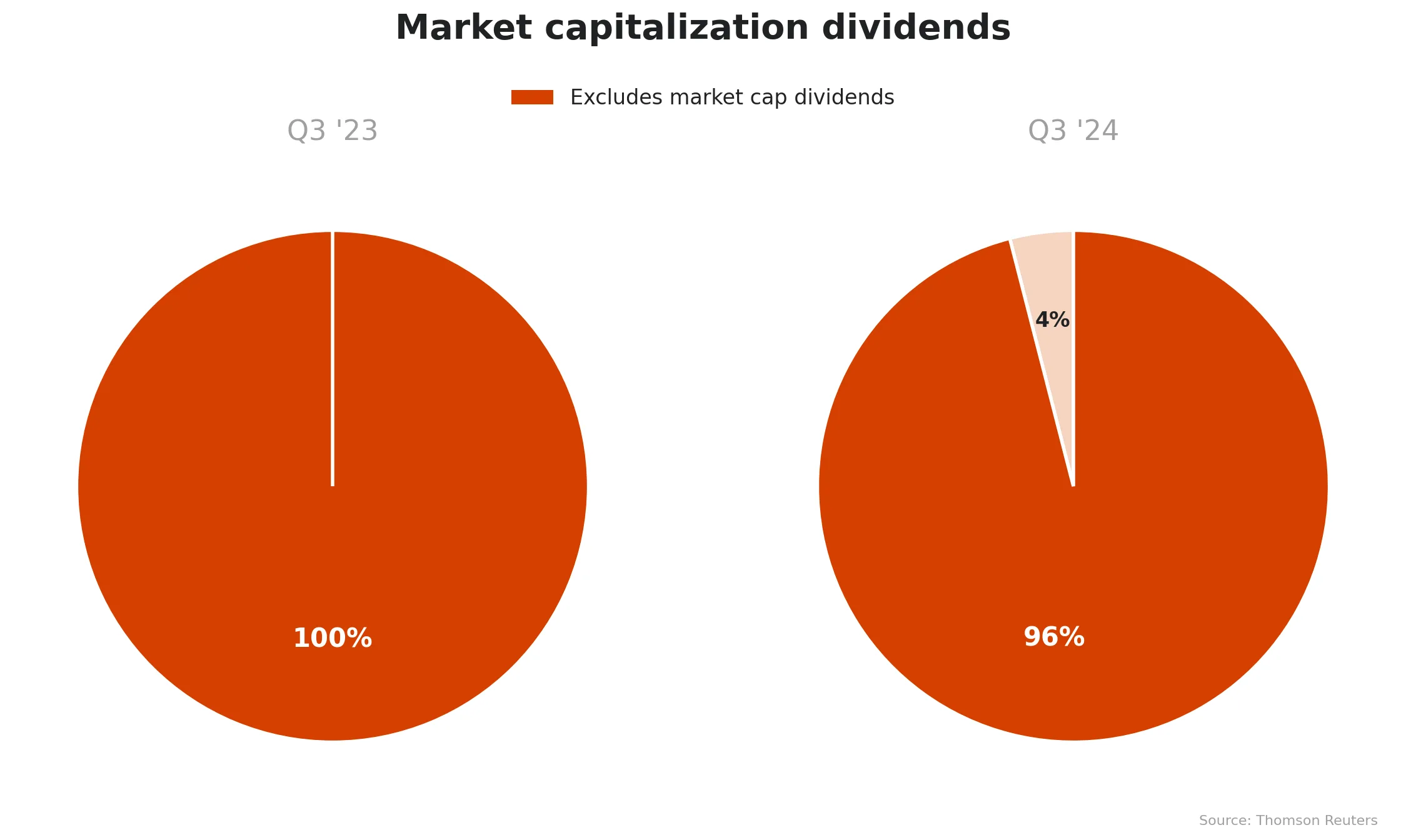
Four percent is still a small minority of deals, but it’s worth watching: a term that didn’t exist in the market a year earlier now has a foothold, and covenant terms that gain traction in one credit cycle have a way of becoming the next cycle’s market standard.
For more deal-term benchmarking like this, explore the latest Capital Markets Radar Report from Noetica, now part of Thomson Reuters.