A four-part series
Highlights
- AI-powered tools help investigators uncover fraud networks across multiple claims and jurisdictions efficiently.
- Modern fraud detection requires mapping complex relationship networks that traditional methods cannot track effectively.
- Automated documentation with audit trails transforms investigation workflows while meeting legal compliance standards.
Insurance fraud has become increasingly sophisticated, making it harder for Special Investigation Units (SIUs) to identify connections between claims, individuals and organized fraud networks.
Fraud schemes frequently span multiple claims, providers, businesses and jurisdictions, creating patterns that can be difficult to uncover through traditional investigative methods.
At the same time, investigators are under pressure to manage growing caseloads while maintaining investigative rigor and thorough documentation.
Jump to ↓
Why fraud investigations are becoming more complex
How AI helps investigators understand unknown connections

Why fraud investigations are becoming more complex
Insurance fraud investigations have evolved into intricate challenges that test the limits of traditional investigative methods. While accessing individual pieces of information remains straightforward, the real difficulty lies in rapidly connecting disparate data points to reveal the complete picture. What appears to be separate, unrelated activity may actually be part of a wider fraud network operating across multiple claims and jurisdictions. AI-powered investigation tools are becoming essential for meeting speed requirements while maintaining investigative accuracy.
The network effect compounds these challenges exponentially. Today’s fraud rarely involves isolated incidents, requiring investigators to understand the full web of relationships: shared addresses, connected phone numbers, common business affiliations, and historical interactions. Traditional investigation methods—running individual searches and manually connecting dots—simply can’t keep pace with sophisticated operations that exploit investigative bottlenecks.
How AI helps investigators understand unknown connections
Modern fraud investigations often require investigators to connect seemingly unrelated pieces of information. For example, two claims may contain different phone numbers, yet both could be linked to the same individual, business, or fraud network.
AI-powered investigation workflows help investigators explore these connections more efficiently, validating information, identifying patterns, and surfacing relationships that might otherwise be missed.
The network effect
Modern insurance fraud rarely involves isolated incidents. Successful investigations require understanding the full network of relationships: shared addresses, connected phone numbers, common business affiliations, and historical interactions. AI-powered tools excel at mapping these relationships and presenting them in formats that investigators can quickly understand and act upon.
When the system identifies potential connections, it automatically suggests next steps: run a person report on a connected individual, investigate adverse media for a related business, or analyze geographical patterns across claims. This guided approach ensures investigators don’t miss critical leads while maintaining the efficiency needed for high-volume caseloads.
Defensible documentation
In insurance investigations, documentation isn’t just important—it’s legally essential. AI-powered investigation tools provide complete audit trails with source citations for every finding. Investigators can download comprehensive reports that include their prompts, the AI’s analysis, and all supporting documentation.
This approach transforms case documentation from a time-intensive manual process into an automated output that meets legal standards while freeing investigators to focus on analysis and decision-making.
Strategic implications
Organizations implementing AI-powered investigation capabilities report significant improvements in case closure rates, fraud detection accuracy, and investigator productivity. More importantly, they’re building sustainable advantages in an increasingly complex fraud environment.
The technology enables SIU teams to shift from reactive claim processing to proactive pattern recognition. Instead of investigating individual claims in isolation, they can identify fraud networks before schemes fully develop, potentially preventing significant losses.
The competitive advantage: Insurance organizations that embrace AI-powered investigation tools today will be better equipped to detect sophisticated fraud schemes, reduce investigation costs, and maintain the investigative rigor that protects both their business and their customers.
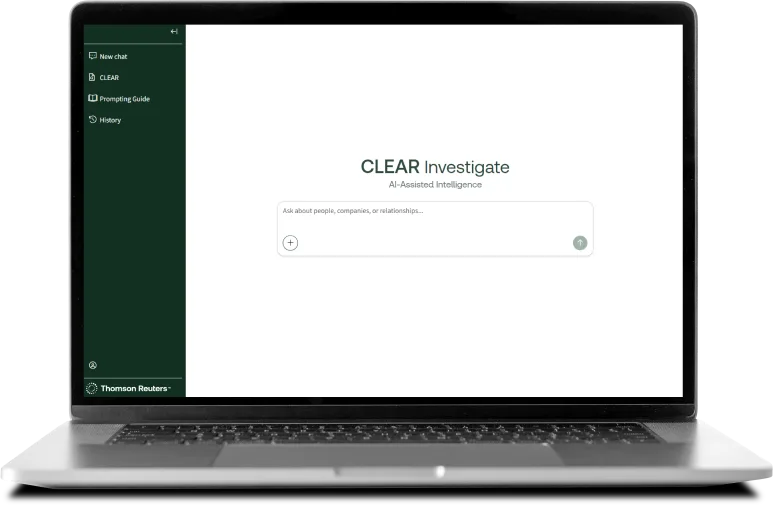
Access to these tools is limited to authorized, vetted professionals.
Thomson Reuters is not a consumer reporting agency and none of its services or the data contained therein constitute a “consumer report” as such term is defined in the Federal Fair Credit Reporting Act (FCRA), 15 U.S.C. sec. 1681 et seq. The data provided to you may not be used as a factor in consumer debt collection decisioning; establishing a consumer’s eligibility for credit, insurance, employment, government benefits, or housing; or for any other purpose authorized under the FCRA. By accessing one of our services, you agree not to use the service or data for any purpose authorized under the FCRA or in relation to taking an adverse action relating to a consumer application.