How financial institutions can accelerate financial crime investigations with AI intelligence.
Highlights
- AI-powered investigation tools help financial institutions process alerts faster and uncover hidden risks.
- Network analysis reveals complex relationships between criminals, shell companies, and suspicious transactions.
- Automated documentation provides audit-ready reports with transparent sourcing for regulatory compliance.
How financial institutions can accelerate financial crime investigations with AI intelligence.
Financial crime investigation has become exponentially more complex. Criminals operate through sophisticated networks of shell companies, use multiple identities, and leverage technology to obscure their activities. Meanwhile, regulatory pressures demand faster, more thorough investigations with complete documentation and defensible conclusions.
Jump to ↓
The investigation challenge: more alerts, more data, less time
AI-enhanced investigation workflows
Uncover unknown connections across people, businesses, and associates
Defensible results, transparent sourcing, and audit-ready documentation
Why this matters for financial crime teams

The investigation challenge: more alerts, more data, less time
Financial institutions face a perfect storm of investigative challenges. Alert volumes continue to increase, fraud schemes evolve rapidly, and regulatory requirements become more stringent. Traditional investigation methods, manual searches, individual record reviews, and siloed analysis, simply cannot scale to meet these demands.
Consider the typical financial crime investigation: An alert triggers on a suspicious transaction, providing only basic information about the involved parties. Investigators must quickly determine legitimacy, identify related risks, and document their findings for regulatory compliance. This process, repeated across thousands of alerts, creates operational bottlenecks that can impact both compliance and customer experience.
AI-enhanced investigation workflows
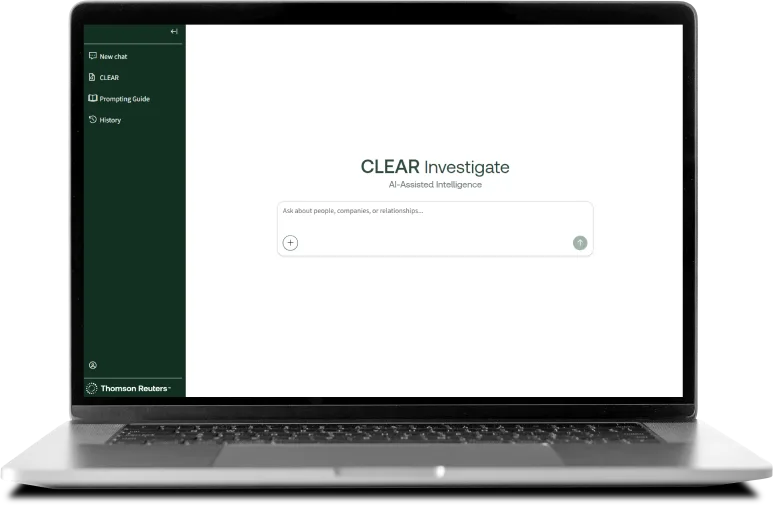
CLEAR Investigate enables financial crime investigators to transform their approach from manual data gathering to intelligent analysis. Instead of running separate searches and manually connecting information, investigators can prompt the system with specific questions: “Run financial crime due diligence on this individual, including network analysis and risk assessment.”
This AI conducts comprehensive analysis across multiple data sources simultaneously: adverse media, sanctions lists, corporate filings, court records, and web-based information. More importantly, it identifies connections and relationships that might not be apparent in individual records, providing investigators with a complete risk picture in minutes rather than hours.
Uncover unknown connections across people, businesses, and associates
Financial crimes rarely involve isolated actors. Successful investigations require understanding the full network of relationships: business affiliations, shared addresses, connected phone numbers, and historical interactions. AI-powered tools excel at mapping these complex relationships and presenting them in formats that enable quick decision-making.
When the system identifies potential risks or connections, it provides suggested next steps and follow-up investigations. This guided approach ensures comprehensive analysis while maintaining the efficiency required for high-volume alert processing.
Defensible results, transparent sourcing, and audit-ready documentation
In a regulated financial services environment, investigation outputs must be clear, transparent, and defensible. AI-powered investigation tools provide complete audit trails with source citations for every finding. Investigators can generate comprehensive reports that include their analysis methodology, supporting evidence, and clear conclusions.
This approach transforms compliance documentation from a manual, time-intensive process into an automated output that meets regulatory standards while enabling investigators to focus on analysis and decision-making rather than administrative tasks.
Why this matters for financial crime teams
For financial institutions, the value is practical: faster access to answers, less manual cross-referencing, reduced data overload, and greater confidence in investigation outcomes. AI-driven workflows can help teams manage growing caseloads while maintaining investigative rigor and consistency.
Perhaps more importantly, AI-powered tools enable financial crime teams to shift from reactive alert processing to proactive risk detection. By analyzing patterns across multiple cases and identifying emerging threats, institutions can strengthen their overall financial crime prevention programs.
Strategic outlook: Financial institutions that embrace AI-powered investigation tools will be better positioned to meet evolving regulatory requirements, detect sophisticated financial crimes, and maintain operational efficiency in an increasingly complex threat environment. The organizations that act now will build sustainable competitive advantages in financial crime prevention and regulatory compliance.
Access to these tools is limited to authorized, vetted professionals.
Thomson Reuters is not a consumer reporting agency and none of its services or the data contained therein constitute a “consumer report” as such term is defined in the Federal Fair Credit Reporting Act (FCRA), 15 U.S.C. sec. 1681 et seq. The data provided to you may not be used as a factor in consumer debt collection decisioning; establishing a consumer’s eligibility for credit, insurance, employment, government benefits, or housing; or for any other purpose authorized under the FCRA. By accessing one of our services, you agree not to use the service or data for any purpose authorized under the FCRA or in relation to taking an adverse action relating to a consumer application.