Highlights
- Criminal organizations use agentic AI to generate profits four times higher than previous methods.
- Human-in-the-loop oversight ensures AI accelerates investigations while maintaining expert judgment and trust.
- AI tools transform workflows by mapping relationships, identifying patterns, and generating sourced reports instantly.
Most professionals see AI as an opportunity to work faster. Corporate investigators see it as an arms race they can’t afford to lose. While 40% of organizations are already using or planning to use agentic AI tools, according to the Thomson Reuters Institute’s recent AI in Professional Services Report, many corporate investigators remain cautious–and for good reason.
The 2026 INTERPOL Global Financial Fraud Threat Assessment reveals a sobering reality: criminal organizations are leveraging agentic AI to generate profits over four times higher than previous digital methods. This creates a critical challenge for corporate investigators who must now fight fire with fire–using advanced AI tools to combat AI-enhanced fraud while maintaining rigorous standards that require trust and verification.
Jump to ↓
Speed meets scrutiny in modern investigations
Human judgment at the center of AI-enhanced investigations
Transforming investigative workflows through intelligent automation
Building stakeholder confidence through transparency
The strategic value of protection and responsiveness
The future of AI-enhanced corporate investigations
Speed meets scrutiny in modern investigations
“Speed is everything these days,” explains Amy Fardella, Senior Vice President of BSA Operations at First National Bank of Texas, speaking at a recent Thomson Reuters webinar on agentic AI in action. “Besides destroying evidence, people will create evidence.” This reality reflects a fundamental trust shift where the traditional luxury of methodical research has given way to urgent response without sacrificing consistency.
Today’s investigators face an evolving threat landscape driven by sophisticated fraud methods including impersonation schemes, romance and investment scams, and business email compromise, as Fardella described in the same webinar. Each tactic has been amplified by AI capabilities, creating both higher volumes of incidents and more sophisticated deception techniques.
Human judgment at the center of AI-enhanced investigations
The most successful verification implementations maintain “human-in-the-loop” oversight. This approach recognizes that while AI can dramatically accelerate data gathering and analysis, nuanced trustworthy interpretation requires experienced human judgment.
Susan Woods, Senior Ethics and Compliance Investigator at Balfour Beatty Investments, emphasized this distinction during the Thomson Reuters agentic AI webinar: “Data on paper means one thing, data in reality–once you put that context around it–means something really different. Now our conversations are more truly about: Is this really a risk? Is it a singular risk? Is it a risk for one person? Is it systemic? Are there other risks attached to it?”
The key insight for corporate risk leaders is that agentic AI tools should be positioned as expertise extenders rather than expertise replacements.
Transforming investigative workflows through intelligent automation
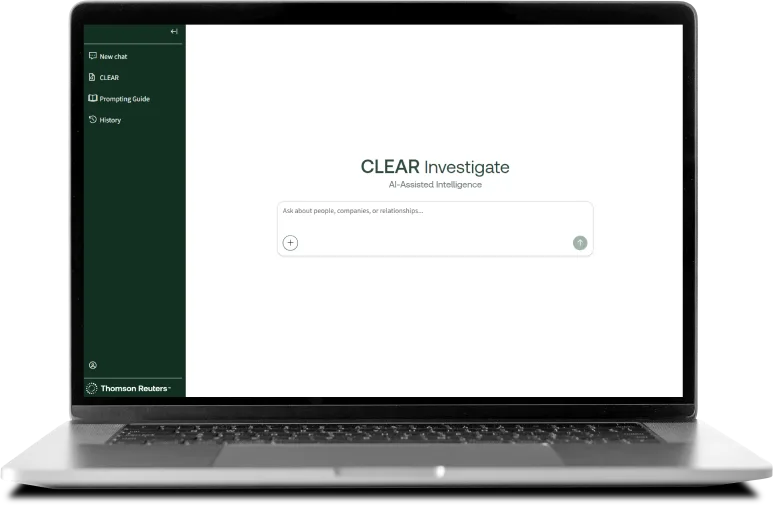
Advanced AI tools can now handle complex workflows: relationship mapping, identify unusual patterns across vast datasets, and generate comprehensive reports with full citation trails–tasks that previously required significant manual effort.
Fardella’s experience, shared during the webinar, illustrates this transformation: “An interview recording becomes a transcript, which becomes an interview report and executive summary instantly after the meeting.” More significantly, AI tools can uncover connections that might escape human notice. “I realized that I could say, is there a connection between persons A, B, and C? And I’d get it all right there at once: One well-written report completely sourced back to the original document,” she explained during her presentation.
The AI’s ability to maintain context across queries proves particularly valuable. “The tool is able to keep up with that same train of thought, like I don’t need to start a new chat,” Fardella noted in the webinar, describing how she can ask follow-up questions without losing the investigative thread.
Building stakeholder confidence through transparency
Successful requires AI tools that meet enterprise-grade security standards, including strict role-based access controls, comprehensive audit logging, and government-grade data privacy protections. Equally important is transparency in methodology–investigators must understand and verify how AI reaches conclusions and trace every piece of information back to its original source.
Woods acknowledged the range of verification questions during the webinar discussion: “Who has access to the information I’m putting into the system? How reliable is that information? And then again, knowing that a lot of our work is based on interviewing and human interaction, how is that going to be handled?”
The strategic value of protection and responsiveness
While efficiency gains provide measurable ROI, the broader strategic value often lies in enhanced protection and responsiveness capabilities. For organizations dealing with fraud or compliance violations, quick response can mean the difference between containing a problem and facing significant business impact.
“I’m getting through those preliminary steps, which are so important to make sure that the allegation’s credible and that it can and should be investigated–but I’m also getting into the investigation so that the people involved will know that the company cares and [we] are responding quicker,” Fardella highlighted during the webinar.
This responsiveness demonstrates organizational competence and trust to customers and business partners affected by fraud or compliance issues, potentially preventing serious reputational or financial damage.
The future of AI-enhanced corporate investigations
As both fraudsters and investigators increasingly leverage AI capabilities, corporate risk teams face a fundamental choice: adapt their investigative capabilities to match evolving threats, or fall behind in their ability to protect their organizations effectively.
The evidence from early adopters suggests that agentic AI tools, when properly implemented with appropriate human oversight, can significantly enhance investigative capabilities without compromising standards. The organizations that successfully navigate this transition will be confidently positioned to protect themselves and their stakeholders in an increasingly complex and AI-enhanced risk environment.

White paper
Human judgment, AI speed: Deploying agentic AI for corporate investigations
Access white paper ↗Access to these tools is limited to authorized, vetted professionals.
Thomson Reuters is not a consumer reporting agency and none of its services or the data contained therein constitute a “consumer report” as such term is defined in the Federal Fair Credit Reporting Act (FCRA), 15 U.S.C. sec. 1681 et seq. The data provided to you may not be used as a factor in consumer debt collection decisioning; establishing a consumer’s eligibility for credit, insurance, employment, government benefits, or housing; or for any other purpose authorized under the FCRA. By accessing one of our services, you agree not to use the service or data for any purpose authorized under the FCRA or in relation to taking an adverse action relating to a consumer application.