Comprehensive overview of AI and law covering how legal professionals are using AI, and what legal teams should do next
Highlights
- Fiduciary-Grade AI™ is built on verified legal content, is essential for accuracy and security, unlike consumer-grade tools that relies on the open web
- Ethical obligations, including human supervision to manage bias and factual inaccuracies, are paramount, with the ABA and state bars issuing guidance for lawyers using AI
The 2026 The Actionable insights for law firm leaders report conducted by the Thomson Reuters Institute reported an intense AI-driven pressure is rising for both law firms and their clients:
- 32% of in-house legal professionals are already reconsidering relationships with firms that do not demonstrate clear AI-enabled value within 12 months.
- 38% of law firm professionals report significant or some financial pressure to act faster on AI.
In 2025, the Thomson Reuters Institute Generative AI in Professional Services Report found that 26% of professionals use generative AI (GenAI) at work, almost twice the 14% who used it in 2024. Law firm attorneys led the way with the highest percentage of usage, followed by in-house counsel and government lawyers.
The 2025 Thomson Reuters Future of Professionals Report found that 80% of professionals think AI will have a high or transformational impact in their jobs over the next five years.
This guide is a one-stop resource for those navigating this profound AI shift.
Jump to ↓
What is AI in the legal context?
Core use cases of AI in legal practice
Legal ethics and regulatory considerations
Perspectives from legal leaders
How can your legal team prepare?
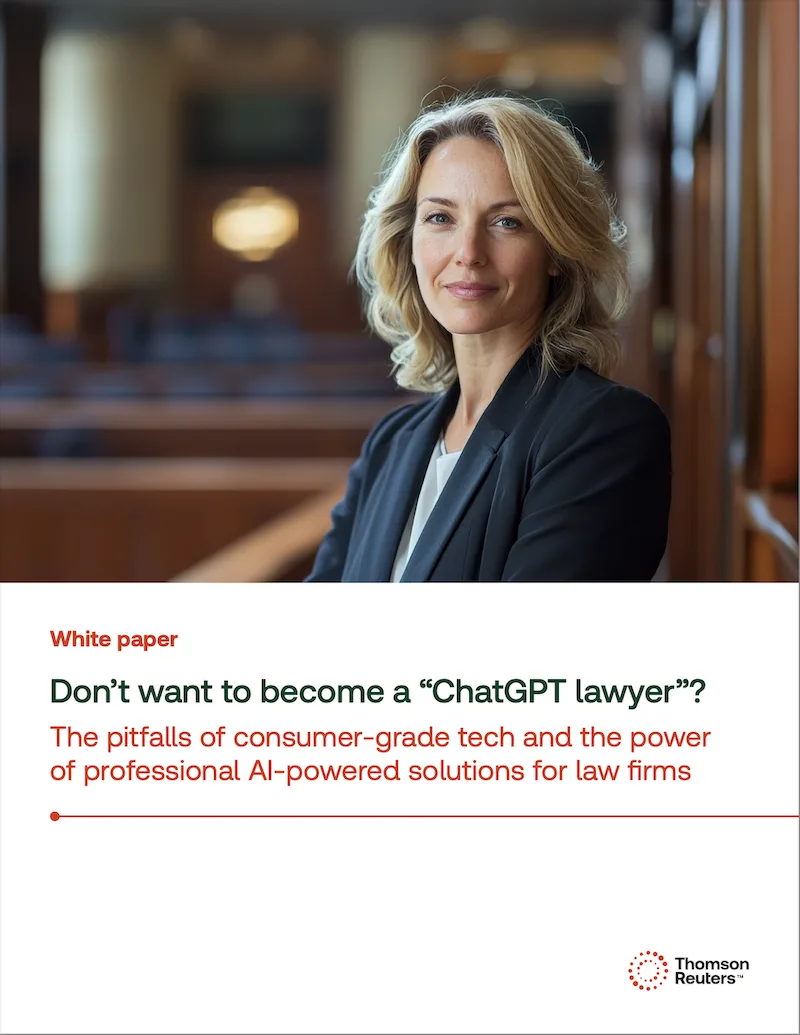
White paper
The pitfalls of consumer-grade tech and the power of professional AI-powered solutions for law firms
Avoid the ChatGPT-lawyer trap ↗
What is AI in the legal context?
Let’s start by defining terms commonly used when discussing AI and law:
- AI is an umbrella term for technology that can simulate human abilities such as learning, reasoning, problem-solving, decision-making, and understanding language.
- Machine learning (ML) is a type of AI that learns from patterns in data to make decisions and recommendations.
- Generative AI (GenAI) is a type of AI that creates new text, images, audio, and video content in response to users’ prompts. Popular GenAI-based solutions include ChatGPT, CoPilot, and Gemini.
- Natural language processing (NLP) uses ML to understand and generate human language. It’s key to GenAI, translation tools, and voice recognition.
- Agentic AI can—often by using other forms of AI—use reason to plan and execute multi-step processes following predefined objectives under human oversight and control.
- Consumer-grade, public tools, such as ChatGPT, train on vast amounts of information covering almost every subject found online — therefore some of the data they rely on is unverified or wrong, meaning those errors will get incorporated into their results.
- Fiduciary-Grade AI™, such as CoCounsel Legal, is the Thomson Reuters standard for high-stakes professional work built on curated, verified legal content containing up-to-date, reliable information. It’s designed to handle tasks specific to legal practice, including legal research, document review, contract analysis, and practice management efficiency.
The 2026 Future of Professionals report revealed that 34% of professionals use AI tools their organization hasn’t sanctioned, in ways it can’t see. This certainly makes the consumer vs. Fiduciary-Grade distinction quite urgent.
In all cases, it’s vital to remember that AI assists with legal reasoning but doesn’t replace it. It automates certain routine tasks and serves as jumpstarts for more complex work.
Lawyers still always need to use their professional skills and judgment to decide how to use the information and insights AI provides.
Timeline of AI in law
Though AI in legal work has increased dramatically in recent years, the history of artificial intelligence and law goes back well more than a decade. Beginning in the early 2000s, e-discovery tools started using AI to search through documents, improved results by using AI capabilities like finding concepts, not just keywords. This is when companies such as Clio got their start. From about 2010 to 2018, AI started to be used for legal analytics. In 2010, Thomson Reuters Westlaw used AI and ML in legal research, as did LexisNexis seven years later.
The next milestone was using GenAI, increasing efficiency tenfold. New companies in the AI and law space, such as Harvey AI, emerged, and existing legal AI vendors created increasingly powerful tools.
Core use cases of AI in legal practice
Lawyers use AI in multiple ways, and these are among the most common use cases cited in the 2025 Generative AI Report:
Document review and analysis
Document review and analysis is the most-used capability, with AI completing in seconds tasks that usually take hours. AI can find the needle in the haystack among millions of pages and review a wide variety of documents, from case files to contracts.
Legal research
Research with professional-grade AI can conduct deep research using proprietary, trusted content.
Document summarization
Document summarization saves lawyers and staff substantial time. GenAI can find the information that’s most relevant to a specific case or project.
Brief or memo writing
Brief or memo writing is fast and thorough with legal AI tools. These help lawyers jumpstart the process, find citations and references, make the document consistent, and answer questions.
Contract drafting
Contract drafting AI tools find relevant documents to use as starting points, locate clauses from trusted sources, and incorporate preferred language.
Correspondence drafting
Correspondence drafting is a time-consuming part of any lawyer’s day. AI speeds up email and letter writing by suggesting phrasing options, summarizing documents, checking grammar, and automating parts of the process.
AI in the courtroom
In June of 2023, an attorney filed a brief written with the help of ChatGPT, citing legal cases supporting his client’s position. But as the judge discovered, six of those cases didn’t exist. ChatGPT had made them up.
In 2024, the Thomson Reuters Generative AI in Professional Services Report found that 31% of those working in courts expressed concern about using AI, making it the most common reaction among them, compared to 26% who felt hesitant. Also, only 15% of court respondents were excited about these technologies—the lowest percentage reported in any job segment in the survey.
Sentiment on the future of GenAI
| Hesitant | 35% |
| Hopeful | 23% |
| Excited | 21% |
| Concerned | 16% |
| Fearful | 2%% |
| None of these | 2%% |
Source: Thomson Reuters 2024 Generative AI in Professional Services
“Courts will likely face the issue of whether to admit evidence generated in whole or in part from GenAI or LLMs, and new standards for reliability and admissibility may develop for this type of evidence”
Head of Product, CoCounsel Transactional & GCOs
Despite the “ChatGPT lawyer headlines,” courts’ hesitation could simply signal that they are taking time to figure out where and how the technology fits into the modern court system.
“I have used ChatGPT and other AI programs, and it saves time and levels the playing field for certain tasks and professions, but [it’s] also a bit dangerous in a sense that if it gets censored, it will inevitably be biased,” said one US judge. “But for computing and translating data, I think it is amazing.”
Legal ethics and regulatory considerations
AI provides many benefits for legal professionals, but it also can pose ethical challenges.
The data used to train AI can be biased because of historical attitudes that we now recognize as unfair, a limited geographical range, or faulty algorithms. Human supervision is important to manage risk, especially when working with general-purpose AI such as ChatGPT. AI, as addressed above, can also return factually incorrect information and even make things up.
In response to GenAI’s rapid emergence beginning in late 2022, with the launch of ChatGPT, in 2024, the American Bar Association (ABA) issued a formal opinion on the ethical obligations involved in lawyers’ use of GenAI. Many state and local bar associations have since also published recommendations or are planning to do so soon.
AI regulations are still evolving. The European Union was ahead of the pack, adopting the world’s first comprehensive set of rules on AI in June 2024. There’s nothing comparable on the federal level in the U.S. However, there are laws that affect certain aspects of AI usage, such as the California Privacy Rights Act and the federal Fair Credit Reporting Act.
Data privacy and security
Legal professionals must prioritize data privacy and security to protect sensitive client information from increasing cyber threats. Professional AI solutions need strong security rules and strict security standards to keep clients’ trust and protect confidential data.
The same Future of Professionals report provided figures sourced from practioneres that carry a lot of weight:
- 96% of professionals say AI must safeguard confidential data
- 94% say outputs must be grounded in authoritative content, and
- 90% say reasoning must be explainable and defensible.
Thomson Reuters prioritizes data security, privacy, and compliance, maintaining a comprehensive information security management framework. For more information on their security commitment and compliance practices, you can visit the Thomson Reuters Trust Center.
What do legal leaders say about AI?
Legal leaders have experienced both challenges and success with incorporating AI into their practice. Many are especially enthusiastic about how much time AI saves them.
Jarret Coleman, general counsel, Century Communities, says, “A task that would previously have taken an hour was completed in five minutes or less. Something that would’ve taken us a couple of weeks to do, now gets back to the business-side in a day or two. That’s huge.”
John Polson, Chairman and Managing Partner at Fisher Phillips, LLP, has had a similar experience, saying, “CoCounsel is truly revolutionary legal tech. Its power to increase our attorneys’ efficiency has already benefited our clients. And we have only scratched the surface of this incredible technology.”
Productivity gains improve work-life balance, but security and reliability are among the top concerns.
Scott Bailey, director of research and knowledge services, Eversheds Sutherland, echoes their enthusiasm: “The AI landscape is transformed with CoCounsel. The power of this technology, deployed in a product that is secure and reliable, is a huge leap forward.”
How can your legal team prepare?
Legal teams approaching AI tool adoption systematically are likely to do so more successfully:
AI readiness checklist
A thoughtful checklist can help you:
- Identify use cases
- Understand responsible AI use
- Get your peers and leadership on board
- Research and select tools
AI education and training resources
These include:
- Internal up-skilling
- Webinars and courses, including those for CLE credit
- Training from vendors
- Joining professional AI groups
- Industry reports
Thomson Reuters publishes scholarly articles on topics such as:
- Segmenting handwritten and printed text in marked-up legal documents
- The best techniques from prompting GenAI
- Uncertainty quantification effectiveness in text classification, and
- Making a computational attorney
AI evaluation criteria
When looking for a legal AI tool or vendor, consider:
- Was the tool trained on a reliable legal database and not the open web?
- If so, what are its legal sources?
- Does it assist with the specific legal tasks you need to complete?
- Will it connect with platforms you are already using?
- How long has the vendor been in business and been working with AI?
- Most important, does the solution keep your data private and secure at all times?
Cross-functional planning
Make sure all relevant teams are involved, including:
- IT
- Compliance
- Risk
Above all, leadership needs real strategy in place. The same Future of Professional Report said firms with a named AI strategy see 66% of professionals reporting AI meets or exceeds expectations for creating value, versus just 22% without one. performance differentiator.
A new era for legal thinking
The time to begin using AI legal solutions is now. The lawyers and organizations that will wind up ahead embrace AI’s ability to amplify expertise, knowing it’s not a replacement for humans’ professional proficiency.
Teams that invest in education and thoughtful adoption of these new tools will move the profession forward and help apply AI’s full potential. Thomson Reuters is committed to partnering with legal professionals who want to become leaders in this new era.

White paper
Why general counsel need more than ChatGPT for legal AI
See why ChatGPT isn't enough for legal teams ↗