
Explore how law firms can accelerate AI adoption by choosing trusted, legal-grade tools built on verified content, professional accountability, and responsible innovation.
Highlights
- Trust and innovation are mutually reinforcing in successful AI adoption within legal services, not competing priorities.
- Agentic AI, built on verified legal content, is transforming legal workflows and raising the bar for accuracy and reliability.
- Leading firms balance rapid AI adoption with responsibility, transparency, and long-term vendor partnerships for institutional confidence.
The conversation about AI in legal services is often framed as a choice: move fast and risk accuracy or stay cautious and fall behind. It is a false dilemma. The firms succeeding with AI today understand that trust and innovation are not competing priorities; they are mutually reinforcing. You can see it in how the best legal tools are being built, and by whom.
Jump to ↓
The AI imperative in legal services
Building confidence: why trust is the foundation of AI adoption
Agentic AI: the next frontier of legal work
Built on the content legal work demands
Balancing innovation with responsibility
The AI imperative in legal services
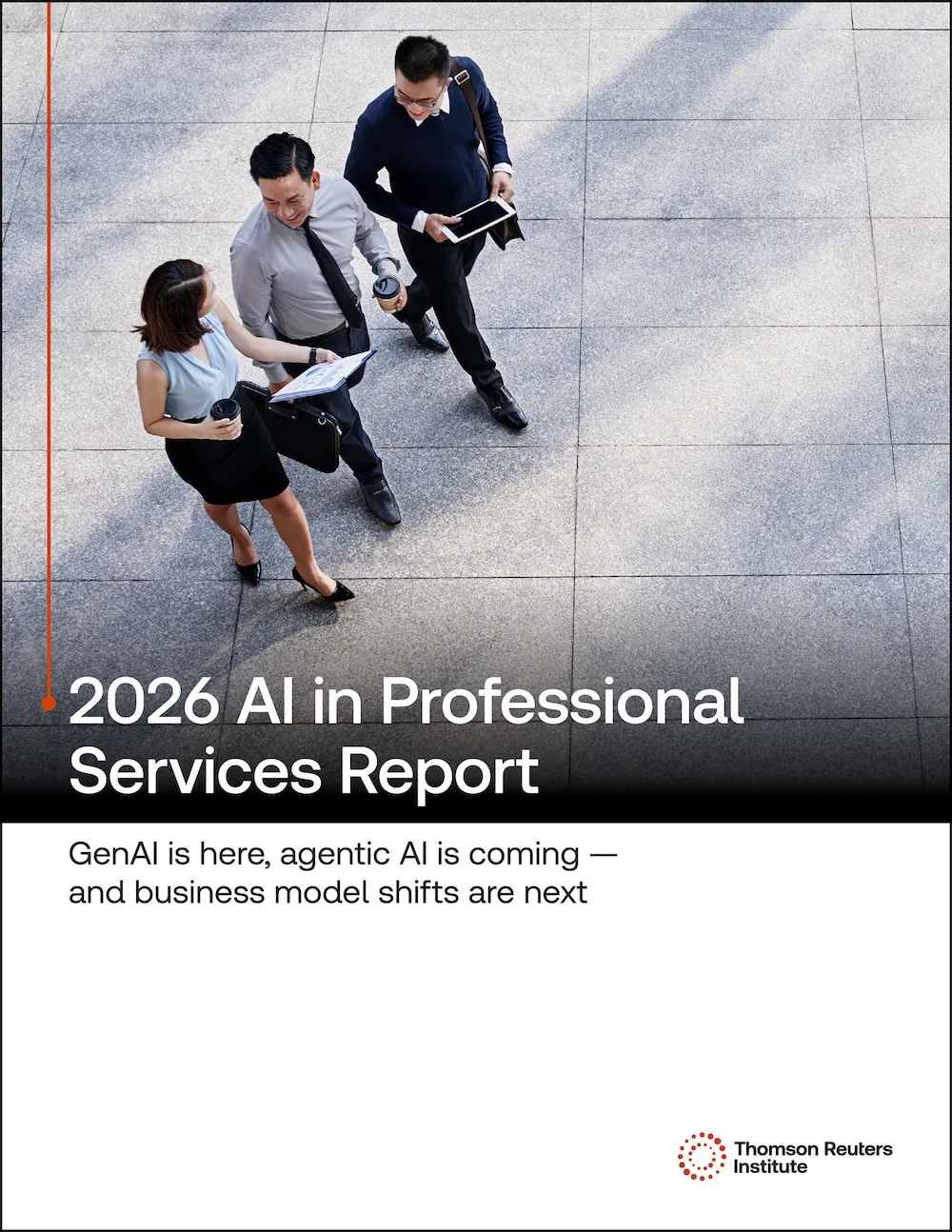
The scale and pace of AI adoption across professional services is no longer speculative. The Thomson Reuters Institute’s 2026 AI in Professional Services Report on the future of AI in professional services puts the momentum in concrete terms:
- GenAI adoption in organizations nearly doubled year-over-year, climbing from 22% to 40%
- More than 80% of professionals who use GenAI do so at least weekly
- 87% of professionals expect AI to be central to their workflow within five years
Agentic AI is following the same trajectory. Only 15% of organizations currently report using agentic AI, but 53% are already in the planning or exploration phase, and 77% of professionals expect it to be a standard part of their work by 2030. For any law firm or legal operations team evaluating AI right now, the question is no longer whether to adopt AI. It is which AI is built to hold up under the demands of professional legal work.
Building confidence: Why trust is the foundation of AI adoption
For legal professionals, trust is not a soft value; it is a professional requirement. In an industry where accuracy can determine the outcome of a case or a regulatory filing, an AI error carries real consequences. Generic tools built for broad consumer audiences were not designed with these stakes in mind. That gap between publicly available models and what legal work demands is precisely where hesitation lives, and where the wrong tool produces the wrong outcomes.
The standard for legal AI is clear: grounded in verified content, built to the professional standards of the discipline, and developed with the accountability law firms and legal departments can stand behind. When that foundation is in place, confidence follows – and adoption accelerates.
This is the particular advantage Thomson Reuters brings to AI development. A 150-year track record of accuracy in legal content is the foundation that makes genuine innovation more credible and more trusted when it arrives. The institutions that have earned the deepest trust in a profession are not the ones held back by it. They are the ones with the most license and the responsibility to push it forward.
Agentic AI: the next frontier of legal work
The shift from generative to agentic AI represents a fundamental change in what legal technology can accomplish. Where GenAI responds to a prompt, agentic AI takes initiative – planning, retrieving, reasoning, and executing across multiple workflow steps without the user directing every action.
For legal professionals, this means moving from AI as a content-generation tool to AI as a genuine collaborator: one that handles the sequencing, not just the output. In practice, that looks like:
- Multi-step legal research completed within a single conversation
- Intelligent synthesis of case law and statutory guidance, guided by attorney judgment
- Contract review and issue-spotting without manual task sequencing
- Analysis grounded in verified, practitioner-curated content
Taken together, these capabilities represent a meaningful shift in how legal professionals spend their time. The hours previously absorbed by repetitive research, manual sequencing, and source verification move to the background – leaving attorneys and legal teams focused on judgment, strategy, and client outcomes. That is the practical value of agentic AI: not replacing legal expertise, but directing it toward the work that requires it most.
Built on the content legal work demands
This shift also raises the bar on content quality. When an agentic system completes legal research, synthesizes case law, or produces analysis, the quality of its sources determines whether the output can be trusted. A platform built on practitioner-curated legal content performs at a fundamentally different level than one drawing from the open web.
That is what makes a foundation in Westlaw and Practical Law decisive – not because the content is broader, but because it is the research foundation legal professionals have relied on for decades to do work that cannot afford to be wrong.
For firms and in-house teams actively evaluating options, agentic AI for legal work is no longer a future consideration – it is a decision being made today.
CoCounsel Legal Reimagined is what that decision looks like when made well. Thomson Reuters built it from a foundation that took 150 years to develop: the legal content, editorial expertise, and deep understanding of how attorneys work that make the technology genuinely capable rather than generically applied.
That foundation is visible at every layer of the product – from the sources it draws on to the way it reasons through a legal question. It is the difference between AI purpose-built for legal work and a general-purpose model pointed at it.
Balancing innovation with responsibility
Trust-first AI adoption is not the same as slow adoption. The legal teams that have moved most effectively follow a three-stage approach: adopt, adapt, advance.
- Adopt: Define use cases before expanding; establish governance policies for what AI can and cannot do on client work
- Adapt: Evaluate tools to legal-grade accuracy and security standards; adjust policies as technology and firm needs evolve
- Advance: Treat adoption as a long-term partnership with a vendor transparent about how the product is built and where it is going
What distinguishes Thomson Reuters’ approach to AI is transparency – not just what the product does today, but how it was built and where it is going, so legal teams can make adoption decisions they can stand behind. That transparency is a prerequisite for institutional confidence and the foundation of every step forward.
Looking ahead
The framing of trust versus innovation was always a false one, and the legal professionals who have moved furthest with AI already know it. The firms pulling ahead chose AI built to the standard of their work: accurate enough to rely on, transparent enough to explain, and backed by a partner that stands behind it.
That is what the next generation of CoCounsel Legal Reimagined delivers. Thomson Reuters’ 150-year legacy in legal content is the reason what it builds is worth trusting -and the reason trust accelerates adoption rather than slowing it.
Ready to see what trust-led legal AI looks like in practice? Explore CoCounsel Legal and see how your firm can move faster with confidence. ↓

CoCounsel Legal
Work smarter with CoCounsel, seamlessly integrated with Westlaw, Practical Law, Microsoft 365, and DMS partners
Go professional-grade AI ↗